



Imagine this: It's the end of August. You step off your plane at Newark Liberty International Airport, arriving in the United States for the first time with a few suitcases and with friends and family thousands of miles away. This is the daunting experience that faces many of Princeton's international students — as well as those students who choose to study abroad during their University career.
While one might expect that international students would have a great deal of difficulty simply adjusting to life in the United States, it is often not this initial "culture shock" that disturbs them, but rather the ensuing struggle to fit in as a Princeton student.
Orientation, Bronson Fung '08 of Hong Kong said, was a time of "meeting so many people, but not really meeting anybody."
Plamen Ivanov '08 grew up in Bulgaria. He said adjusting to the many idiosyncrasies of life in America, such as the unusually high legal drinking age, is the hardest part of the transition.
"Some things just don't make sense," Ivanov said.
Even after participating in Community Action, Ivanov said he still finds himself baffled when he overhears conversations about the lives of American celebrities or the latest music stars. He said he was worried he would "always be a foreigner."
While exposure to American cinema at home provided Fung with some idea of what to expect, he said he still felt, at least initially, like "the odd one out" on his Outdoor Action trip.
Fung said he chose to participate in Outdoor Action, nonetheless, in an attempt to branch out and interact with American students.

"I worried about self-segregation before I arrived," he said. "I didn't want to be looked upon as simply [one of] the Asians who just stick together."
Americans abroad
Students who participate in one of Princeton's many study abroad programs face challenges similar to those confronting international students who arrive at the University.
When Kris Lazzaretti '06 traveled to South Africa during the spring, he said he initially felt that people viewed him as "an item of interest and an item of disdain." To many South Africans, Lazzaretti said, "we as Americans are simply George W. Bush."
Nevertheless, Lazzaretti said that the more he immersed himself, the more he became interested in the serious issues facing South Africa, including the HIV/AIDS epidemic and the struggle to maintain democracy.
"Africa gets in your blood," he said. "I fell in love with the place."
Alina Rekhtman '05 has also become involved in international affairs. Raised in Russia, she spent time with various organizations and programs in Israel, Afghanistan, Eastern Europe, Chile, Mexico and Spain.

During her stay in Chile this past spring and summer, Rekhtman spent her time conducting research and volunteering.
"There's only so much one can learn about human rights in Chile through a textbook," she said.
Upon returning to Princeton this fall, Lazzaretti said it is a challenge "to relate to people after being in a place where abject poverty is the rule of the day." While he said he still enjoys the array of social opportunities at Princeton, he "can't help but think of how extremely privileged we are."
Many new internationals also struggle to adjust to the social scene at Princeton. Fung said he still feels somewhat uncomfortable with the eating clubs. "It bothers me that people go there simply to get drunk," he said.
According to Fung, this dislike of the focus on alcohol within the Princeton social scene "applies to very many internationals."
A great deal of student and institutional support is available, however, for internationals who are struggling to adjust to the American lifestyle.
Daniel Scher '06, from South Africa, is vice president of the International Students Association at Princeton (ISAP). Along with coordinating and running the International Pre-Orientation program that attracts a large majority of the incoming international freshmen each year, ISAP organizes biweekly study breaks and discussions that focus on current international issues.
Resources also exist within the University administration for multicultural and international students.
While any stay in a foreign country necessarily involves a certain amount of adjustment, it seems to be a consensus that this sort of cultural exchange, whether it be internationals coming to Princeton or American Princetonians going abroad, merits the accompanying struggles.
"I want to cherish my time at Princeton," Rekhtman said, "but students who do study abroad are always happy with [their experiences]."
Read More

Princeton University Orchestra and men’s ultimate frisbee team named in University’s latest hazing report
Andrew ArthurTwelve students in the Princeton University Orchestra and Men's Ultimate Frisbee team were found responsible for hazing violations in the University's latest Campus Hazing Transparency Report. Sanctions ranged from Dean's warnings to disciplinary probation.
Twelve students in the Princeton University Orchestra and Men's Ultimate Frisbee team were found responsible for hazing violations in the University's latest Campus Hazing Transparency Report. Sanctions ranged from Dean's warnings to disciplinary probation.

Murray-Dodge Café celebrates 50th Anniversary, drawing over 260 students
Hifza KaleemOn Wednesday, Murray Dodge Cafe celebrated its 50th anniversary, drawing more than 260 students to celebrate with free cookies and merchandise.
On Wednesday, Murray Dodge Cafe celebrated its 50th anniversary, drawing more than 260 students to celebrate with free cookies and merchandise.
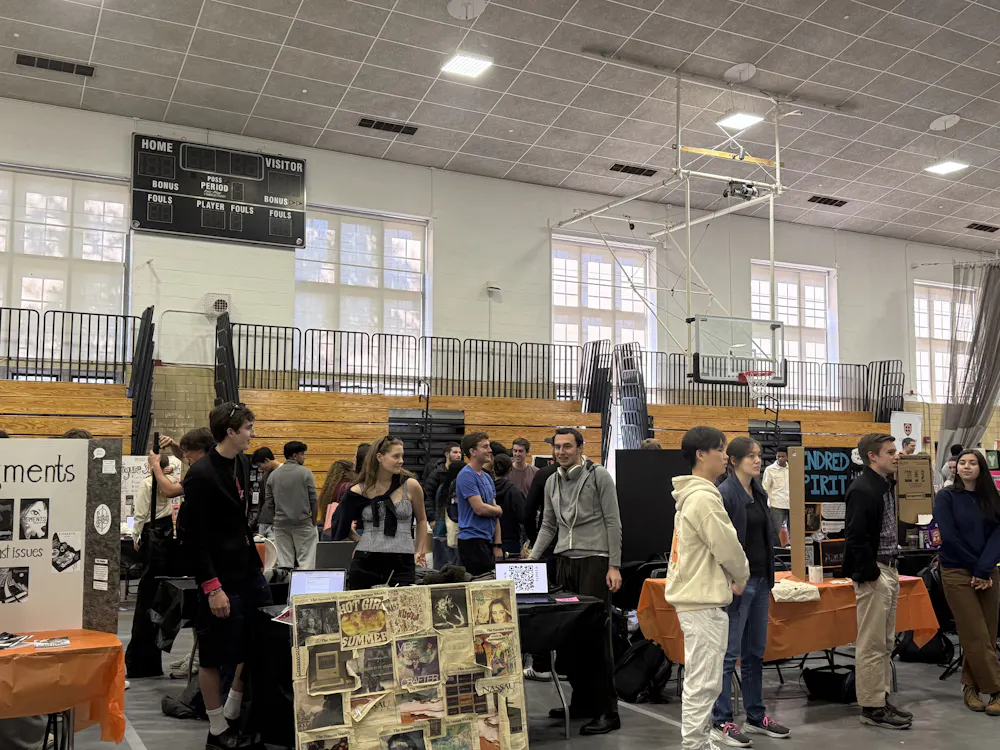
Students share mixed reactions as mandated officer and treasurer trainings return to in-person format
David EstradaThe University's student organization officers and treasurers returned to mandatory in-person training this fall after years of online sessions. Student reactions found parts of the training redundant or tedious, though most agreed the sessions were important.
The University's student organization officers and treasurers returned to mandatory in-person training this fall after years of online sessions. Student reactions found parts of the training redundant or tedious, though most agreed the sessions were important.