



Several professors raised concerns about fellowship policies discussed in a recent memo sent to all faculty members by Dean of the Graduate School William Russel at Monday's faculty meeting in Nassau Hall.
The University has routinely granted one-year extensions to five-year fellowships for graduate students in the humanities and social sciences who chose to study abroad for a year, professor Brigid Doherty of the German department said.
However, in a memo sent to all faculty members at the beginning of the month, Russel said the University would no longer grant extensions to the fellowships except in "extreme" circumstances.
Several professors said the change in practice would have a negative impact. Doherty said it is important for graduate students in the German department to be able to spend a year abroad as part of their studies, and added that she fears the change will discourage students from exploring the option.
David Howell of the East Asian studies department said the change would have "a devastating impact" on that department.
"I see no justification for this policy on educational grounds," philosophy professor Alexander Nehamas said.
Other institutions with comparable reputations routinely extend a graduate student's fellowship program if a student chooses to spend a year abroad, Doherty said.
For this reason, she added, the change will make it more difficult for the German department to attract the best students in the field because the fellowship extension at other institutions may be perceived as more attractive.

"It would be significantly damaging to the intellectual life of our graduate students," she said.
However, Russel said that this change is not reworking the existing policy.
The change is, in fact, meant to reduce the number of exceptions that are allowed under the preexisting policy, he said.
Russel added that the administration will continue to pay close attention to the academic needs of individual students and make exceptions if needed.
The issue will be discussed in detail at the next meeting of directors of graduate studies from all departments. That meeting will take place in October, Russel said.
Class of 2008
Dean of the College Nancy Malkiel also presented information about the Class of 2008 at the meeting.

"Academic ones" — the highest score awarded to admission candidates for academic achievement — account for more than 50 percent of the freshman class, Malkiel said. That figure represents a six percent increase over the Class of 2007.
She added that recent changes in financial aid policies — including the University's all-grant financial aid packages — have had a significant effect in attracting the most qualified students to the University.
Fifty-two percent of the entering class is going to receive some form of University scholarship, Malkiel said.
"This puts us well ahead of our closest peer institutions," she added.
Just under 15 percent of the Class of 2008 come from low-income backgrounds. This is an 83 percent increase in the number of students from low-income backgrounds since the Class of 2001, Malkiel added.
New faculty
Dean of the Faculty David Dobkin introduced new members of the faculty as well.
The Wilson School's G. John Ikenberry and Helen Milner — described by Wilson School Dean Anne-Marie Slaughter as "two of the top scholars in their generation in international relations" — were notable recruits to the faculty this year.
Six new full professors have joined the Wilson School faculty this fall, Dean Anne-Marie Slaughter later added.
"We're on our way to having the best international relations faculty in the country," she said.
She added that she had worked together with politics department chair Jeffrey Herbst to recruit new faculty. "Constant attention" was key to the successful recruitment of new faculty members, she said.
Slaughter added that the University recently extended an offer to another "internationally-renowned scholar of international relations."
Read More

Princeton University Orchestra and men’s ultimate frisbee team named in University’s latest hazing report
Andrew ArthurTwelve students in the Princeton University Orchestra and Men's Ultimate Frisbee team were found responsible for hazing violations in the University's latest Campus Hazing Transparency Report. Sanctions ranged from Dean's warnings to disciplinary probation.
Twelve students in the Princeton University Orchestra and Men's Ultimate Frisbee team were found responsible for hazing violations in the University's latest Campus Hazing Transparency Report. Sanctions ranged from Dean's warnings to disciplinary probation.

Murray-Dodge Café celebrates 50th Anniversary, drawing over 260 students
Hifza KaleemOn Wednesday, Murray Dodge Cafe celebrated its 50th anniversary, drawing more than 260 students to celebrate with free cookies and merchandise.
On Wednesday, Murray Dodge Cafe celebrated its 50th anniversary, drawing more than 260 students to celebrate with free cookies and merchandise.
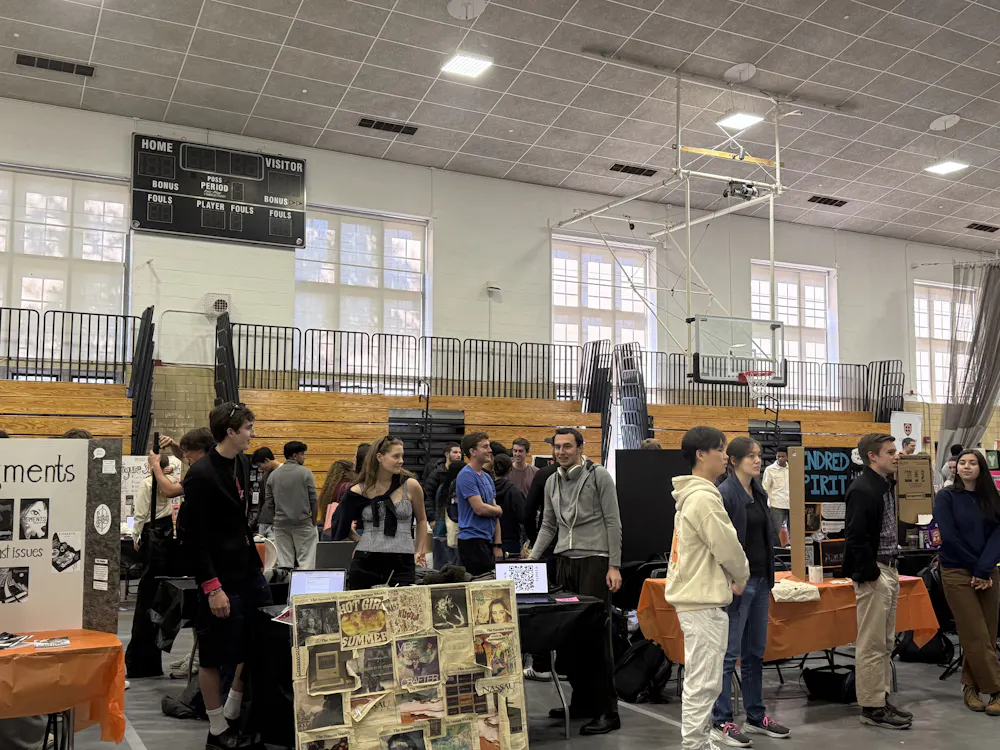
Students share mixed reactions as mandated officer and treasurer trainings return to in-person format
David EstradaThe University's student organization officers and treasurers returned to mandatory in-person training this fall after years of online sessions. Student reactions found parts of the training redundant or tedious, though most agreed the sessions were important.
The University's student organization officers and treasurers returned to mandatory in-person training this fall after years of online sessions. Student reactions found parts of the training redundant or tedious, though most agreed the sessions were important.