



Explaining Thanksgiving Day to foreigners can be tricky business. For Julia Philip '06, the problem was finding the correct props.
"I was trying to find a picture of a pilgrim, and I couldn't," she said smiling. She never minded that her listeners could hardly speak to her.
These listeners are not kids, but graduate students new to the United States, trying to learn about American customs.
"They think it's really weird; they don't have anything like that," Philip said.
She's not alone. Every semester, the University's Conversation Partners trains new international graduate students on the conversational English skills needed to teach undergraduates.
The program, now in its third year, teams up two graduate students and an undergraduate, who then meet for one hour each week to have informal talks.
Bobbie Thompson manages Conversation Partners under the umbrella of the McGraw Center for Teaching and Learning. She said "[the students] meet for a cup of coffee" to "practice culture, slang and idioms."
The program is not voluntary. Pre-admission English proficiency tests determine graduate student participation.

Each year, the Graduate School sends the McGraw Center a list of new students with low proficiency scores. Before becoming TAs, they must complete the English Language Program, a series of classes which incorporates Conversation Partners as a speaking component.
Thompson said she has been satisfied with both graduate and undergraduate student responses. She noted that there are several returning undergraduates involved. "Some graduated, some went abroad, some are just too busy, but most do come back," she said.
"This semester will be my fifth time," said Philip, who enjoys acquainting newcomers to American customs. "I get to help explain to them the strange things they see that they don't understand, like Halloween or Thanksgiving."
Laura Hurd '07 is participating in Conversation Partners for the third semester. For her, the program revolves around the cultural aspect of the chats. "We put a lot of emphasis on American food, music, TV, movies," she said.
Conversation Partners serves also as an opportunity to build otherwise unlikely friendships.
Hurd said she and her students "still email back and forth for a social thing, ice cream or coffee."

The perseverance displayed by some of the graduate students also touches undergraduates.
"Sometimes they seem to struggle, but they always stick to English," Hurd said.
Despite being obligatory, the program has garnered overwhelmingly positive feedback from graduates. In a survey of the fall 2003 participants, 56 graduate students called their involvement "a positive experience," while only four said it was not.
The graduate students' feedback included statements, like "I gained much confidence for speaking English;" "I learned a lot of new words and expressions" and "I learned a lot about the life of undergrads who will be our students in the future."
Wei Chen, a physics lab instructor, took the English Language Program last year. He said classes help, but "this part of the program is actually more helpful."
"We had been studying English forever, but the best way to learn was to practice," he added.
This semester, returning undergraduates filled most openings. To offer more students the cultural and linguistic experience, the Association of Chinese Students and Scholars — a graduate body — and the undergraduate Chinese Students Association are developing a similar program.
Chen, a member of the ACSS, expects this program to be formally announced within the next few weeks. It would begin this semester.
Read More

Princeton University Orchestra and men’s ultimate frisbee team named in University’s latest hazing report
Andrew ArthurTwelve students in the Princeton University Orchestra and Men's Ultimate Frisbee team were found responsible for hazing violations in the University's latest Campus Hazing Transparency Report. Sanctions ranged from Dean's warnings to disciplinary probation.
Twelve students in the Princeton University Orchestra and Men's Ultimate Frisbee team were found responsible for hazing violations in the University's latest Campus Hazing Transparency Report. Sanctions ranged from Dean's warnings to disciplinary probation.

Murray-Dodge Café celebrates 50th Anniversary, drawing over 260 students
Hifza KaleemOn Wednesday, Murray Dodge Cafe celebrated its 50th anniversary, drawing more than 260 students to celebrate with free cookies and merchandise.
On Wednesday, Murray Dodge Cafe celebrated its 50th anniversary, drawing more than 260 students to celebrate with free cookies and merchandise.
Students share mixed reactions as mandated officer and treasurer trainings return to in-person format
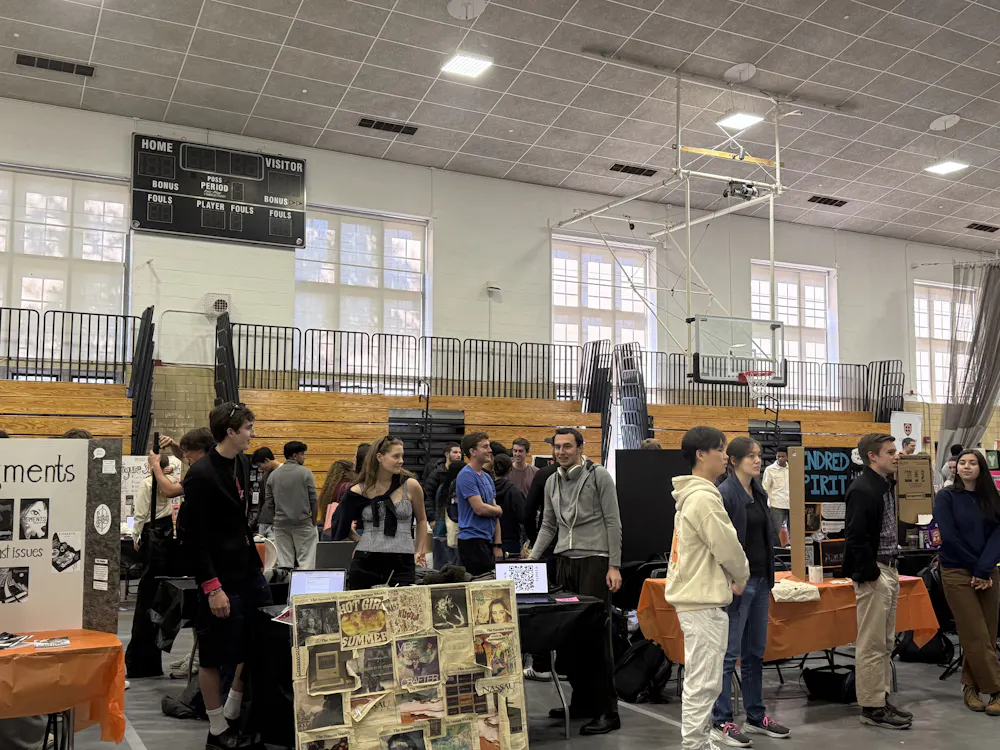
David EstradaThe University's student organization officers and treasurers returned to mandatory in-person training this fall after years of online sessions. Student reactions found parts of the training redundant or tedious, though most agreed the sessions were important.
The University's student organization officers and treasurers returned to mandatory in-person training this fall after years of online sessions. Student reactions found parts of the training redundant or tedious, though most agreed the sessions were important.