



"Princeton students are even better than I thought they would be. They are engaged, alert, lively and smart. I really did not have any withdrawn or bored students," Evan Thomas, assistant managing editor of Newsweek, said of his experience as a humanities fellow.
Each year, eminent artists, writers and scholars like Thomas spend a semester at the University as part of the Humanities Council's Long-Term Visiting Fellows Program, teaching a course and interacting with both faculty and students.
The Executive Committee of the Humanities Council reads nominations from departments and programs in the humanities and related departments, and makes a recommendation to the Dean of the Faculty, who appoints the fellows.
"For the University, the program is a wonderful way to expand faculty expertise, and for the fellows, the semester can offer intellectual stimulation, collaborative opportunities and some extra time to work on a scholarly project," said Carol Rigolot, executive director of the Humanities Council.
Renaissance scholar
Kenneth Gross, Class of 1932 Fellow in English, is a scholar of Renaissance poetry from the University of Rochester. Gross taught ENG 313: "The 16th Century" this semester, an undergraduate lecture course focusing on the 16th century Renaissance poetry of William Shakespeare, John Donne and Ben Jonson.
Gross stressed his students' high level of engagement in class.
"I've enjoyed the students in my class a lot; they are very responsive," he said. "It's a very eclectic and supportive intellectual environment."
In addition to teaching, Gross also worked closely with humanities graduate students and faculty on the Humanities Council. On a Friday in early March, Gross gave a seminar for the council, discussing his project on the aesthetics and literary uses of puppet theater with faculty from the English, classics, music and French departments.

"It was a very energetic and moving conversation," Gross said. "Faculty here are tremendously welcoming and open to talk, and I enjoyed the possibility of sharing work."
Accomplished journalists
Marc Fisher '80 applied to serve as a Ferris Professor of Journalism and was selected by the Ferris committee of the Humanities Council. A columnist at the Washington Post, the seminar "The Literature of Fact," taught by professor John McPhee '53, intrigued Fisher. Fisher approached the council with the thought of teaching a course on the journalism of daily life.
"Both McPhee's teaching manner and the work of my fellow students have stayed with me through my career and I have long thought that I would love to try my hand at teaching a similar course," Fisher said.
In HUM 455 this semester, Fisher explored "nonfiction writing that focused on people who are not celebrities, sports figures or politicians, but folks in supposedly ordinary walks of life — people whose stories tell us what we need to know about each other and why we behave as we do," he said.
Fisher said the majority of students in his seminar were eager to engage in an exchange of ideas and devote the time necessary to push their work to new levels.
"I found students today to be perhaps less willing to argue and engage in heated debate than we were in my day, but on the other hand, students now are much more open about their own lives, even in the most intimate ways," Fisher said.

The conversations he had with students about his work and their career musings made Fisher "more hopeful about the role that journalism and writing can play in serving our society and nation," he said.
Along with Fisher, Thomas was chosen as a Stuart/Ferris Professor of Journalism.
Thomas, also a Butler College Fellow, taught a course on narrative writing last fall and another on mass media and public policy this spring.
"It's been incredibly wonderful and a treat to teach here," Thomas said.
While teaching, Thomas has managed to continue his work for Newsweek.
"Because of the nature of the publication, I can crunch that work into Thursday, Friday and Saturday," he said.
Thomas will continue his teaching at the Kennedy School of Government at Harvard University next year.
French Historian
According to Rigolot, Professor Carla Hesse GS '86, a historian from Berkeley, Calif., will be joining Princeton faculty as a Long-Term Humanities Fellow this fall.
Hesse will be teaching an undergraduate history lecture course in her area of specialization — French history from Louis XIV to Napoleon.
"I will also give an interdisciplinary seminar in November for the Council for the Humanities on the how the works of the eighteenth-century French philosopher, Jean-Jacques Rousseau, were edited, interpreted and marketed during the French Revolution," Hesse said.
In addition to renewing ties with former teachers and colleagues in history and literature at Princeton, Hesse is anxious to return to the treasures and attractions of Firestone Library.
Hesse said in an email, "As a graduate student, I catalogued the French revolutionary pamphlet and song-sheet collection in Firestone, and I can't wait to get a chance to use it again."
After her year at Princeton, Hesse intends to conduct research in Berlin and return to her home institution, UC Berkeley.
"Princeton-Berlin-Berkeley — what a lucky life!" Hesse said.
Read More

Princeton University Orchestra and men’s ultimate frisbee team named in University’s latest hazing report
Andrew ArthurTwelve students in the Princeton University Orchestra and Men's Ultimate Frisbee team were found responsible for hazing violations in the University's latest Campus Hazing Transparency Report. Sanctions ranged from Dean's warnings to disciplinary probation.
Twelve students in the Princeton University Orchestra and Men's Ultimate Frisbee team were found responsible for hazing violations in the University's latest Campus Hazing Transparency Report. Sanctions ranged from Dean's warnings to disciplinary probation.

Murray-Dodge Café celebrates 50th Anniversary, drawing over 260 students
Hifza KaleemOn Wednesday, Murray Dodge Cafe celebrated its 50th anniversary, drawing more than 260 students to celebrate with free cookies and merchandise.
On Wednesday, Murray Dodge Cafe celebrated its 50th anniversary, drawing more than 260 students to celebrate with free cookies and merchandise.
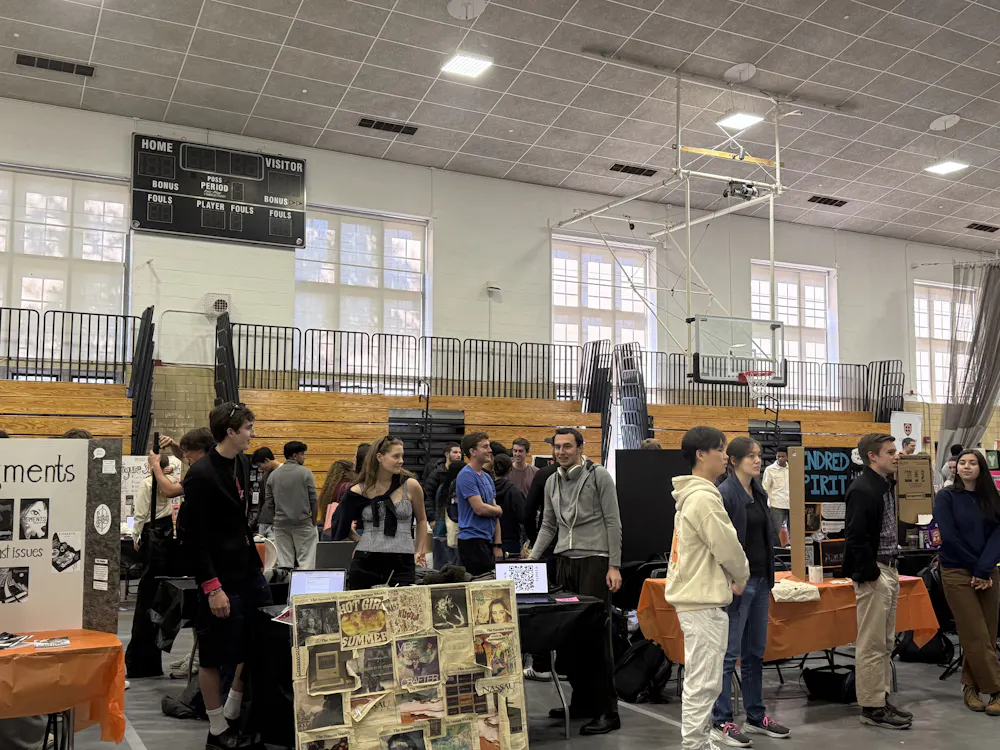
Students share mixed reactions as mandated officer and treasurer trainings return to in-person format
David EstradaThe University's student organization officers and treasurers returned to mandatory in-person training this fall after years of online sessions. Student reactions found parts of the training redundant or tedious, though most agreed the sessions were important.
The University's student organization officers and treasurers returned to mandatory in-person training this fall after years of online sessions. Student reactions found parts of the training redundant or tedious, though most agreed the sessions were important.