



Following a change in University policy last week, the College Democrats and Republicans are now permitted to conduct voter registration drives in common areas on campus. The University previously banned such drives, arguing that its tax-exempt status prohibits partisan activity.
Voter registration will be restricted to public areas such as Frist Campus Center and communal space within the residential colleges. Students will not be allowed to go door-to-door. That restriction is in the interest of maintaining privacy and respecting that some students are ineligible to vote, Assistant Dean of Undergraduate Students Thomas Dunne explained.
"We want [students] to be able to engage or disengage," Dunne said. "We want voter registration to be in high-traffic areas where students can choose the degree to which they participate."
Not-for-profit institution
The change in policy comes following a reexamination of University regulations in anticipation of the upcoming election season. Dunne worked with Lorraine Sciarra, a lawyer in the University counsel's office, who consulted legal experts at other universities and a D.C. law firm.
As a tax-exempt, not-for-profit institution, the University itself is prohibited from participating in a political campaign on behalf of a candidate. The law does not apply to individual students or organizations conducting partisan activities without use of University resources.
But difficulty arises, Sciarra explained, when the actions of an individual or group may be attributed to or involve the use of the resources of the tax-exempt institution.
"So for example, Princeton itself could not conduct partisan voter registration," Sciarra said in an email. "The question is, when may a university-supported student group do so?"
New policy
Under the new policy, partisan groups are permitted to conduct voter registration drives as long as they are entirely student-run and it is clear that they are not being endorsed by the University.

Current plans for voter registration this fall center around a nonpartisan, USG-sponsored effort called Princeton Votes 2004.
The idea originated before the change in policy, when College Republicans President Evan Baehr '05 said he and other student group leaders were "frustrated that we couldn't do our own [registration]."
The drive will draw together political groups from both ends of the spectrum to register voters at orientation events and in public areas throughout the month of September.
"In the end, we don't have an interest in the political party of the person registering," Baehr said. "We're interested in getting them to the polls."
Baehr said he would prefer to have the flexibility to conduct door-to-door registration, but acknowledged that such drives can be time-consuming and perceived as intrusive.
"I'm happy that we finally have a clear policy on this," Baehr said.
Other schools

While interpretations of the law vary widely by school, Princeton's revised policy is more in line with that of many other universities.
At Harvard University, the College Democrats and Republicans play a major role in registering voters.
Associate Dean of Harvard College Judith Kidd explained that according to the general counsel, "The IRS recognizes that the actions of student groups are generally not attributable to the University."
Student groups can therefore engage in partisan political activity without jeopardizing the nonprofit status as long as the activity is not undertaken at the direction of a university official, Kidd said.
Read More

Princeton University Orchestra and men’s ultimate frisbee team named in University’s latest hazing report
Andrew ArthurTwelve students in the Princeton University Orchestra and Men's Ultimate Frisbee team were found responsible for hazing violations in the University's latest Campus Hazing Transparency Report. Sanctions ranged from Dean's warnings to disciplinary probation.
Twelve students in the Princeton University Orchestra and Men's Ultimate Frisbee team were found responsible for hazing violations in the University's latest Campus Hazing Transparency Report. Sanctions ranged from Dean's warnings to disciplinary probation.

Murray-Dodge Café celebrates 50th Anniversary, drawing over 260 students
Hifza KaleemOn Wednesday, Murray Dodge Cafe celebrated its 50th anniversary, drawing more than 260 students to celebrate with free cookies and merchandise.
On Wednesday, Murray Dodge Cafe celebrated its 50th anniversary, drawing more than 260 students to celebrate with free cookies and merchandise.
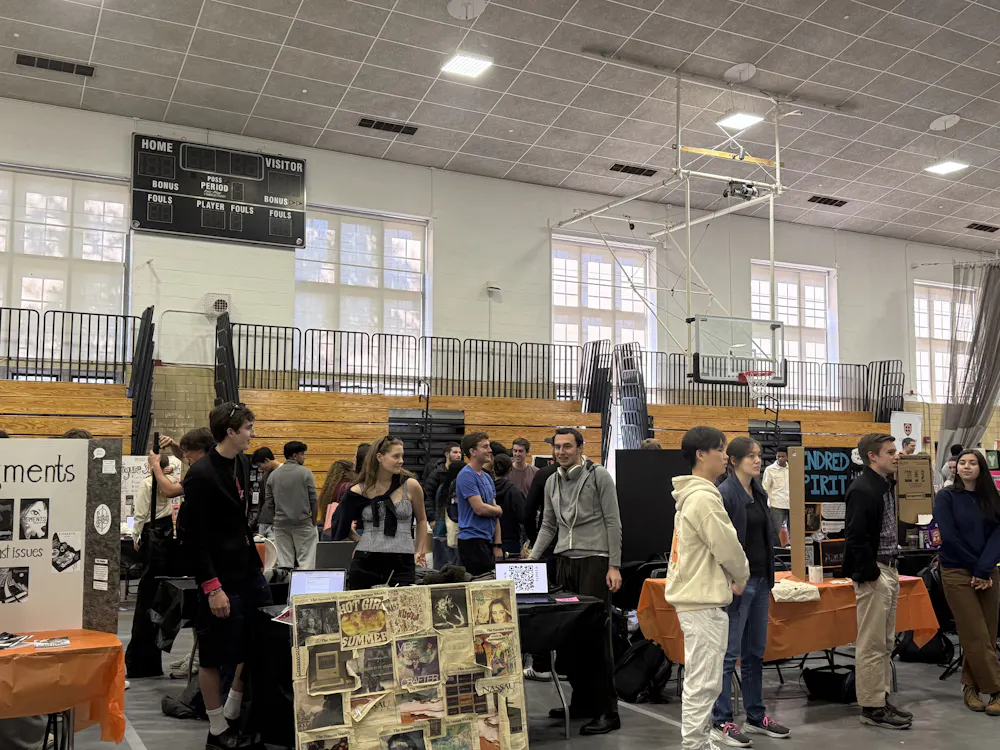
Students share mixed reactions as mandated officer and treasurer trainings return to in-person format
David EstradaThe University's student organization officers and treasurers returned to mandatory in-person training this fall after years of online sessions. Student reactions found parts of the training redundant or tedious, though most agreed the sessions were important.
The University's student organization officers and treasurers returned to mandatory in-person training this fall after years of online sessions. Student reactions found parts of the training redundant or tedious, though most agreed the sessions were important.