



Full professors at Princeton are the third highest-paid professors in the country and the second highest-paid in the Ivy League, according to a new report published last week by the American Association of University Professors.
The University's 457 full professors earned an average annual salary of $145,600 — about 8 percent less than professors at Harvard, the highest paying school, and roughly 7 percent less than professors at the Rockefeller University, a graduate and research institution in New York City and the second-highest paying.
Associate professors at Princeton earned an average of $92,400; assistant professors $70,900 and instructors $56,400. Salaries for these positions varied significantly among the top 10 best-paying institutions.
The principal conclusions of the report were evident from its title: "Don't Blame Faculty for High Tuition." The report provides an unusual glimpse into faculty salaries at the University and other top schools.
Next week's Chronicle of Higher Education reports that salaries for all faculty members rose 2.1 percent over last year when not adjusted for inflation and 0.2 percent when adjusted for inflation.
"Though faculty salaries may contribute to tuition increases, they are not the major cause of it," Ronald Ehrenberg, chair of the AAUP committee that produced the report and director of the Cornell Higher Education Institute, said in an interview.
Public schools suffering
The highest-paying colleges from the AAUP survey have one thing in common, Ehrenberg said: "They are the absolutely richest institutions in per-student endowments — and there Princeton is right at the top."
Though large endowments may explain why the best-paying colleges are able to better compensate their faculty, their endowments are not the reason large salaries are necessary, Ehrenberg added.

In an increasingly competitive academy, the nation's best colleges are under significant pressure to offer high salaries if they want to attract and retain first-rate scholars. It's a simple concept, according to John Curtis, director of research at the AAUP: "If an institution wants to achieve the highest quality faculty, they're going to have to pay the highest salaries."
This pressure has led to a troubling finding and the second major conclusion of the AAUP report: As well-endowed private institutions continually raise faculty salaries, public institutions of higher education that continue to face budget cuts are being left behind.
At Princeton, "students and faculty benefit from a great position of wealth, but if you look at the rest of academia," Ehrenberg said, "it is very difficult for [public institutions] to retain and attract top faculty. It means undergraduate education is suffering in higher public education in a way it's not suffering at Princeton."
Berkeley, the highest-paying public institution, had an average full-professor salary comparable to that of Washington University in St. Louis, a private institution ranked seventeenth on the AAUP survey. Berkeley's professors were paid, on average, 15 percent less than their Princeton counterparts.
Schools in urban areas without large endowments also face a difficult challenge, Ehrenberg added. He pointed to private school New York University, which — despite its small endowment — must compensate its faculty for the high cost of living in the New York area and thus ranks highly on the AAUP survey.
Gap between sexes
The AAUP report also found a significant gap between compensation for male and female professors at all levels. The gap was at its highest — 11.6 percent — at the full professor level, according to data analysis presented in the Chronicle. It was 7.7 percent at the assistant professor level.

But Ehrenberg cautioned that the data must be analyzed with a grain of salt. Because men and women are not necessarily present in individual departments in equal numbers, one cannot expect that — on average — women and men will be paid equally.
Ehrenberg offered an "extreme" example to illustrate his point: If all women faculty are in a university's English department and all men are in its computer science department, the average salaries of men and women will greatly differ because academic salaries are determined by the compensation levels of the nonacademic world, where one assumes computer scientists are better paid than authors and critics.
A better way of determining any gap between compensation for men and women is to ignore a university-wide perspective.
"What you could do is look within departments as opposed to across departments," Ehrenberg said.
Citing "delicate personnel issues," Dean of the Faculty David Dobkin declined to release data regarding the compensation of the University's faculty members, including any pay gap between male and female faculty members. Dobkin also declined to comment on the AAUP report's findings.
May be best paying
Though Harvard and Rockefeller ranked higher on the AAUP survey of best-paying institutions, Princeton may actually be the highest-paying institution in the country if one were to exclude a university's often lucrative professional schools.
"Harvard has massive business and law schools [and] these disciplines tend to be paid much more," Ehrenberg said. "That really boosts up the average salaries at Harvard."
"Don't feel sorry for [Princeton professors]," he said with a laugh. "The economist at Princeton gets paid just as much as the economist at Harvard. It may very well be that Princeton [actually pays more]."
Read More

Princeton University Orchestra and men’s ultimate frisbee team named in University’s latest hazing report
Andrew ArthurTwelve students in the Princeton University Orchestra and Men's Ultimate Frisbee team were found responsible for hazing violations in the University's latest Campus Hazing Transparency Report. Sanctions ranged from Dean's warnings to disciplinary probation.
Twelve students in the Princeton University Orchestra and Men's Ultimate Frisbee team were found responsible for hazing violations in the University's latest Campus Hazing Transparency Report. Sanctions ranged from Dean's warnings to disciplinary probation.

Murray-Dodge Café celebrates 50th Anniversary, drawing over 260 students
Hifza KaleemOn Wednesday, Murray Dodge Cafe celebrated its 50th anniversary, drawing more than 260 students to celebrate with free cookies and merchandise.
On Wednesday, Murray Dodge Cafe celebrated its 50th anniversary, drawing more than 260 students to celebrate with free cookies and merchandise.
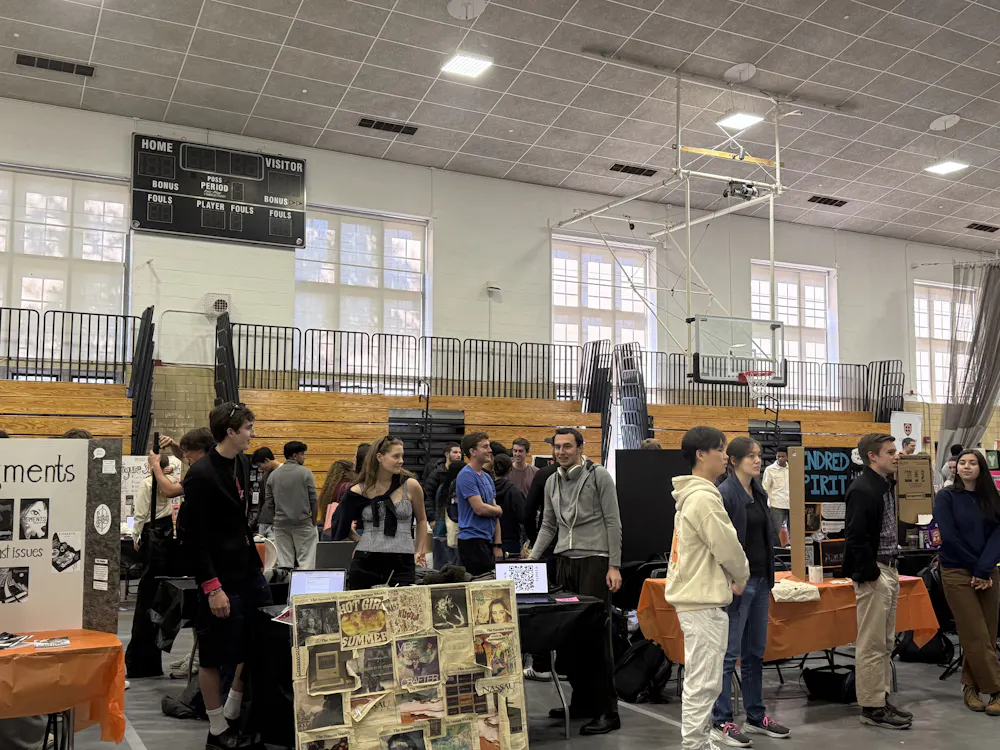
Students share mixed reactions as mandated officer and treasurer trainings return to in-person format
David EstradaThe University's student organization officers and treasurers returned to mandatory in-person training this fall after years of online sessions. Student reactions found parts of the training redundant or tedious, though most agreed the sessions were important.
The University's student organization officers and treasurers returned to mandatory in-person training this fall after years of online sessions. Student reactions found parts of the training redundant or tedious, though most agreed the sessions were important.