



As anthropologist Anne-Maria Makhulu pondered whether to accept an appointment with the University's Society of Fellows last year, Princeton's prestige, picturesque campus and distinguished faculty could not assuage her anxieties about a more mundane problem: the cost of living in the upscale suburbia of the Princeton area.
"We couldn't come to Princeton if we didn't get housing through the University," said Makhulu, a University of Chicago Ph.D. who ultimately accepted the three-year fellowship. "When it looked like we might not get housing, we started looking in Trenton, but there's a real disincentive with the commute."
Makhulu and her husband now live in the apartment complex at 120 Prospect Avenue, where they rent from the University for $1,200 per month. It is one of dozens of University-owned properties scattered throughout the area that are rented to faculty and staff at below-market prices.
The University accommodates roughly 700 people in a combination of houses, townhouses and apartments. The housing is spread between Nassau and Murray streets, the Millstone Apartments off Route 1 and the Stanworth complex on Bayard Street, among other locations.
Tenants range from visiting professors and postdoctoral fellows like Makhulu to tenured faculty and top administrators, University housing official Kim Napolitano said.
"Anybody who works at least halftime for the University can rent," Napolitano said. "That's anybody. We have a mix of all different levels of staff here."
Makhulu said her neighbors at 120 Prospect include a senior professor of mechanical engineering, a visiting professor in the architecture school and a recent Princeton graduate who now works for the athletics department.
She also said that some University-owned properties are more desirable than others.

"I feel particularly lucky we got in where we did," she said. "Stanworth, down Bayard, is probably the worst of the lot. I looked at the kitchen and said, 'No way.' It was like a little niche or a dorm or something."
Napolitano acknowledged that the market value of the units varies widely.
The rent charged for University properties ranges from $670 to $4,500 monthly, she said.
Napolitano said no priority is given to high-ranking University administrators or faculty, but one resident of University housing, who asked not to be named, disagreed.
"I was told there were things we should not even vie for because they would go to senior faculty," the resident said. "I get the sense there's a pecking order."
The resident added, "There's clearly a sense there aren't enough rental stocks to go around. And some of these junior professors and postdocs, who are economically very vulnerable, need to be able to rely on the University."

Dean of the Faculty David Dobkin, while not addressing the shortage issue directly, acknowledged the importance of the University's housing stock in recruiting new faculty to Princeton.
"We desire to have the very best faculty we can have," he said in a email. "We pay careful attention to compensation. Housing is one part of the compensation package we address."
Dobkin added, "For those who depart we look at the causes and evaluate whether changes are needed in the overall compensation package."
In addition to renting out a permanent housing stock, the University offers low-interest mortgages to high-ranking faculty and staff to ease the cost of living in the Princeton area.
Under the Standard Mortgage Program, the University issues mortgages to financially eligible faculty, administrators, researchers and technical staff at one percent below the prevailing local interest rate.
Among other restrictions, the mortgaged home must be located within nine miles of the University's central campus to ensure that "Princeton remains a residential University," according to the program website.
In the 1960s, Dean of the Faculty J. Douglas Brown instituted the mortgage program with the aim of providing "a sense of security within an attractive environment" for faculty.
"Even in those days, housing costs were escalating and faculty were having trouble staying in the area," said Caroline Clancy, director of the University real estate office.
Read More

Princeton University Orchestra and men’s ultimate frisbee team named in University’s latest hazing report
Andrew ArthurTwelve students in the Princeton University Orchestra and Men's Ultimate Frisbee team were found responsible for hazing violations in the University's latest Campus Hazing Transparency Report. Sanctions ranged from Dean's warnings to disciplinary probation.
Twelve students in the Princeton University Orchestra and Men's Ultimate Frisbee team were found responsible for hazing violations in the University's latest Campus Hazing Transparency Report. Sanctions ranged from Dean's warnings to disciplinary probation.

Murray-Dodge Café celebrates 50th Anniversary, drawing over 260 students
Hifza KaleemOn Wednesday, Murray Dodge Cafe celebrated its 50th anniversary, drawing more than 260 students to celebrate with free cookies and merchandise.
On Wednesday, Murray Dodge Cafe celebrated its 50th anniversary, drawing more than 260 students to celebrate with free cookies and merchandise.
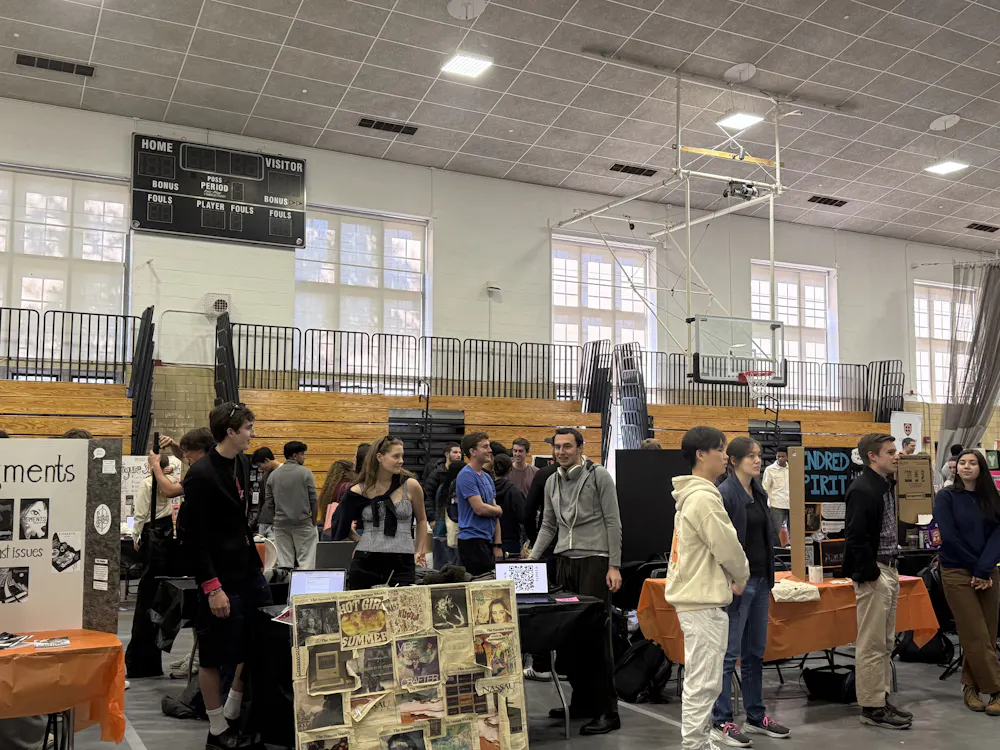
Students share mixed reactions as mandated officer and treasurer trainings return to in-person format
David EstradaThe University's student organization officers and treasurers returned to mandatory in-person training this fall after years of online sessions. Student reactions found parts of the training redundant or tedious, though most agreed the sessions were important.
The University's student organization officers and treasurers returned to mandatory in-person training this fall after years of online sessions. Student reactions found parts of the training redundant or tedious, though most agreed the sessions were important.