



What do you do with an eight-ounce, 23-karat Nobel Prize? Philip Anderson, professor emeritus of physics and 1977 Nobel Prize winner keeps his stored in a safety deposit box.
Anderson, a theoretician in the field of solid-state physics, remembers the day he won the coveted prize for an idea called localization as if it were yesterday.
"In 1973 there were rumors that my name was being linked with the Nobel Prize," Anderson said, "and they were just rumors, I had no reason to believe them. Yet, each October when the prize came around, I became very nervous."
Anderson assumed that if he were to win the Nobel it would be linked to his research on the Josephson effect, where supercurrents — currents that can flow through specific materials with zero resistance — can be influenced, controlled and then studied by applying an electric or magnetic field.
In 1973, however, Brian David Josephson himself won the Nobel Prize for his theory, and Anderson's nerves faded, making his 1977 award even more unexpected.
"I was just back from Cape Cod and I was hoping to sleep in," Anderson said, recalling an early morning in 1977, when the phone rang.
His wife answered the phone and handed it to Anderson, thinking that the Associated Press reporter on the line wanted his comments on another prizewinner, not comments about himself.
"When we sorted it all out, I was over the moon," Anderson recalled.

And the award week was no less magical. "They told my wife to bring no less than four party dresses," he laughed. "You couldn't appear before the king and queen in an old dress!"
Anderson himself rented a white-tie ensemble for the occasion from a local shop. "And when I brought them back, they placed them on display in the store window," he said.
A long road
Anderson did not begin with lofty goals of golden prizes, royal dinner parties and expensive champagne.
At Harvard, where Anderson did both his undergraduate and graduate work, he admits to having been a bit of a "goof-off."
"If I didn't like a course, I'd be damned if I did any work," he said.
Ironically, it was this type of mindset that may have helped Anderson achieve academic greatness.

"I was lazy," he admitted, "I still am lazy, but it's my best characteristic. I won't do anything the hard way if I can find an easier method."
Some time early in Anderson's undergraduate years he happened to find himself in a physics class.
On the first day of class the professor asked the students to look around. At the end of the year, he promised, only one out of every three people would still be sitting in that class.
"I took that to be a challenge," Anderson said, "and I got an A+."
But it wasn't until two years into his graduate studies that Anderson buckled down.
"I got married, and became more serious about my work. Suddenly, I realized I could do it," he said.
One year out of graduate school, while working for Bell Laboratories, Anderson received a surprise visitor.
The young scientist had written a fairly obscure paper, but it had caught the attention of renowned physicist H.A. Kramers.
"At a time when my boss at Bell Labs was trying to fire me and things were not going well, Kramers came and found me. He told me that he thought my paper was wonderful and he wished he had thought of it first. That was a thrilling moment," Anderson said.
Superconductivity theory
By 1957, Anderson had established himself in the scientific community.
It was that same year that a new superconductivity theory emerged, named "BCS" for its discoverers — Bardeen, Cooper and Schrieffer.
"I had the distinction of being known as one of the first people who believed the theory," Anderson said.
Anderson was considered an expert in the field early on for his work on superconductivity. One colleague supposedly said, "I don't know what I think about the BCS theory, but if Anderson believes it, it must be true."
The mechanisms of early BCS theory suggested that no two electrons — the negatively charged particles in an atom — can occupy the same space. Additionally, it was postulated that pairs of electrons can occupy the same quantum states.
In doing so, electrons scatter in and out of formations, doing a kind of box step.
The theory wasn't complete in a number of ways, Anderson explained, and so he set to work.
"Superconductivity is a very simple concept," Anderson explained. "When you cool a metal down to very low temperatures, the resistance of the metal drops to zero, meaning that electricity can pass through it freely."
However, in most instances electricity does not flow freely and infinitely.
Instead it is hindered by factors such as electrons bouncing off impurities in the metal.
In setting out to explain some of these concepts, Anderson wrote a journal paper about "dirty superconductors." The paper was censored, he said, because the editors thought it had pornographic connotations.
Prizewinning work
After his influential work with superconductors, Anderson was invited to teach at Cambridge University, a position he held part-time for eight years.
In 1975, Anderson left his position at Cambridge to join the Princeton physics department, where he still works on superconductivity.
He was working at Princeton when he won his Nobel Prize along with Sir Nevill Mott and John van Vleck.
"I was surprised that the award was given for that section of work," he said. "I don't think people would have known what I was doing if it weren't for my early work."
It has been a long journey for Anderson.
"This [Nobel Prize winning] work started in 1956," he said. "Nobody believed it and most people ignored it."
Twenty years later, Anderson found himself sitting with royalty, celebrating his achievements.
More recently, Anderson's fresh theories regarding new superconductors have not yet caught on with the whole physics community.
"Seeing the opportunity to win their own Nobel Prize, everyone and their brother created a theory about the new superconductors. And once someone created a theory, it is hard to make them look at the problem in any other way," he said.
Yet, Anderson said he is sure that 20 years from now all those mistaken scientists will look back and say, "Philip Anderson was right all along."
Read More

Princeton University Orchestra and men’s ultimate frisbee team named in University’s latest hazing report
Andrew ArthurTwelve students in the Princeton University Orchestra and Men's Ultimate Frisbee team were found responsible for hazing violations in the University's latest Campus Hazing Transparency Report. Sanctions ranged from Dean's warnings to disciplinary probation.
Twelve students in the Princeton University Orchestra and Men's Ultimate Frisbee team were found responsible for hazing violations in the University's latest Campus Hazing Transparency Report. Sanctions ranged from Dean's warnings to disciplinary probation.

Murray-Dodge Café celebrates 50th Anniversary, drawing over 260 students
Hifza KaleemOn Wednesday, Murray Dodge Cafe celebrated its 50th anniversary, drawing more than 260 students to celebrate with free cookies and merchandise.
On Wednesday, Murray Dodge Cafe celebrated its 50th anniversary, drawing more than 260 students to celebrate with free cookies and merchandise.
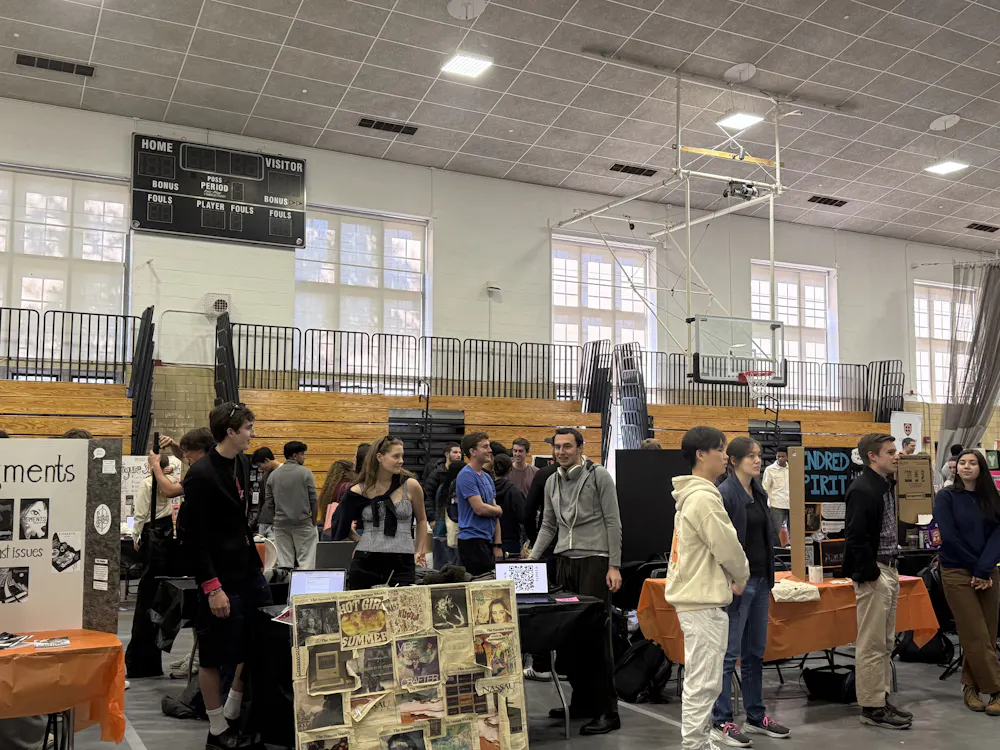
Students share mixed reactions as mandated officer and treasurer trainings return to in-person format
David EstradaThe University's student organization officers and treasurers returned to mandatory in-person training this fall after years of online sessions. Student reactions found parts of the training redundant or tedious, though most agreed the sessions were important.
The University's student organization officers and treasurers returned to mandatory in-person training this fall after years of online sessions. Student reactions found parts of the training redundant or tedious, though most agreed the sessions were important.