



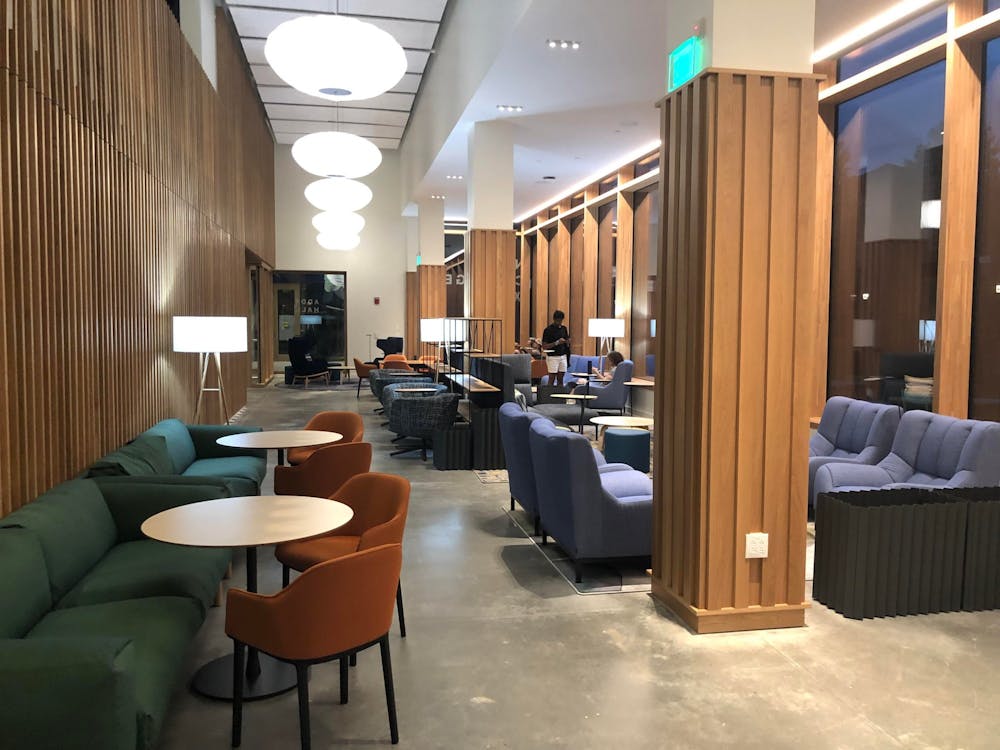
An updated version of the University’s undergraduate room draw system will launch next month, enabling more efficient group dynamics and offering new features such as 360-degree images of certain rooms, a mobile-friendly platform, and an available rooms list that updates in real time.
“We are very excited about [the new system] because it presents a much better and much more simplified approach to our room selection process, which we know is very stressful for students,” Dorian Johnson, executive director of housing, said in a meeting with housing administrators and The Daily Princetonian.
Room draw is the annual process by which undergraduate students who intend to live on campus the next academic year select their rooms.
For this upcoming cycle, the University’s previous housing system, CBORD, will be replaced with StarRez, a new mobile-friendly platform that is widely used by Princeton’s peer institutions, including Columbia, Harvard, Yale, and Georgetown.
Under the new system, the room draw process will be divided into three distinct phases: application, group formation, and room selection. This is a departure from the previous application and selection two-phase system. The new process will allow students to apply as individuals, as well as the option to form draw groups. The new process will also allow group members to more easily select rooms on behalf of other members of their group, should they miss the assigned draw time. All students who complete the application by March 24 will receive a draw time.
Previously, if students were attempting to draw as a group, each person was required to complete their part of the group application in order to receive a group draw time. If one person did not submit the application by the deadline, then the rest of the group would not receive a draw time.
Each part of the phase will be completed in the new Starrez housing portal.
Phase I: Application

During the first phase, all students who intend to live in on campus housing will complete an individual application on the StarRez website, which will be open from noon on March 17 to noon on March 24. During this timeframe, rising juniors and seniors will also have the option to apply for a Spelman Hall room draw on the website.
Students applying to live in Spelman must have a group of 4 students, and at least 2 of the 4 students must complete “attestations” confirming they are not members of eating clubs or co-ops, will not purchase the unlimited dining meal plan, and will instead purchase the Block 128 university dining plan. Any violation of these attestations will be considered a violation of Rights, Rules, Responsibilities, and will be subject to disciplinary action, according to Johnson.
The Spelman room draw will occur on March 26, separately from the campus-wide room draw.
Phase II: Group Formation
For the second phase of the process, group formation, the University is introducing an optional profile feature to help students find roommates through the portal. Through this feature, students will be able to fill out a lifestyle preference sheet, message each other through a portal, and view ratings of their roommate lifestyle compatibility with other students.
Dennis Daly, housing engagement specialist, highlighted that the new roommate matching tool “is going to provide people more information than they’ve had in the past, and it’s going to lower the kind of traditional stress points around [matching roomates].”

The lifestyle profile, as well as group formation, is optional.
Groups can have a maximum of eight people, who can be divided into multiple different room types according to the members’ wishes. If a member is unable to make their draw time, other members of their group will be able to assign them to a room to ensure that everyone has a living space.
Students can edit or leave their group until the conclusion of the phase. This phase will run from 2 p.m. on March 24 to 12 p.m. on March 31. Students are also not required to draw in a group.
Phase III: Room Selection
The final room selection phase will function similarly to an e-commerce site, featuring a cart functionality.
According to Daly, “the new system increases student agency by allowing users to add rooms to a digital cart; once a room is selected, a timer begins and the space is ‘pulled from general circulation’ to prevent others from claiming it during the deliberation process.”
During this phase, students will be able to track the available rooms in real-time. Rising sophomores will only be able to view rooms in their residential colleges, while rising juniors and seniors will be able to view rooms both in their colleges and in upperclass housing facilities.
“We used to have a static list of people who would make their plans. But then, in reality, you wouldn’t have an idea of what spaces were available until half an hour before your draw time. Now you’ll be able to follow that in real time,” Daly told the ‘Prince.’
This new interface will include features such as 360-degree images of certain rooms, floor plans that include furniture layouts, and exact dimensions of the rooms.
Johnson shared that the Housing team has begun the process of capturing each room with a 360-degree camera, offering a “Google Earth-esque” functionality, but the process to capture every room could take “years.”
Previously, students were required to fill an entire room to draw into it. Under StarRez, the University can now “toggle off” this requirement at the end of the draw, allowing students to select a single bed in a room that is already partially occupied.
This new system follows the University’s recent elimination of the Community Living Adviser (CLA) position in residential colleges. Those former CLA rooms will now be integrated into the general room draw, slightly increasing the available inventory for undergraduates.
The final phase will begin at noon on April 6 and is expected to conclude by noon on April 24.
While the new system offers more flexibility in the lead-up to the draw, administrators emphasized that “room selection remains binding and cannot be changed” once the selection of the room has been completed. Students will then have to sign a the contract.
To assist with the transition, the University plans to host more information sessions than they have in previous years. Before the room draw application opens, the housing team will hold two virtual webinars and one hybrid virtual and in-person info session.
During the room draw application phase, the housing team will hold a series of five info sessions at each residential college. During the group formation phase, there will be a series of six info sessions at the residential colleges and Frist Campus Center.
The first webinar will be on March 3, and the first in-person session will be at Rockefeller College on March 17.
A memo sent to University students on Monday detailed these changes and provided a guide to the new room draw.
Ultimately, the new system is expected to enable more control over the room draw process. “You kind of are the master of your own destiny,” Johnson added.
Luke Grippo is a head News editor for the ‘Prince.’ He is from South Jersey, and typically covers high-profile interviews and University and town politics. He can be reached at lg5452[at]princeton.edu.
Nika Schindler is the assistant News editor for the ‘Prince’ leading University operations coverage. She is from Atherton, Calif., and can be reached at ns1295[at]princeton.edu.
Please send any corrections to corrections[at]dailyprincetonian.com.
Corrections were made on Feb. 16, 2026: A previous version of this article incorrectly attributed quotes said by Dennis Daly to Mike Stillwagon and said that members in a group would miss their room draw time if they did complete the selection phase together, under the previous system. Actually, they would not receive a draw time if everybody did not submit an application by the application deadline. Additionally, the room selection phase will begin on April 6, not April 5 as was previously stated. The ‘Prince’ regrets these errors.
Editor's note: This article has been updated to clearly reflect that a student or group is bound to their room following the completion of the selection, not after the housing contract has been signed. It also been lightly edited to clarify the individual versus group selection, as well as the Spelman Hall group size and requirements.
Read More

VP for Campus Life Calhoun to retire, leaving behind mixed legacy
Luke GrippoVice President of Campus Life W. Rochelle Calhoun will retire at the end of the 2026–2027 academic year. She entered the position in 2015 and has worked to expand mental health resources on campus, though she was criticized for her response to a sit-in at Clio Hall during the “Gaza Solidarity Encampment.”
Vice President of Campus Life W. Rochelle Calhoun will retire at the end of the 2026–2027 academic year. She entered the position in 2015 and has worked to expand mental health resources on campus, though she was criticized for her response to a sit-in at Clio Hall during the “Gaza Solidarity Encampment.”

Students awarded prizes for academic achievement, discuss Princeton experience
Mia ChenSeven undergraduate students were awarded four different awards during Opening Exercises on Aug. 31. These awards spotlight academic excellence among students.
Seven undergraduate students were awarded four different awards during Opening Exercises on Aug. 31. These awards spotlight academic excellence among students.

The Experimental College: the short-lived radical intellectual guild
Chris XinIn 1966, discontent with Princeton’s curricular offerings and preceptorial system, a group of students from the already avant-garde Woodrow Wilson Society founded an even more radical institution: the “Experimental College.” In its short lifespan of two years, the Experimental College provided a glimpse into a different possibility for Princetonians’ social and intellectual life.
In 1966, discontent with Princeton’s curricular offerings and preceptorial system, a group of students from the already avant-garde Woodrow Wilson Society founded an even more radical institution: the “Experimental College.” In its short lifespan of two years, the Experimental College provided a glimpse into a different possibility for Princetonians’ social and intellectual life.