



The white earphones are unmistakable. They dangle from the person passing you on your way to class, the one exercising on the adjacent elliptical machine, and that kid studying behind you in Cafe Vivian.
Princeton students, it seems, have embraced the iPod, a compact portable unit for downloading, storing and listening to music. The device can hold up to 10,000 songs, most of them in MP3 format.
"I'm obsessed with my iPod. I'll admit it," said Megan McAllen '07. "It's like having a personal soundtrack to your life that's aesthetically pleasing and fits conveniently in your back pocket."
Many students attest to the convenience of the iPod because it eliminates the need to carry CDs. Laura Tallent '07 said she also uses the iPod to store addresses and appointments, and she recently acquired special speakers that transform the unit into a mini 'boom box.'
While the iPod is manufactured by Apple Computer, it is now compatible with both Apples and PCs, which has expanded its appeal. The iPod's popularity also stems from its easy interface, reliability and fashionable appearance, according to Aaron Zimmerman '04, an operations research and financial engineering major whose thesis develops a theoretical model for pricing digital music files.
"It's trendy-looking and that's really important," Zimmerman said.
However, iPods remain relatively expensive — from $229 to $469 — which has discouraged some students from purchasing one. Elena Olivi '06 said she would only consider buying one if prices dropped.
"I would never spend that much money on something I don't need," she said.

Olivi also said that while she appreciates the convenience of the digital music revolution, she resents that it has divorced individual songs from their albums.
She said the digital music trend makes people more dependent on MTV and the radio to determine their music choices.
"[People] just end up downloading the overplayed singles and compiling them on their iPod," she said.
Zimmerman said that, ironically, it was the evolution of music technology that created "the album," and that it is the continued evolution of music technology in the form of digital storage capabilities that has imperiled the old concept.
Another component of the digital music revolution is iTunes, free software from Apple that allows users connected to the same local or wireless network to access each other's music libraries.
OIT Director of Support Services Steven Sather explained that iTunes is legal because, unlike file sharing, users cannot actually copy or download the music files. He equated the program with playing a CD for a friend.

iTunes also offers access to the online iStore, where users can purchase songs for 99 cents each.
Sather said he uses iTunes and currently has 2,341 songs collected from CDs or through other legal means.
"My whole CD collection — which used to take up a few bookshelves — is now all in storage," he said.
Students also have positive things to say about iTunes. Alycia Somers '04 noted that it has created a welcomed online music community "without the guilt of piracy."
Beth Ann Ingrassia '07 enjoys iTunes, but said it is "dangerously easy to buy 99-cent songs." She explained that she recently purchased six versions of the same song before finding the right one.
Others complain that iTunes primarily offers mainstream music.
In addition, fans of the iPod are not necessarily proponents of iTunes. McAllen, who loves her iPod, still resents Apple for dominating the market.
"I still won't use iTunes," she said, "and you'll never catch me using a Mac."
Read More

Princeton University Orchestra and men’s ultimate frisbee team named in University’s latest hazing report
Andrew ArthurTwelve students in the Princeton University Orchestra and Men's Ultimate Frisbee team were found responsible for hazing violations in the University's latest Campus Hazing Transparency Report. Sanctions ranged from Dean's warnings to disciplinary probation.
Twelve students in the Princeton University Orchestra and Men's Ultimate Frisbee team were found responsible for hazing violations in the University's latest Campus Hazing Transparency Report. Sanctions ranged from Dean's warnings to disciplinary probation.

Murray-Dodge Café celebrates 50th Anniversary, drawing over 260 students
Hifza KaleemOn Wednesday, Murray Dodge Cafe celebrated its 50th anniversary, drawing more than 260 students to celebrate with free cookies and merchandise.
On Wednesday, Murray Dodge Cafe celebrated its 50th anniversary, drawing more than 260 students to celebrate with free cookies and merchandise.
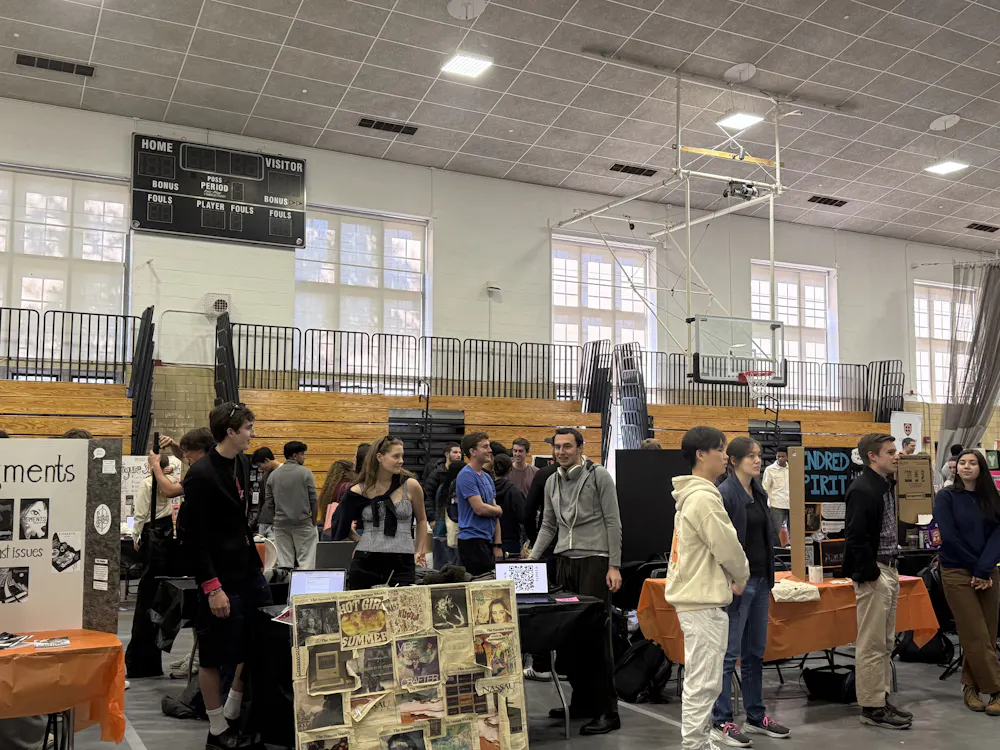
Students share mixed reactions as mandated officer and treasurer trainings return to in-person format
David EstradaThe University's student organization officers and treasurers returned to mandatory in-person training this fall after years of online sessions. Student reactions found parts of the training redundant or tedious, though most agreed the sessions were important.
The University's student organization officers and treasurers returned to mandatory in-person training this fall after years of online sessions. Student reactions found parts of the training redundant or tedious, though most agreed the sessions were important.