



Just days after the faculty voted to approve the anti-grade inflation proposals, University members are starting to come to terms with the implications of that vote.
Earlier this month, the Committee on Examinations and Standing released the proposals, which aimed to limit A-range grades to 35 percent in undergraduate courses and 55 percent in independent work. The faculty voted 156 to 84 Monday to approve the measure after two weeks of public debate.
USG President Matt Margolin '05 said the student government will work to ease the transition as the proposals are phased in beginning next fall.
He said he envisions the USG working on four goals: ensuring similar grading standards among precepts; asking administration and faculty to examine the proposals' effects on students while at the University and after their graduation; encouraging freshmen to get help from their advisers and getting an explanation of the grading process.
"We are going to be the model which other institutions that wish to address this problem will use," he said.
Computer science professor Brian Kernighan said he supported the proposal, but "uneasily."
"I don't know whether grades are genuinely inflated, or people are smarter than they used to be," he said. "The bottom line is that I think it is a worthwhile experiment to try and see how it works."
Anthropology professor John Borneman, however, said he voted against the proposal, partly because it may hurt smaller departments.

"We have a more select group of people who don't fit the same curve as in bigger disciplines," he said. "In any particular year, we don't get the exact curve. So we'd have to make an artificial one."
Students have a variety of concerns with the proposals. Jennifer Andresen '07 said students' mindsets may change for the worse. "It may make people less helpful when it comes to aiding others with problem sets in things like entry-level math and science," she said. "And it could cause some people who are already intense studiers to decide that no matter what they have to be in the 35 percent, making a pretty unhealthy lifestyle of obsession."
Justin Johnson '04 said strict limits also unfairly punish qualified students. "They let in all the science fair winners, the math fair winners, they say we're number one, but then we can't get A's? It's preposterous," he said. "Why do they feel the need to penalize people who they already know are intelligent and are working at increasing their intelligence — why penalize them by decreasing their grades?"
Students also said the proposals may adversely affect acceptance to graduate schools or jobs. "If there are no standards across the nation, it makes it much more difficult for Princeton students," Marcus Saskin '06 said. "The only way it works is if we get together with all the major institutions in the upper echelon, and they all agree."
Ted Jeon '07 said that even if Princeton sends distribution curves to graduate schools and employers, "who's going to really look at it? They hardly read the cover letter."
Some students, however, expressed support for the plan.

"I definitely agree that there's grade inflation in humanities classes, so in that way it's a good thing," Raleigh Martin '07 said. "I don't think it's as big a deal as people think. If you graduate from Princeton, as long as you don't fail all your classes, you'll get a good job."
Christine Eun '04 said the proposal will help equalize the grades across departments. "It's so much easier to get an A in other departments than science," she said. "It's good to even that."
Read More

Princeton University Orchestra and men’s ultimate frisbee team named in University’s latest hazing report
Andrew ArthurTwelve students in the Princeton University Orchestra and Men's Ultimate Frisbee team were found responsible for hazing violations in the University's latest Campus Hazing Transparency Report. Sanctions ranged from Dean's warnings to disciplinary probation.
Twelve students in the Princeton University Orchestra and Men's Ultimate Frisbee team were found responsible for hazing violations in the University's latest Campus Hazing Transparency Report. Sanctions ranged from Dean's warnings to disciplinary probation.

Murray-Dodge Café celebrates 50th Anniversary, drawing over 260 students
Hifza KaleemOn Wednesday, Murray Dodge Cafe celebrated its 50th anniversary, drawing more than 260 students to celebrate with free cookies and merchandise.
On Wednesday, Murray Dodge Cafe celebrated its 50th anniversary, drawing more than 260 students to celebrate with free cookies and merchandise.
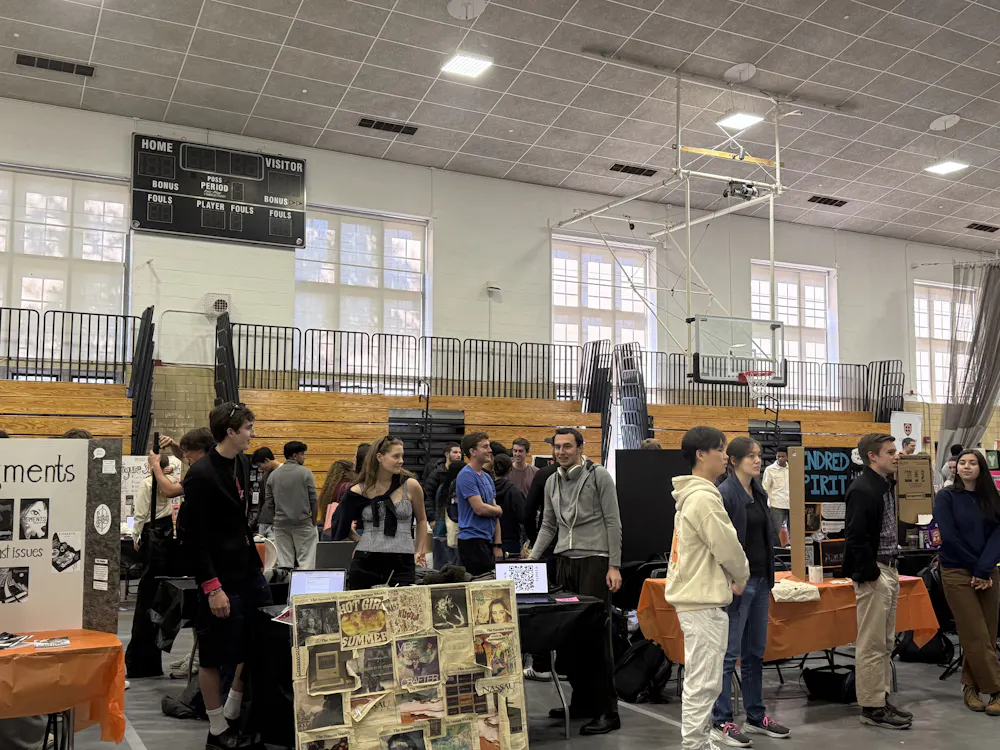
Students share mixed reactions as mandated officer and treasurer trainings return to in-person format
David EstradaThe University's student organization officers and treasurers returned to mandatory in-person training this fall after years of online sessions. Student reactions found parts of the training redundant or tedious, though most agreed the sessions were important.
The University's student organization officers and treasurers returned to mandatory in-person training this fall after years of online sessions. Student reactions found parts of the training redundant or tedious, though most agreed the sessions were important.