



In a wide-reaching discussion Monday on the University's future, President Tilghman pledged to keep all main University buildings within a 10 minute walk from the center of campus, praised the coming four year residential college as a third option for undergraduates and reaffirmed her commitment to improving the engineering school and expanding the University's creative arts program. She said engineering school dean Marie Klawe would brief the University's Board of Trustees at the April meeting on her strategy to enhance the school, explained that overwhelming growth in faculty made it necessary for the University to increase the number of students in each class and heard complaints from graduate students about rising rents and a lack of diversity in the graduate school.
The hour-long discussion at the end of the meeting of the Council of the Princeton University Community was billed as a first-of-its-kind town-hall style interaction between Tilghman and students. But at the end, student leaders and others suggested they were unsatisfied.
USG president Matt Margolin '05 said he was dismayed, asserting that Tilghman was too concerned with longterm issues instead of immediate campus concerns.
Other students echoed his position.
"I was glad that [Tilghman] finally gave students the opportunity to speak their minds," said Black Student Union President Leslie-Bernard Joseph '06. "But I wish she had given more time to issues that affect students now."
Joseph asked Tilghman whether the University would create a cultural studies requirement. She deferred to Dean of the College Nancy Malkiel, who said that it was unlikely changes to the distribution requirements would come any time soon after a major review a decade ago.
"The response I received was quite possibly the most discouraging thing I have heard in terms of effecting change on this campus," Joseph said of the view.
In other responses, Tilghman emphasized a commitment to fostering diversity on campus, integrating graduate students into residential life and training students to transfer their learning to real-life applications that can improve the world.

The discussion, modeled after Tilghman's annual meeting with alumni, covered University goals and touched on several issues raised by undergraduates and graduate students.
'Too much on the future'
Margolin expressed the concern after the meeting that many critical current issues were bypassed in favor of more distant future plans that would not affect present students.
"Today was supposed to be a town-hall meeting," Margolin said, in which he had hoped students could discuss issues impacting campus life now. "Today was supposed to prove [to the administration] that these are real issues." Instead, he said, the meeting "focused too much on the future."
He said that important issues such as Pequod prices and 24-hour study spaces were not even brought up, and that [instead] the discussion focused on increasing the size of the student body, and the role of graduate students.
Margolin said the small student body, attractive campus and focus on undergraduate education are three reasons many students choose the University over other prestigious institutions.
"Today proved we're becoming more like Harvard," he said.

Margolin added that while he thought the event had positive aspects, it fell short of some of his hopes.
He said the discussion was intended as a response to complaints about the lack of transparency in the administration.
The event was planned to be more of a back-and-forth dialogue between Tilghman and undergraduates, he said.
He had also wanted it to be at night when more students would be able to attend, but he said Tilghman's busy schedule only worked with an afternoon setting.
Positive responses
Some students had more positive responses to Tilghman's discussion.
Mac Friddell '06 said he thought the session was "definitely helpful."
"President Tilghman is very eloquent and very intelligent," he said, adding that "she has a very good vision for Princeton and a sense of where we should be going."
A group of Graduate Student Government members also expressed satisfaction with Tilghman's response to one question about improving the affordability of graduate housing.
"I was very impressed with the president's commitment to graduate student housing," said GSG Parliamentary Secretary Leonard Pease.
He added that he was pleased with Tilghman's dedication to incorporating GSG input into the process.
Tilghman's agenda
At the beginning, Tilghman set out her view of what the session shoud be like.
"This CPUC meeting is really devoted to a town meeting where you ask questions . . . to let you know what's on my mind and let me know what's on your minds," Tilghman said.
She added that her goal was to outline "the highest priorities of the University."
Citing the "extraordinary quality of the applicant pool" and the steady increase of faculty members, Tilghman explained the trustees' recent decision to increase the size of the undergraduate student body.
She then outlined plans for "a new option for residential life: the four-year college."
While stressing that the current two options for upperclassmen — joining an eating club or becoming independent — would remain in place, she said that it had become very clear from surveys that "there was a contingent of students unhappy with both options . . . who were most happy in the years spent in their residential colleges."
She also discussed the decisions to construct Whitman College and tear down Butler College in order to create new, attractive residences that would "make the campus feel more transversable."
Read More

Princeton University Orchestra and men’s ultimate frisbee team named in University’s latest hazing report
Andrew ArthurTwelve students in the Princeton University Orchestra and Men's Ultimate Frisbee team were found responsible for hazing violations in the University's latest Campus Hazing Transparency Report. Sanctions ranged from Dean's warnings to disciplinary probation.
Twelve students in the Princeton University Orchestra and Men's Ultimate Frisbee team were found responsible for hazing violations in the University's latest Campus Hazing Transparency Report. Sanctions ranged from Dean's warnings to disciplinary probation.

Murray-Dodge Café celebrates 50th Anniversary, drawing over 260 students
Hifza KaleemOn Wednesday, Murray Dodge Cafe celebrated its 50th anniversary, drawing more than 260 students to celebrate with free cookies and merchandise.
On Wednesday, Murray Dodge Cafe celebrated its 50th anniversary, drawing more than 260 students to celebrate with free cookies and merchandise.
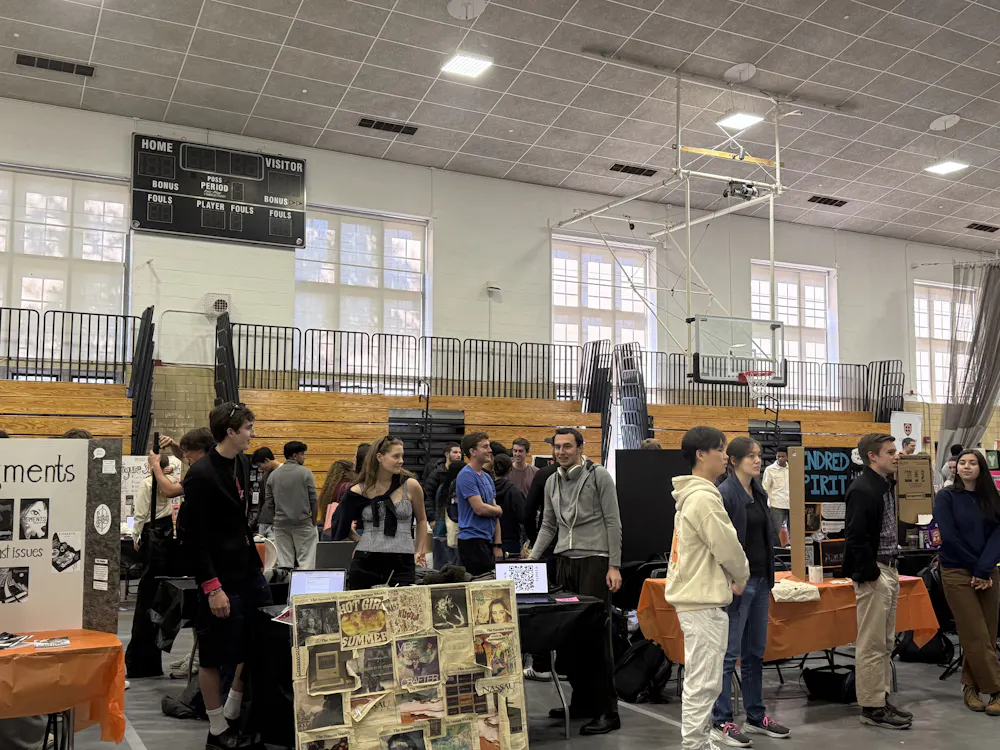
Students share mixed reactions as mandated officer and treasurer trainings return to in-person format
David EstradaThe University's student organization officers and treasurers returned to mandatory in-person training this fall after years of online sessions. Student reactions found parts of the training redundant or tedious, though most agreed the sessions were important.
The University's student organization officers and treasurers returned to mandatory in-person training this fall after years of online sessions. Student reactions found parts of the training redundant or tedious, though most agreed the sessions were important.