



While the crew teams gear up to host races on Lake Carnegie, environmental concerns are brewing in and around Princeton's largest lake.
The lake suffers from low oxygen content and a mercury level high enough to prompt an advisory on fish consumption, said Denise Patel, campus organizer for New Jersey Water Watch, an environmental activist group.
Most of the northeastern seaboard has mercury-related problems in its waterways, but Patel said New Jersey's are the worst in the region.
"New Jersey has a lot of environmental problems stemming from its long legacy of industrial pollution to more recent problems related to overdevelopment," she said.
In addition, New Jersey's status as the most densely populated state in the country only exacerbates the problem.
"Princeton happens to fall into an area that is being developed faster than any other part of the state," Patel said.
Neighboring West Windsor Township has had the highest rate of development in the state in recent years, which can stress local waterways.
However, Lake Carnegie's water quality problems are not due to large industrial plants but to other, more local environmental conditions.

"Lake Carnegie's large mercury and phosphorous load comes mainly from non-point sources such as litter, fertilizers, pesticides and oil and gas from cars," said Peter Jaffe, a civil and environmental engineering professor. Fertilizers and pesticides are a source of nutrients in the water, he said, which can cause oxygen-depleting algal blooms.
Jaffe, who lectures on water pollution technology and conducts research on radionuclides in water, said non-point source pollution is difficult to deal with and that buffers between water sources and agricultural or activity zones are necessary.
Efforts made by the Stony Brook Watershed Association, a local group, may lead to decreased levels of mercury in the future.
George Hawkins '83, director of the association, said the amount of sedimentation in the lake is "slower than expected because of settling ponds built on Stony Brook river and tributaries." Such ponds prevent unnecessary fertilizer runoff and pesticides from filling the lake, he said.
Under Patel's direction, Princeton Water Watch, one of eleven chapters of New Jersey Community Water Watch, is working to improve local water quality through education and community projects.
Service projects include removing debris from riverbanks, collecting water samples to test for types of pollution, mapping local waterways, and offering environmental education in local schools.

Catherine Chou '06, president of the Princeton chapter and 'Prince' contributor, said the group "sponsor[s] four cleanups a year of the Delaware and Raritan Canal, which runs behind Carnegie, and many stream monitoring programs."
This Sunday, Water Watch will be in the Borough from 2 to 7 p.m. to talk to local residents about Princeton's water quality problems and distribute leaflets containing tips on how to help protect local water quality. Princeton Borough Mayor Joseph O'Neill will open the Water Watch initiative by speaking to the community at a press event in Palmer Square.
"We always welcome new volunteers and hope students get involved to really make a difference in their community," Chou said.
Read More

Princeton University Orchestra and men’s ultimate frisbee team named in University’s latest hazing report
Andrew ArthurTwelve students in the Princeton University Orchestra and Men's Ultimate Frisbee team were found responsible for hazing violations in the University's latest Campus Hazing Transparency Report. Sanctions ranged from Dean's warnings to disciplinary probation.
Twelve students in the Princeton University Orchestra and Men's Ultimate Frisbee team were found responsible for hazing violations in the University's latest Campus Hazing Transparency Report. Sanctions ranged from Dean's warnings to disciplinary probation.

Murray-Dodge Café celebrates 50th Anniversary, drawing over 260 students
Hifza KaleemOn Wednesday, Murray Dodge Cafe celebrated its 50th anniversary, drawing more than 260 students to celebrate with free cookies and merchandise.
On Wednesday, Murray Dodge Cafe celebrated its 50th anniversary, drawing more than 260 students to celebrate with free cookies and merchandise.
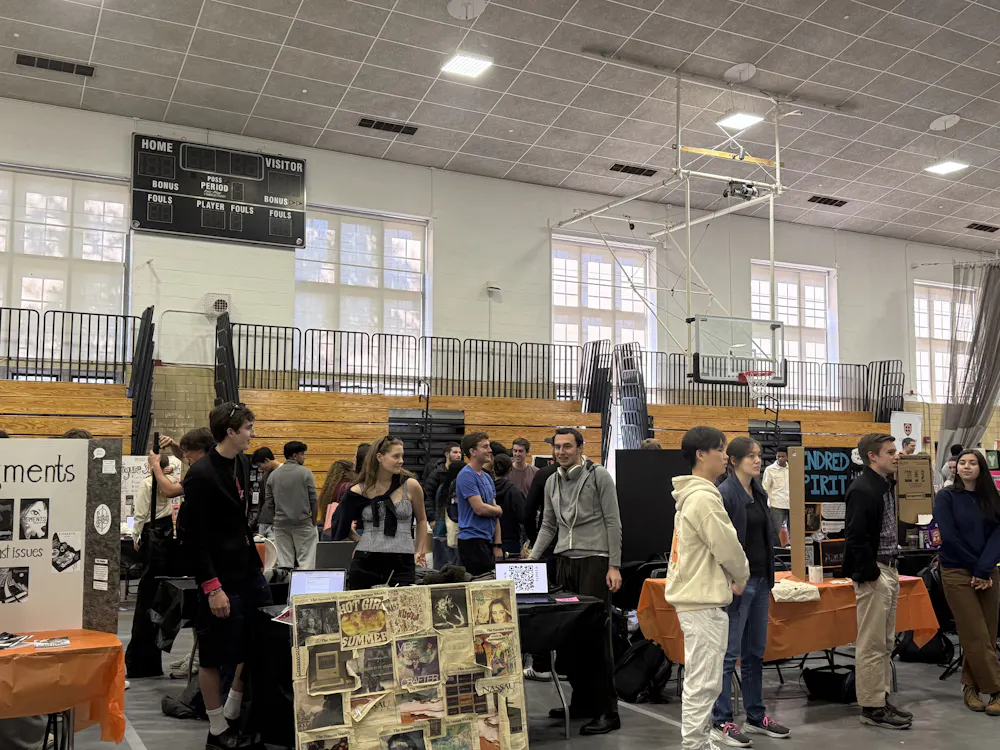
Students share mixed reactions as mandated officer and treasurer trainings return to in-person format
David EstradaThe University's student organization officers and treasurers returned to mandatory in-person training this fall after years of online sessions. Student reactions found parts of the training redundant or tedious, though most agreed the sessions were important.
The University's student organization officers and treasurers returned to mandatory in-person training this fall after years of online sessions. Student reactions found parts of the training redundant or tedious, though most agreed the sessions were important.