



The Graduate School suffered a 26 percent decline in applications from international students this year, following a nationwide trend. The undergraduate program experienced a 20 percent reduction in international applications, but that could not immediately be attributed to one particular reason.
Graduate College Dean of Academic Affairs David Redman said the school suffered a nine percent drop in applications from U.S. citizens as compared to the 26 percent decrease in applications from non-citizens. This year, 3,066 foreign citizens applied compared to 4,149 last year.
The departments hit hardest by the decrease are in the sciences and engineering, Redman said.
The drop in international applications for Princeton's graduate program is part of a trend sweeping the nation, according to recent surveys. A survey released March 2 by the Council of Graduate Schools reported that graduate school applications from international students declined 32 percent from last year, with the sharpest drops in numbers from Chinese and Indian applicants. University officials pointed to several new possible barriers to international graduate students applying.
Undergraduate figures
In undergraduate admissions, Dean of Admissions Janet Rapelye said it was too early to know why the University underwent a 20 percent decrease — a difference of roughly 500 students compared to last year. Overall, undergraduate applications were down 14 percent this year.
"There can be very wide variations from one year to another," said the official in charge of international student affairs, Associate Dean of Undergraduate Students Hilary Herbold, noting that last year the number of international applicants rose by 15 percent.
She said that while fluctuations of 15 percent were not uncommon, "20 percent is a fairly dramatic difference."
A second recent survey, conducted by five leading higher education associations, found both increases and decreases of international undergraduate applications. The survey said roughly a third of the institutions surveyed experienced a decline in international applicants, a third experienced an increase and a third had no change.
Graduate reasons

Peter Syverson, vice president for research at the Council of Graduate Schools, identified three factors that might account for the trend.
The first factor he identified was the increasingly complex visa process, which now encompasses registration with the Student and Exchage Visitor Information System — a tracking database — and a mandatory interview at a U.S. consulate.
"The second factor," he said, "is a holistic one. The word on the street is that it's just more difficult to be an international student in the states than it used to be."
Syverson said this cultural problem was reinforced by the visa laws.
The third factor Syverson identified is that some public institutions have experienced fairly severe budget cuts, which translate to less support staff for internationals.
Redman said that some reasons for the decrease at Princeton might include that the Graduate College moved its application deadline up to Dec. 1, and the Educational Testing Service instituted a mandatory writing component in its grad school test.

He also said he had heard anecdotal evidence from colleagues who thought some faculty members at institutions abroad were discouraging students from applying to study in the States.
Redman said the number of Chinese students applying to the Graduate College had declined around 50 percent. Meanwhile, "some of our fellow grad schools in Canada did report significant increases in international grad students, especially from China," he said.
Redman said that if this trend continues, graduate applications in the United States would become much more competitive for universities. "There'll be the same number of institutions competing for a smaller number of students," he said.
Syverson said the most striking thing about the nationwide trend was that "no institution was immune from this decrease."
"We found that across the spectrum of institutions these decreases are commonplace," Syverson said. "That's very unusual."
Read More

Princeton University Orchestra and men’s ultimate frisbee team named in University’s latest hazing report
Andrew ArthurTwelve students in the Princeton University Orchestra and Men's Ultimate Frisbee team were found responsible for hazing violations in the University's latest Campus Hazing Transparency Report. Sanctions ranged from Dean's warnings to disciplinary probation.
Twelve students in the Princeton University Orchestra and Men's Ultimate Frisbee team were found responsible for hazing violations in the University's latest Campus Hazing Transparency Report. Sanctions ranged from Dean's warnings to disciplinary probation.

Murray-Dodge Café celebrates 50th Anniversary, drawing over 260 students
Hifza KaleemOn Wednesday, Murray Dodge Cafe celebrated its 50th anniversary, drawing more than 260 students to celebrate with free cookies and merchandise.
On Wednesday, Murray Dodge Cafe celebrated its 50th anniversary, drawing more than 260 students to celebrate with free cookies and merchandise.
Students share mixed reactions as mandated officer and treasurer trainings return to in-person format
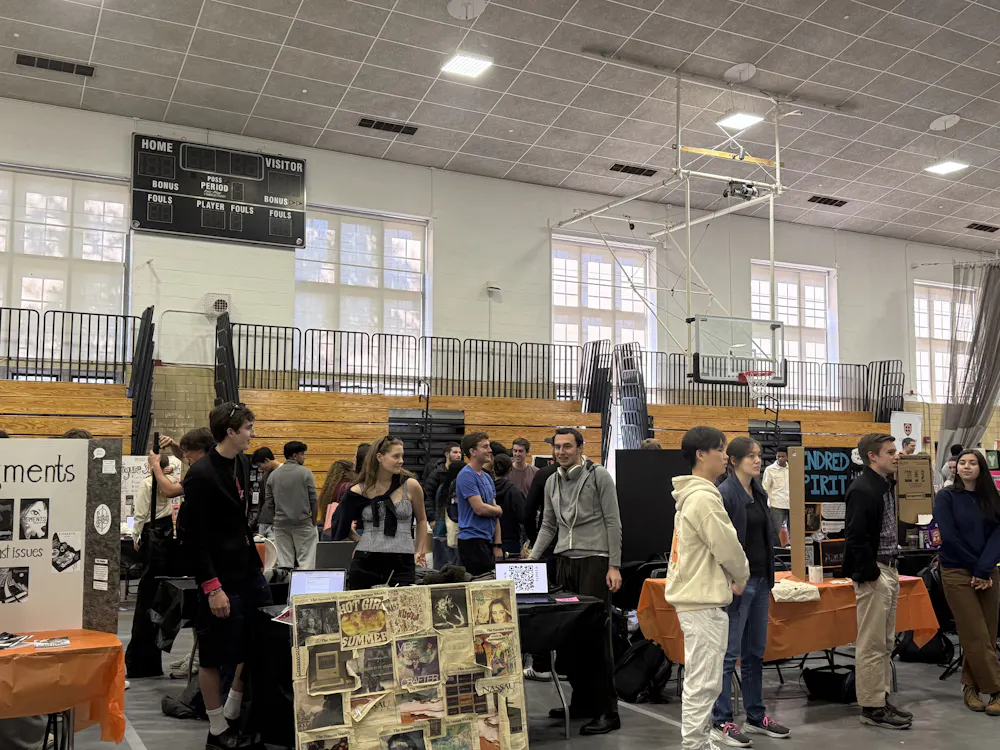
David EstradaThe University's student organization officers and treasurers returned to mandatory in-person training this fall after years of online sessions. Student reactions found parts of the training redundant or tedious, though most agreed the sessions were important.
The University's student organization officers and treasurers returned to mandatory in-person training this fall after years of online sessions. Student reactions found parts of the training redundant or tedious, though most agreed the sessions were important.