



When Francis Bellamy wrote the "Pledge to the Flag" in 1892, the now-ubiquitous wording was quite different than what children are familiar with today: "I pledge allegiance to my Flag, and to the Republic for which it stands, one Nation indivisible, with Liberty and Justice for all."
The pledge, which underwent several major revisions — including the addition of the phrase "under God" in 1954 — now faces an ideologically-charged constitutional test at the Supreme Court. And Professor Christopher Eisgruber '83, the University's next provost, has proposed a solution to the Court in an amicus curiae brief — a brief filed with the court by someone who is not a party to the case.
The brief, filed independently of the University, was coauthored with Lawrence Sager of the University of Texas at Austin.
To protect the constitutionality of the phrase "under God," Eisgruber proposed creating an alternate, secular and nonsectarian alternative to the pledge which could be used by those uncomfortable with the pledge as it now stands.
"It's okay to have the words 'under God,'" Eisgruber said, so long as the government provides an officially recognized secular alternative to the religious version.
The road to the Supreme Court began four years ago, when California atheist Michael Newdow asked a federal district court to strike down the 1954 federal law that added "under God" to the pledge.
The law was passed at the height of McCarthyism and the Cold War in order to distinguish American beliefs from those of the officially atheistic Soviet Union.
The district court dismissed Newdow's complaint, but in June 2002 a three-judge panel of the San Francisco-based U.S. Court of Appeals for the 9th Circuit ruled 2 to 1 in Newdow's favor.

The decision said that because the pledge includes the words "under God," the state unconstitutionally supports religion.
The Supreme Court heard the case of Elk Grove School District v. Michael Newdow on Wednesday.
The brief
Eisgruber and Sager, experts in religious liberty and constitutional law, believe the Constitution allows for the incorporation of religious elements in public ceremonies.
As long as the religious elements are fundamentally nonsectarian and the government provides an officially recognized secular alternative to the religious version, they explained, the current pledge is legal.
The public, Eisgruber said, wants to make the case an issue of whether the U.S. is primarily a religious or a secular country.
"I do think the case is being blown a bit out of proportion," he said.

However, Eisgruber suggested the reduction of the argument to a choice between religion and secularism creates a "false dichotomy." Attempting to label the nation in such absolute terms, he said, is difficult because because of the country's diversity.
"We try to have a secular government that accommodates religious faith," he said.
Two possibilities have been suggested by Eisgruber and Sager. First, they say, the secular form of the pledge could omit the phrase "under God." Also, they believe other appropriate phrases could be substituted on an individual basis.
Solicitor General Theodore Olson told the justices that the appeals court misunderstood the pledge, according to a New York Times article published Thursday.
The phrase "under God" does not make the pledge a religious expression that the Supreme Court could find unconstitutional, he argued.
Olson said in the Times that "under God" was one of many "civic and ceremonial acknowledgements of the indisputable historical fact that caused the framers of our Constitution and the signers of the Declaration of Independence to say that they had the right to revolt and start a new country."
There are several possible outcomes to the case, Eisgruber explained. As usual, the court could rule either for or against Newdow. But because Justice Antonin Scalia, who earlier spoke critically of the case, recused himself at Newdow's request, there is also the possibility of a 4-4 deadlock.
Also, the court could dismiss the case due to a technicality — Newdow is not the custodial parent of his daughter, for whom he claims to be arguing — and therefore his standing in court is questionable.
If the parenthood issue ends up deciding the case, Eisgruber said, there will probably be similar cases in the future to compensate for an inconclusive conclusion to the case.
Eisgruber and Sager, who have collaborated in their work for several years and were formerly colleagues at the New York University Law School, are currently working on a book about religious freedom which will be published by the Harvard University Press.
Read More

Princeton University Orchestra and men’s ultimate frisbee team named in University’s latest hazing report
Andrew ArthurTwelve students in the Princeton University Orchestra and Men's Ultimate Frisbee team were found responsible for hazing violations in the University's latest Campus Hazing Transparency Report. Sanctions ranged from Dean's warnings to disciplinary probation.
Twelve students in the Princeton University Orchestra and Men's Ultimate Frisbee team were found responsible for hazing violations in the University's latest Campus Hazing Transparency Report. Sanctions ranged from Dean's warnings to disciplinary probation.

Murray-Dodge Café celebrates 50th Anniversary, drawing over 260 students
Hifza KaleemOn Wednesday, Murray Dodge Cafe celebrated its 50th anniversary, drawing more than 260 students to celebrate with free cookies and merchandise.
On Wednesday, Murray Dodge Cafe celebrated its 50th anniversary, drawing more than 260 students to celebrate with free cookies and merchandise.
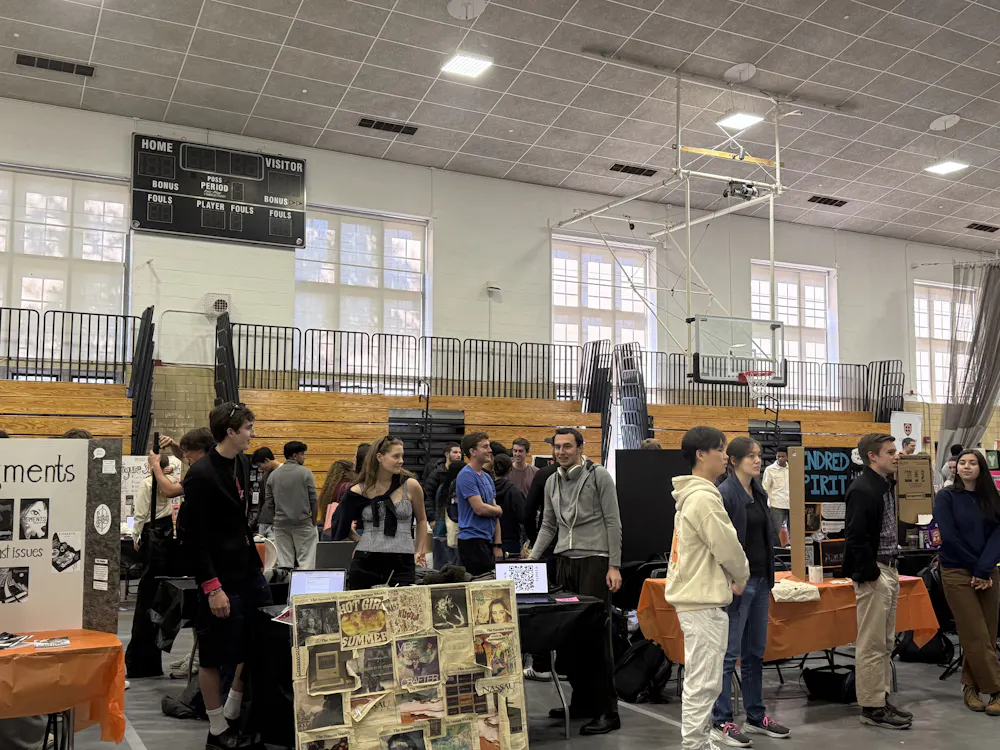
Students share mixed reactions as mandated officer and treasurer trainings return to in-person format
David EstradaThe University's student organization officers and treasurers returned to mandatory in-person training this fall after years of online sessions. Student reactions found parts of the training redundant or tedious, though most agreed the sessions were important.
The University's student organization officers and treasurers returned to mandatory in-person training this fall after years of online sessions. Student reactions found parts of the training redundant or tedious, though most agreed the sessions were important.