



Anthony Miller '04 and Michael Tibbetts '04 have been recognized nationally for outstanding academic achievement in science research at Princeton.
The seniors will be among 60 students who serve on USA TODAY all-academic teams this year. Both Miller and Tibbetts received, as a junior, a Goldwater science scholarship — awarding them $7,500 each.
Princeton is allowed to nominate four candidates for the Goldwater award. All four received it.
The University alerted members of the senior class to the existence of the USA TODAY teams by email earlier this year. Miller and Tibbetts asked advisers for recommendations and wrote essays on their most significant scholarly achievements.
Though they did not earn first-place spots on the academic teams, Miller scored a place on the second team and and Tibbetts on the third.
Miller, a physics major, has developed a technique to detect cancer and image brain activity. Applications of this development will affect medical approaches to determining whether someone has a disease and the understanding of the brain.
"I was one of those people who always took stuff apart," Miller said. He said he was interested in practical uses of quantum mechanics and "the cleverness that goes into experimental design."
He said his advice to students about physics is: "Try it. You learn a different way of thinking about the world. At least be exposed to the advantages."

In his hometown of Hopewell, N.J., 15 minutes away from the University, Miller attended public school and was able to enroll in Physics 105-6 at the University while still a high school senior.
He said this taste of Princeton and physics made him want to study here full-time. "I'd gotten to know physics majors a year above me," he said, "I didn't particularly advertise that I was a high school student."
Just four years later, Miller reflected on his undergraduate career. "I've had really fantastic experiences here," he said.
He highlighted the attention undergraduates enjoy, estimating the student-faculty ratio in the physics department as 1:3.
"I've never gone to a professor's office and had him say, 'I'm busy, I can't talk.'"
Waiting to hear from graduate schools for next year, Miller said he hopes to attend MIT. Eventually he wants to continue his career in academics.

Tibbetts, a molecular biology major from Clearwater, Fla., said he had his most significant scientific achievement working for the National Institute of Health and Immunology in Bethesda, Md., for two summers.
He published a paper on molecules in individual cells that are involved in both creating new cells and in killing cells.
On campus Tibbetts spends some of his time outside the classroom working for the Princeton Bioethics Society and Hospice, where he volunteers with terminally ill patients.
"I'm probably the only volunteer under 40," he said, adding that the experience has given him insight into the lives of his patients.
At the University, he enjoyed taking Professor John McPhee's famed literary nonfiction course because it enabled him to write science in a way understandable to laymen.
"It challenged me to write about science for a general audience," he said. The Hospice patients were one of his topics.
"I've known for a while that I want to go into medicine," he said.
Tibbetts is applying to several joint M.D./Ph.D. programs — seven to eight-year programs funded by Congress.
Though he has been accepted to several schools, he would like to attend Harvard University or the University of Pennsylvania.
"They have strong biomedical research programs," he said. He will find out where he has been accepted in the next three to four weeks.
Read More

Princeton University Orchestra and men’s ultimate frisbee team named in University’s latest hazing report
Andrew ArthurTwelve students in the Princeton University Orchestra and Men's Ultimate Frisbee team were found responsible for hazing violations in the University's latest Campus Hazing Transparency Report. Sanctions ranged from Dean's warnings to disciplinary probation.
Twelve students in the Princeton University Orchestra and Men's Ultimate Frisbee team were found responsible for hazing violations in the University's latest Campus Hazing Transparency Report. Sanctions ranged from Dean's warnings to disciplinary probation.

Murray-Dodge Café celebrates 50th Anniversary, drawing over 260 students
Hifza KaleemOn Wednesday, Murray Dodge Cafe celebrated its 50th anniversary, drawing more than 260 students to celebrate with free cookies and merchandise.
On Wednesday, Murray Dodge Cafe celebrated its 50th anniversary, drawing more than 260 students to celebrate with free cookies and merchandise.
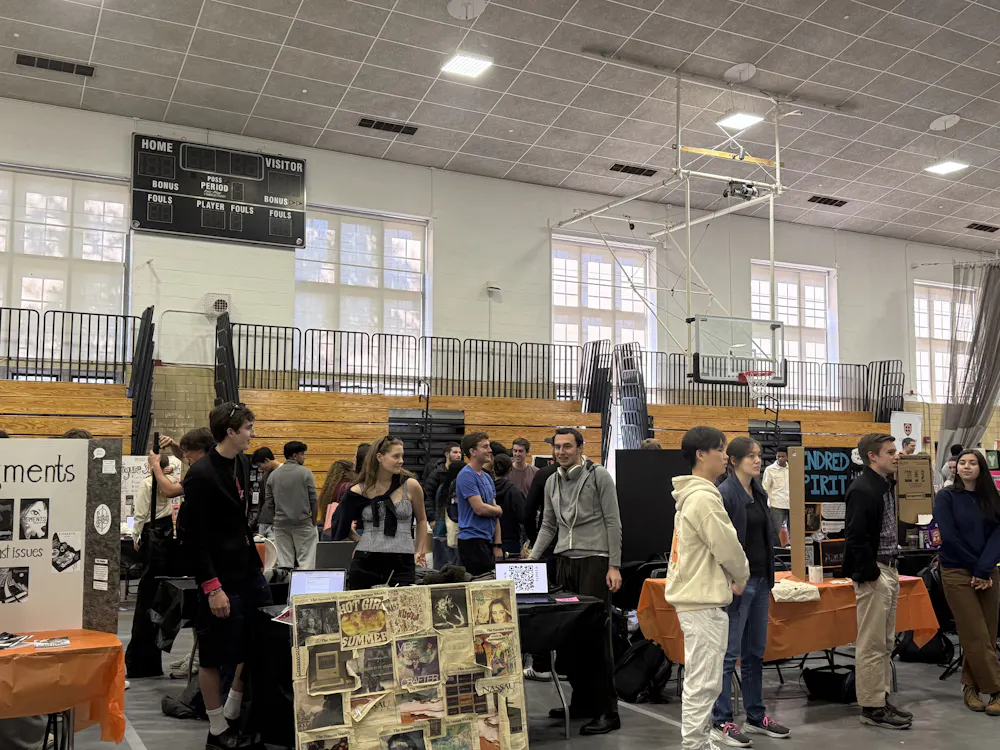
Students share mixed reactions as mandated officer and treasurer trainings return to in-person format
David EstradaThe University's student organization officers and treasurers returned to mandatory in-person training this fall after years of online sessions. Student reactions found parts of the training redundant or tedious, though most agreed the sessions were important.
The University's student organization officers and treasurers returned to mandatory in-person training this fall after years of online sessions. Student reactions found parts of the training redundant or tedious, though most agreed the sessions were important.