



For Janet Lavin Rapelye, now in her first year as dean of admissions, complacency is no way to ensure that the University continues to attract a topflight applicant pool for its undergraduate student body each year.
"We are essentially reviewing every program and strategy to see what we can do better — to see how we can reach students who might not have been thinking about Princeton," Rapelye said in an interview on Wednesday.
The University remains atop the college rankings of publications like U.S. News and The Atlantic Monthly. Yet even as increasing numbers of high school students vie for a limited number of spots at elite universities, competition among those universities for the best scholars, artists and athletes has grown fiercer than ever.
The heightened intensity of college admissions has made high school seniors something of an unpredictable entity for gatekeepers like Rapelye. Last November, within months of her appointment as dean, the University announced that early decision applications dropped by more than 20 percent relative to the previous year, while early applications at Yale and Stanford rose sharply.
Amidst such intense competition and rapid change, Rapelye said, the University operates at a disadvantage compared to its rival institutions in some areas.
Noting that there are about 30,000 high schools in the United States, and only 15 staffers in the University admissions office, Rapelye said, "We're lean. We're very lean."
The Priorities Committee chaired by Provost Amy Gutmann has approved the addition of two admissions officers next year, but, Rapelye said, "That takes us to the minimum of where we need to be."
Even with increased staffing, no admissions office could ever hope to send representatives to all of the high schools in the U.S., Rapelye said. At least one high school guidance counselor suggested, however, that the University could have trouble attracting applicants for reasons other than understaffing.
Eating club

"The eating club thing does not serve Princeton well with our students," said Steve Singer, guidance director at the Horace Mann School in Riverdale, N.Y. "This particular community is not traditionally prep school type kids, although they're very smart kids. Lots of Jewish kids, lot of Asian kids, lot of immigrant kids. The idea of an eating club just makes some people uncomfortable."
Rapelye denied that she had sought to play down the prominence of the eating clubs in the redesigned viewbook published by the admissions office last year, as some suggested.
"There was no intention of leaving the eating clubs out," she said. "We absolutely want to represent the eating clubs in the way they want to be represented."
The perceived omission of the clubs will be corrected in the next edition, Rapelye said, while also suggesting she was aware the University's historically conservative image could be a liability in attracting students.
"Reputations of schools are always about 20 or 30 years old, and we have to articulate who we are now," Rapelye said, adding that the University has become an open, diverse and tolerant place. "But if you don't tell students who you are now, they'll make it up."
Rapelye said University admissions officers each spend five or six weeks per year traveling across the country to visit high schools of various racial and economic compositions.

"We try to balance between high schools where we will get very strong applicants — that's valuable because we're competing with other schools — and high schools where reaching out will make a difference, places where people might not know about us," she said.
Like many schools, the University purchases the SAT scores of high school students from the College Board to target its mailings of promotional literature. However, the University does not purchase PSAT scores and misses out on the opportunity to contact high school students in their sophomore year.
"I would like to start sending information to sophomores," Rapelye said.
Singer said most Horace Mann students were already aware of the University, and that many would apply regardless of what the admissions office did. But he also said a University representative visits the school every year, and he singled out the quality of the University's literature. "It's superbly well-written," he said.
Humanities Symposium
Singer reserved his highest praise for the Humanities Symposium, an admissions event which draws talented high school students onto campus every year for a weekend of workshops with prominent professors.
Calling the program "absolutely unparalleled," Singer said, "what you're doing is you're showing smart kids the reality of Princeton's academic and intellectual life, and that's real recruiting."
"Every single kid from our school who has gone to that weekend has applied and gone to Princeton," he added.
In some cases, then, the efforts of Rapelye and her staff might make the difference for a student on the fence about applying to the University. But some Princetonians who have long since put the application frenzy behind them suggested that the work of the admissions office had little influence on their decision to apply to the University in the first place.
Indeed, they suggested more intangible factors were at work — like the mystique of popular culture.
"I first knew about Princeton from 'The Fresh Prince of Bel-Air,'" said Chika Anekwe '06, who attended Bunnell High School in Stratford, Conn. "For some reason I always wanted to come, even though I knew nothing about it."
Anekwe said she never received any University literature in the mail, and that an admissions officer never visited her school. Her roommate, Katherine McCulloch '06, said the same of her experience at Billings West High School in Billings, Mont.
"A very small percentage of kids from my high school went to college outside Montana," McCulloch said.
So how did she decide to apply to the University? "I was talking to one of my friends, and he said, 'You should think about applying to Princeton, because you'd like it,'" she said. "Plus, it's famous, and I thought it was beautiful when I saw A Beautiful Mind."
Read More

Princeton University Orchestra and men’s ultimate frisbee team named in University’s latest hazing report
Andrew ArthurTwelve students in the Princeton University Orchestra and Men's Ultimate Frisbee team were found responsible for hazing violations in the University's latest Campus Hazing Transparency Report. Sanctions ranged from Dean's warnings to disciplinary probation.
Twelve students in the Princeton University Orchestra and Men's Ultimate Frisbee team were found responsible for hazing violations in the University's latest Campus Hazing Transparency Report. Sanctions ranged from Dean's warnings to disciplinary probation.

Murray-Dodge Café celebrates 50th Anniversary, drawing over 260 students
Hifza KaleemOn Wednesday, Murray Dodge Cafe celebrated its 50th anniversary, drawing more than 260 students to celebrate with free cookies and merchandise.
On Wednesday, Murray Dodge Cafe celebrated its 50th anniversary, drawing more than 260 students to celebrate with free cookies and merchandise.
Students share mixed reactions as mandated officer and treasurer trainings return to in-person format
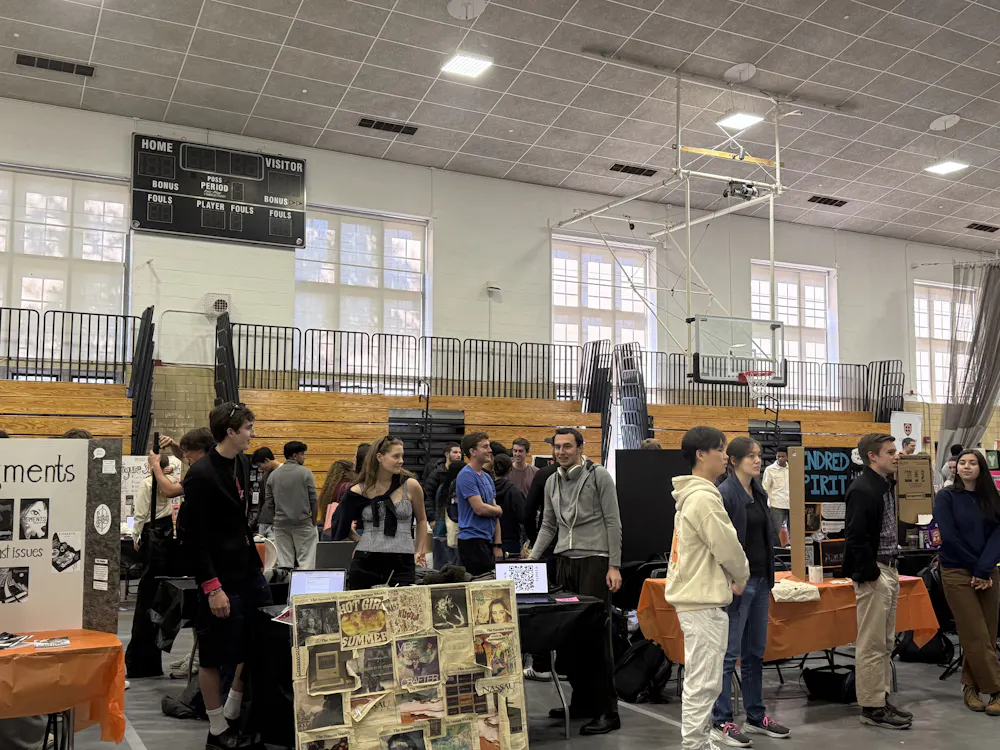
David EstradaThe University's student organization officers and treasurers returned to mandatory in-person training this fall after years of online sessions. Student reactions found parts of the training redundant or tedious, though most agreed the sessions were important.
The University's student organization officers and treasurers returned to mandatory in-person training this fall after years of online sessions. Student reactions found parts of the training redundant or tedious, though most agreed the sessions were important.