



One of the nation's top international relations scholars, Georgetown University professor John Ikenberry, has agreed to join the faculty of the Wilson School, dean Anne-Marie Slaughter '80 announced Monday.
The move comes as part of an ongoing effort to reinvigorate the school's international studies program, Slaughter said.
"Jeff Herbst, chair of the politics department, and I, are working hard to rebuild the IR [international relations] subfield," Slaughter said in an email.
The hiring of Ikenberry and of Tom Christensen, an East Asia specialist lured from MIT last year, were "important steps in that direction," Slaughter said.
Ikenberry did not respond to phone messages, but Slaughter said he would teach undergraduate courses on international relations, likely including the introductory survey course.
"I am absolutely delighted that Professor Ikenberry has accepted our offer," Slaughter said. "He brings great expertise in international political economy, international institutions, American foreign policy and U.S.-East Asia relations."
At a meeting last May, Wilson School faculty recommended Ikenberry be considered for a job offer, The Daily Princetonian reported in September 2003.
Slaughter declined to give details of the negotiation with Ikenberry, including the timing of the offer or why Ikenberry decided to leave Georgetown.

She did hint, however, that University officials will continue to move aggressively in strengthening the international relations faculty.
There is currently "an offer out to another senior professor" outside the University, Slaughter said.
The Wilson School has suffered from the departure of many of its most prominent international relations faculty in recent years. International lawyer Michael Doyle left for Columbia University, while "just war" theorist Richard Falk and foreign policy specialist Richard Ullman have retired. Ikenberry, who taught at Princeton from 1984 to 1992, is perhaps best known for his recent critiques of unilateralism in U.S. foreign policy. He has argued that the Bush administration's lack of commitment to international institutions after Sept. 11, 2001, amounts to a "neoimperial grand strategy," in which preserving U.S. domination takes precedence over maintaining coalitions with other nations.
Even before Sept. 11, Ikenberry had argued that the U.S. could better advance its interests through international organizations.
"The hegemonic state gives up some of its freedom in the use of its power in exchange for a durable and predictable order that will safeguard its interests in the future," he said in 1999.
In addition to his professorships at Georgetown, Princeton and the University of Pennsylvania, Ikenberry has held senior posts at the State Department and the Carnegie Endowment for International Peace.
Read More

Princeton University Orchestra and men’s ultimate frisbee team named in University’s latest hazing report
Andrew ArthurTwelve students in the Princeton University Orchestra and Men's Ultimate Frisbee team were found responsible for hazing violations in the University's latest Campus Hazing Transparency Report. Sanctions ranged from Dean's warnings to disciplinary probation.
Twelve students in the Princeton University Orchestra and Men's Ultimate Frisbee team were found responsible for hazing violations in the University's latest Campus Hazing Transparency Report. Sanctions ranged from Dean's warnings to disciplinary probation.

Murray-Dodge Café celebrates 50th Anniversary, drawing over 260 students
Hifza KaleemOn Wednesday, Murray Dodge Cafe celebrated its 50th anniversary, drawing more than 260 students to celebrate with free cookies and merchandise.
On Wednesday, Murray Dodge Cafe celebrated its 50th anniversary, drawing more than 260 students to celebrate with free cookies and merchandise.
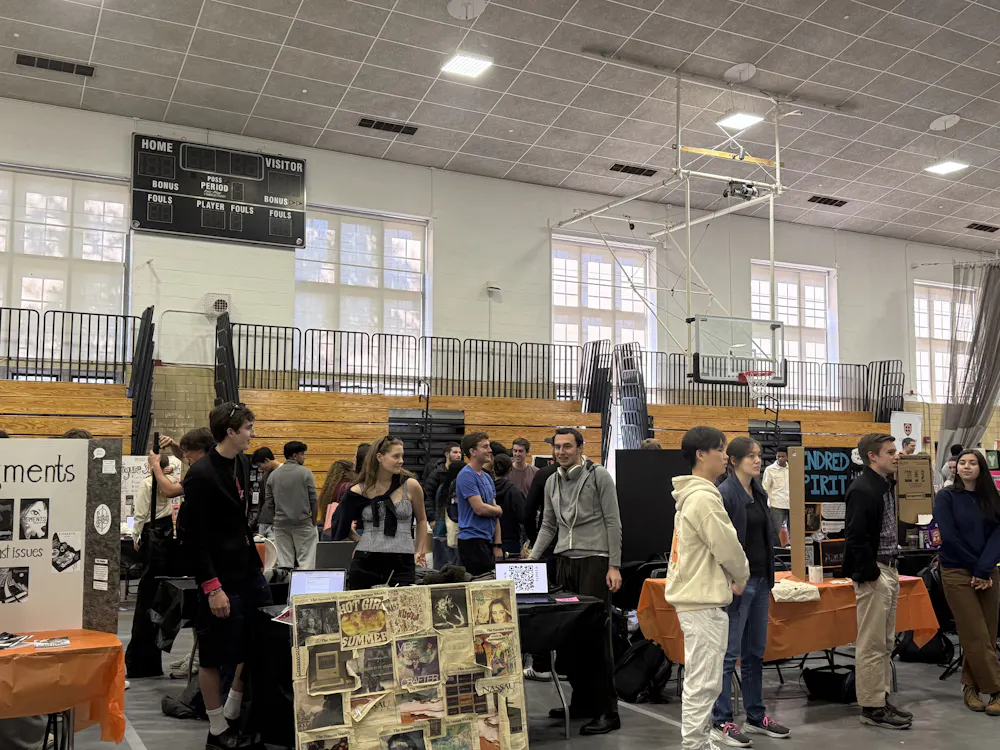
Students share mixed reactions as mandated officer and treasurer trainings return to in-person format
David EstradaThe University's student organization officers and treasurers returned to mandatory in-person training this fall after years of online sessions. Student reactions found parts of the training redundant or tedious, though most agreed the sessions were important.
The University's student organization officers and treasurers returned to mandatory in-person training this fall after years of online sessions. Student reactions found parts of the training redundant or tedious, though most agreed the sessions were important.