



Despite trying to portray a tough, if not invincible, image over the past few years, the recording industry is in trouble, and it is beginning to admit it.
It may come as a shock to those who have read about lawsuits and possible criminal penalties for copyright infringement that the recording industry should be in a vulnerable position, but last night, in the Mathey College common room, three industry executives said just that.
"We are going through a watershed . . . [a] pronounced longterm decline" in sales, said Suzanne Nossel, vice president for corporate strategy at BMG.
The music industry "has gone through changes, is going through changes and will go through changes in the future," said David Benjamin, head of anti-piracy for Universal Music Group.
Since music became widely, freely and often illegally available for download in the last few years, the industry has seen sales decline by almost 10 percent each year. Layoffs have accompanied the drop in sales with some companies staffing some offices with skeleton crews.
"If we're not careful, we risk the whole thing just collapsing," Benjamin said. "That we have to change is a given."
But the problem goes beyond piracy itself, the panelists said. The industry has seen a large change in the culture associated with music recently. In the '90s, as companies began to hype prepackaged artists and singles for the radio, artists lost touch with their fans. And, as companies cashed in on huge album sales from these one hit wonders, they began to ignore other sources of revenue including merchandise and live performances.
"We created an industry around these prefabricated artists and we created this culture of super product concentrated thought," Jeffrey Kempler, head of business and legal affairs for Island/Def Jam, said. "And when that fell apart, we went from a huge peak of selling eight or 10 million Britney Spears albums" to the current situation.

"The record business became so fat and happy with itself that it [lost interest in] those other businesses," he said. And now, it seems, they wish they had them back.
The digital revolution caught the industry off guard, forcing changes at a far more rapid pace than would have occurred otherwise. In response, the industry has tried to adapt old business models, like individual CD sales, to create new methods for online distribution.
Though the industry has tried to promote online distribution through for pay or subscription services, their efforts have been hampered by consumer distaste for restrictive copy-protection methods. These methods are seen by some as overly restrictive, forcing users to play songs only in certain players or on certain devices.
"If you acquire music in a licensed way then in an ideal world you should be able to use it as broadly as possible," Nossel said. However, she added, "we don't have, and we won't have for some time, a technological regime that will let us do that."
But consumers and the industry may be separated by more than the annoyances associated with current online systems.
Computer science graduate student John Halderman GS said the philosophical gap between the two groups is significant and frequently ignored.

Though the recording industry sees peer-to-peer applications as mere piracy tools, Halderman "brought up in the panel the idea that [peer-to-peer software] serves as a check and [exerts] a selective pressure on the entertainment industry."
Peer to peer may be "a force that is making the industry innovate instead of stagnate. [One that] limits their power to charge whatever they want" and forces them to allow fair use of music once downloaded, he said.
For the bulk of the hour-and-a-half long discussion, panelists and students discussed the theory of how the music industry could once again entice consumers to pay for their music. However, none of the panelists were entirely sure how, in practice, the industry would woo people from illegal services to legal ones.
So far, each time the Recording Industry Association of America has taken legal action against or shut down an infringing system, one or more new ones have been adopted to fill the void.
A new piece of software called MyTunes allows Microsoft Windows users to exploit a feature in Apple's iTunes program — which is the most visible legal music service available — to copy music across a local network.
What made last night's discussion so different than the information disseminated by the RIAA was the sense of desperation the industry executives seemed to show.
The online music phenomenon has "lit a massive fire under the industry," Nossel said. "It's hard to imagine what else could have occasioned so much self looking in our business."
"We know there is no silver bullet." Benjamin said. "We know we have to do lots of things at the same time. If we don't believe in our product, and don't live it and aren't willing to go put it on the line for you, then shame on us. . . . It has been my life."
Asked if he thought he could save his industry, "I have no choice but to save it," he said.
Read More

Princeton University Orchestra and men’s ultimate frisbee team named in University’s latest hazing report
Andrew ArthurTwelve students in the Princeton University Orchestra and Men's Ultimate Frisbee team were found responsible for hazing violations in the University's latest Campus Hazing Transparency Report. Sanctions ranged from Dean's warnings to disciplinary probation.
Twelve students in the Princeton University Orchestra and Men's Ultimate Frisbee team were found responsible for hazing violations in the University's latest Campus Hazing Transparency Report. Sanctions ranged from Dean's warnings to disciplinary probation.

Murray-Dodge Café celebrates 50th Anniversary, drawing over 260 students
Hifza KaleemOn Wednesday, Murray Dodge Cafe celebrated its 50th anniversary, drawing more than 260 students to celebrate with free cookies and merchandise.
On Wednesday, Murray Dodge Cafe celebrated its 50th anniversary, drawing more than 260 students to celebrate with free cookies and merchandise.
Students share mixed reactions as mandated officer and treasurer trainings return to in-person format
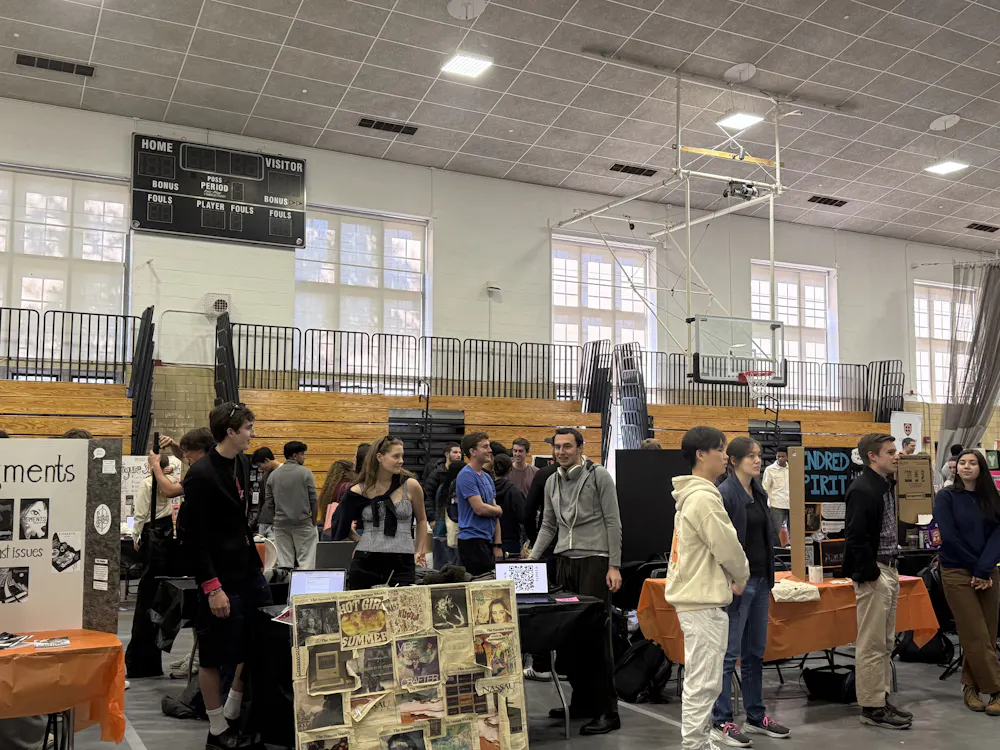
David EstradaThe University's student organization officers and treasurers returned to mandatory in-person training this fall after years of online sessions. Student reactions found parts of the training redundant or tedious, though most agreed the sessions were important.
The University's student organization officers and treasurers returned to mandatory in-person training this fall after years of online sessions. Student reactions found parts of the training redundant or tedious, though most agreed the sessions were important.