



It's a busy time right now for Matthew Gantz '87.
In September, he was named president and CEO of Hydra Biosciences, a young company that is pioneering the field of regenerative medicine. On Oct. 30, his wife gave birth to their second child, and next month his family will move into a new house.
Everything seems to be falling into place for Gantz, who has always dreamed of running his own company, and he attributed much of that success to his time at the University.
"Princeton has played a major role in providing me with the confidence to get to where I am today," he said. "It exposed me to new ways of thinking, encouraged me to ask questions and not be afraid, and it's also given me a network and opened up doors that would not have been open to me if I had made other choices."
His decision to attend Princeton, like many others in Gantz's life, mirrored that of his father, Wilbur Gantz '59.
Wilbur Gantz, now a University trustee, is the former president of the healthcare company Baxter International and current CEO of Ovation Pharmaceuticals.
Matthew Gantz recalled hearing about the University at a young age from his father's stories. He was never pushed to follow in his father's footsteps but "always kind of knew" that he wanted to go.
Still, Gantz was not fully prepared for what to expect when he arrived in 1983. Getting his first exam back was something of a shock, he recalled.

"I realized I was competing against best and brightest people not only from the United States, but around the world," he said. "I had to dig down and work harder to compete in a global environment."
Gantz started out taking courses to fulfill premed requirements but quickly realized that using Bunsen burners and conducting experiments was not for him.
"I'm much more of a people person than I am a budding scientist," he said.
Long fascinated by the history of war and the role of great leaders in shaping the world, Gantz became a history major.
He took courses in subjects ranging from Soviet politics to economics to art history and remembers with particular fondness James McPherson's civil war course.
"I took advantage of what Princeton had to offer," Gantz said. "I probably could have worked harder, but Princeton teaches you how to work hard and also how to have fun and get to know your classmates and your professors."

Despite having abandoned the idea of becoming a doctor, Gantz was still interested in the healthcare industry. But he knew that he could always go back to school later for a preprofessional degree if he needed it.
"College was a time to dabble in different areas and keep the door open," he said.
Gantz was particularly attracted to the concept of a liberal arts education, believing that the exposure to multiple disciplines teaches students how to think and ask questions.
This skill is particularly useful in today's world, in which people have to "sift through all the extraneous info that we end up seeing come our way," he noted.
But Gantz, who played basketball and rowed crew at Princeton, said that one of the greatest lessons he learned in college was the concept of striving for balance in life.
"Academics are very important, but Princeton places a high premium on students who aren't just bookworms — who are willing and able to do different things," he said.
After graduating, Gantz decided to follow Princeton's motto of "in the nation's service" by joining the Marine Corps.
"That for me was one way to give back," Gantz explained. "I'd been very fortunate and blessed. My parents had done well. This country has been great to me."
He also knew that many in the business world attributed their success to lessons learned while serving in the military, and his father had been a reservist during the Bay of Pigs crisis.
In October 1987, after spending the four months after graduation touring Europe with friends, Gantz started boot camp. The environment there was quite different from the positive reinforcement he was used to in college.
"As a candidate, you're halfway between subhuman and worm," he said.
Gantz found that his background and education gave him no advantage in the egalitarian military world.
"None of that amounts to anything," he said. "Just because you come from Princeton doesn't make a difference to a drill officer."
When the Gulf War began, Gantz, who was supposed to meet his family for a vacation in Italy, instead took a flight to Saudi Arabia. As a company commander, he led his battalion into Kuwait City. The successful campaign was over in a matter of months.
Meanwhile, Gantz had been thinking about life after the Marine Corps, and he decided that he wanted to go to business school.
"I tell my buddies that in my application, I put a little blood and poured some sand," he said.
In April 1991, he left the Marine Corps to pursue an MBA at Harvard University, where his father had also earned his degree decades earlier.
Gantz then joined Abbott Laboratories, a large pharmaceutical company, and quickly rose through the ranks.
When his father decided to start a new company called PathoGenesis in 1996, Gantz signed on. He was drawn to the tangible promise of improving people's lives that working in the health care industry offered.
Pathogenesis, for example, manufactured an inhaled antibiotic that enabled people with cystic fibrosis to breathe better.
"Parents come up to you and thank you for what you've done," Gantz said. "There's nothing better than that — knowing that you had a hand in helping their children or family members overcome an ailment."
Gantz was sent to Europe —"with a suitcase and a blank piece of paper," he said – to establish PathoGenesis abroad.
When PathoGenesis was acquired by Chiron Corporation, he took over the European division of that company and helped build a 250-person, $110-million business.
During his time in London, Gantz met his wife. They had a daughter, Josephine, now three. But after six years abroad, Gantz was ready to bring his family back home.
In September 2003, he accepted the position of president and CEO of Hydra Biosciences. Founded in 2001 by three renowned scientists, the company is focusing its research on using the body's mature cells to regenerate damaged tissue or muscle.
Scientists are currently studying the process of regeneration in zebrafish, which can repair damaged heart muscle, in hopes of developing a way to reduce scarring of the human heart after heart attacks.
"If you could regrow the heart and other parts of the body, just think what that could do in terms of advances in medicine," Gantz said. "We have the people that can make that a reality. We're not talking science fiction here — this is real medicine."
And people are taking notice. Hydra, which was featured in a September New York Times article about regeneration, secured $9.3 million in its first round of funding last year.
The company's other research includes treatment for cardiovascular disease and the development of a non-hormonal contraceptive that would inhibit the ability of the sperm to fertilize an egg.
Gantz intends to keep Hydra on the cutting edge of medical research. "I want to make sure we're one step ahead," he said. "I want us to be the best at it."
As CEO, his day-today functions include running meetings with Hydra's board, talking with CEOs of other companies, presenting to investors — "a thankless job at times, but very important" — as well as keeping up with current scientific developments.
In October, Hydra signed a two-year research collaboration with Abbott Laboratories. But Gantz envisions developing the company to a stage where it can independently run clinical trials and put products on the market.
Gantz, who puts in 12-hour days and frequently comes in on weekends, knows that will take hard work. But he also emphasized the importance of striking a balance between career and family. As he guides Hydra towards greater success, Gantz hopes he will also have more time to spend at home.
"I want my children to feel the same way about me that I feel about my father," he said.
Read More

Princeton University Orchestra and men’s ultimate frisbee team named in University’s latest hazing report
Andrew ArthurTwelve students in the Princeton University Orchestra and Men's Ultimate Frisbee team were found responsible for hazing violations in the University's latest Campus Hazing Transparency Report. Sanctions ranged from Dean's warnings to disciplinary probation.
Twelve students in the Princeton University Orchestra and Men's Ultimate Frisbee team were found responsible for hazing violations in the University's latest Campus Hazing Transparency Report. Sanctions ranged from Dean's warnings to disciplinary probation.

Murray-Dodge Café celebrates 50th Anniversary, drawing over 260 students
Hifza KaleemOn Wednesday, Murray Dodge Cafe celebrated its 50th anniversary, drawing more than 260 students to celebrate with free cookies and merchandise.
On Wednesday, Murray Dodge Cafe celebrated its 50th anniversary, drawing more than 260 students to celebrate with free cookies and merchandise.
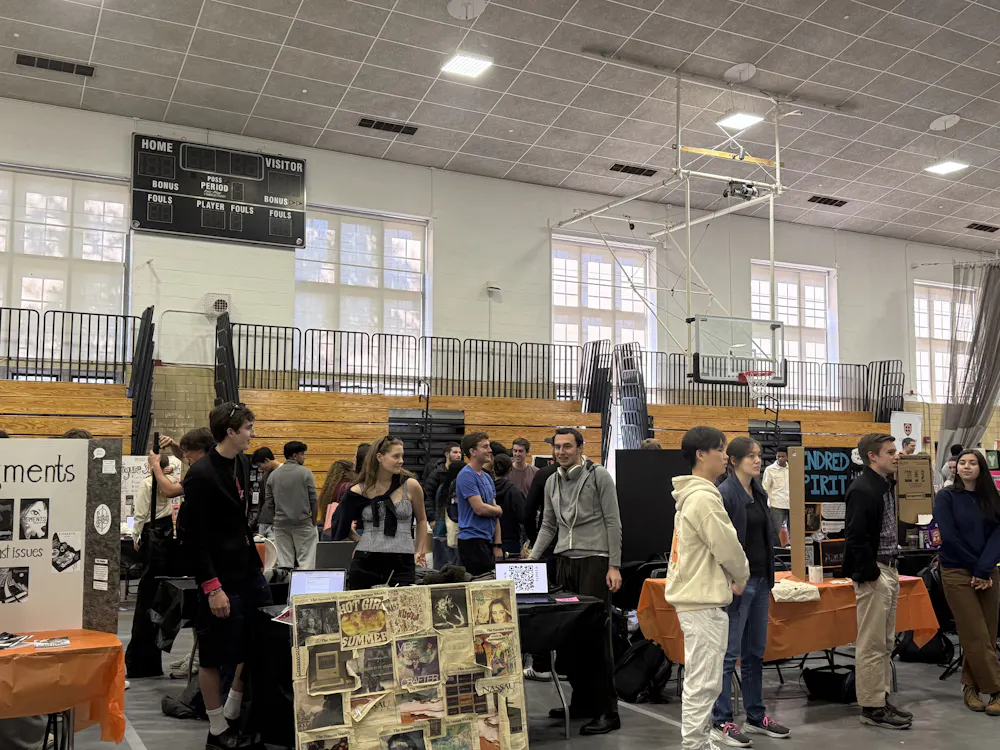
Students share mixed reactions as mandated officer and treasurer trainings return to in-person format
David EstradaThe University's student organization officers and treasurers returned to mandatory in-person training this fall after years of online sessions. Student reactions found parts of the training redundant or tedious, though most agreed the sessions were important.
The University's student organization officers and treasurers returned to mandatory in-person training this fall after years of online sessions. Student reactions found parts of the training redundant or tedious, though most agreed the sessions were important.