



When thinking about history, one usually thinks about distant places and foreign circumstances, but a lunchtime discussion yesterday highlighted the rich cultural history closer to home — within the John Witherspoon community, a historically African-American neighborhood in Princeton.
Part of the Voices program sponsored by the Student Volunteers Council, the discussion, "The John Witherspoon Community and Princeton," gave two residents of the neighborhood the opportunity to share their own memories and experiences with fellow Princetonians.
Albert Hinds, who has lived in the Witherspoon neighborhood for almost all of his 101 years, and Shirley Satterfield, a fifth-generation Princeton resident, displayed slides and photos. They shared stories from the neighborhood dating from its formation in 1930 to the present day.
The speakers were introduced by Jessica Lautin '03, who became friends with both Hinds and Satterfield while writing her senior thesis about the neighborhood. Lautin explained how much the neighborhood has meant to her and how greatly her experience at the University was enriched by "stepping out of the gates," not into a foreign country but a few blocks down Nassau Street into the Witherspoon community.
Satterfield — who recently retired from her position as a guidance counselor at Princeton High School—presented a slide show with photographs of historic buildings, both past and present.
"It's important that you know how the community used to exist and why it's an important part of our history," she told the group of University students and local residents who attended the talk.
The neighborhood began when the African-American community was displaced from its original location on Baker Street in order for Palmer Square to be built in its place, she said. Focusing on religious life, education and social life, she showed pictures of churches, schools, shops and gathering places, many of which have changed functions multiple times through the years.
Adding commentary to the photos, she told how Witherspoon Presbyterian hosted many speakers pushing for civil rights earlier in the century and how it is rumored to have been a stop on the Underground Railroad. Another building, opened by Betsy Stockton as a school in 1968, has since been a YMCA, a laundromat, a dance hall, a movie house, a church, a rooming house and apartments.

The Witherspoon community's most famous resident was Paul Robeson, a renowned actor, singer, athlete and political activist. Robeson, the son of a minister, spent his childhood in the Witherspoon neighborhood in the early 1900s before going on to star on the stage and fight apartheid.
Hinds, widely acknowledged as the neighborhood's most knowledgable, frequently interjected his personal experiences into the discussion. Demonstrating his remarkable memory, he rattled off dates and names and had a story for almost every picture. Having grown up with the community, Hinds, who was a star for the Princeton High School football team and is the school's oldest living alumnus, has known most of the residents and been to most of its places.
Hinds contrasted the community's past, in which segregation was the norm and Witherspoon residents were told that the University did not admit African-Americans, with the present, saying that the changes that have been made are "gratifying."
Both speakers noted that there is still progress to be made, however. Rising prices and rents are driving many African-Americans out of their homes.
Witherspoon resident Hendricks Davis, who attended the talk, emphasized that economic conditions still are not stable in the community and encouraged University students to get involved.
Davis, who is executive director of the Princeton-Blairstown Center, added that there are remaining problems junior papers and senior theses could investigate. "Why are the conditions so intractable?" he asked the group.

The discussion underscored the cultural richness of the Witherspoon neighborhood and its links to the town and University. A large portion of the neighborhood worked at the University earlier in the century as servants, and many buildings and organizations in Princeton have their roots in the Witherspoon community.
Elisa Minoff '04, who organized the discussion, said Lautin's senior thesis inspired the decision to ask the residents to speak. Minoff said the goal of the program is to raise awareness on campus about issues students feel are important.
"We've always tried to bring people from the Princeton community to Princeton to speak," she said.
Teaching students about the neighborhood, through Hinds' and Satterfield's presentation and Lautin's thesis research, ensure that its history will not be forgotten.
Read More

Princeton University Orchestra and men’s ultimate frisbee team named in University’s latest hazing report
Andrew ArthurTwelve students in the Princeton University Orchestra and Men's Ultimate Frisbee team were found responsible for hazing violations in the University's latest Campus Hazing Transparency Report. Sanctions ranged from Dean's warnings to disciplinary probation.
Twelve students in the Princeton University Orchestra and Men's Ultimate Frisbee team were found responsible for hazing violations in the University's latest Campus Hazing Transparency Report. Sanctions ranged from Dean's warnings to disciplinary probation.

Murray-Dodge Café celebrates 50th Anniversary, drawing over 260 students
Hifza KaleemOn Wednesday, Murray Dodge Cafe celebrated its 50th anniversary, drawing more than 260 students to celebrate with free cookies and merchandise.
On Wednesday, Murray Dodge Cafe celebrated its 50th anniversary, drawing more than 260 students to celebrate with free cookies and merchandise.
Students share mixed reactions as mandated officer and treasurer trainings return to in-person format
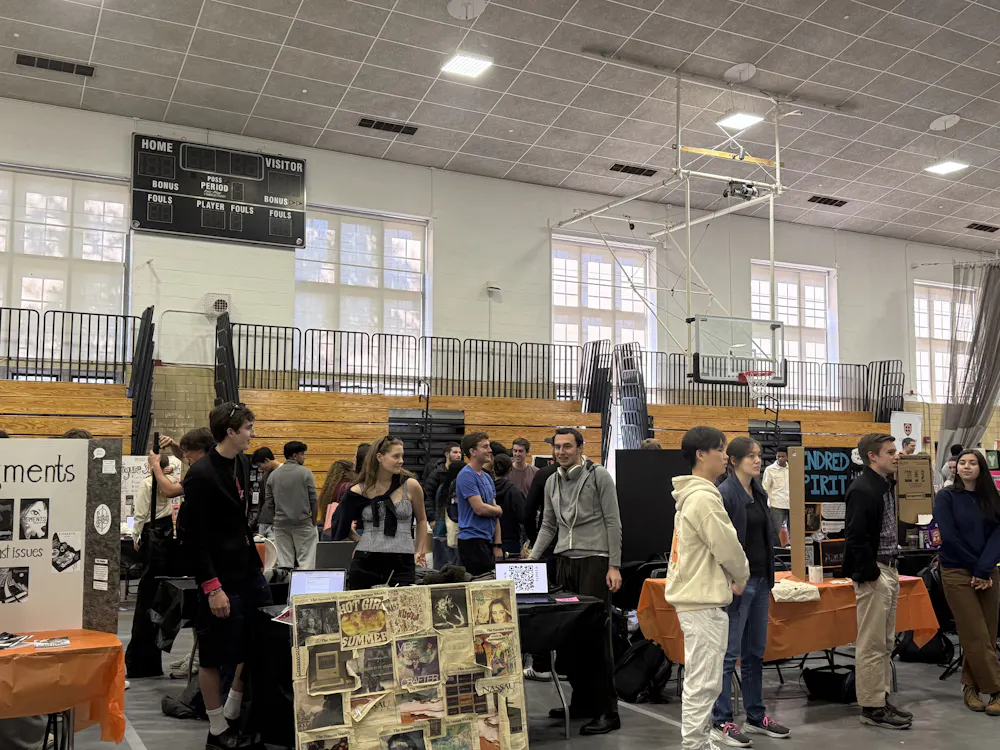
David EstradaThe University's student organization officers and treasurers returned to mandatory in-person training this fall after years of online sessions. Student reactions found parts of the training redundant or tedious, though most agreed the sessions were important.
The University's student organization officers and treasurers returned to mandatory in-person training this fall after years of online sessions. Student reactions found parts of the training redundant or tedious, though most agreed the sessions were important.