



In three years, a new science library building designed by Frank Gehry will grace Princeton's campus with bold curves and organic, non-rectangular shapes finished in titanium and glass.
A $60 million gift from Peter Lewis '55 will fund the construction of the building, which is to be located at the corner of Ivy Lane and Washington Road and on the field between Fine and Peyton Halls.
Lewis' 2000 donation of $55 million helped establish the Lewis-Sigler Institute for Integrative Genomics.
Robert Barnett, assistant director of Physical planning and project manager for the new building, has worked closely with his physical planning team and local construction group, Los Angeles-based firm Gehry Partners, LLP. in the two-year old project.
Form and function
The building's architecture aims to reflect Princeton's sense of freedom and an open society. Its function involves serving students and faculty working on projects that cross scientific fields, providing facilities that incorporate revolutionary changes in scholarly publishing. And, it aims to meet the needs of students far better than the current patchwork of small, discipline-specific libraries where seating tends to be tight and tucked away in corners.
The library will occupy almost half of the total building space of 85,000 square feet, while classrooms, academic technological services, study and public spaces and a cafe will make up the rest, Barnett said.
Bowl-type classrooms, an electronics-equipped classroom and several seminar and study rooms will not only provide more educational resources for faculty and students but also "account for the future increase in Princeton's study body due to Whitman College," said Barnett.
Furthermore, the science library will provide OIT with more lab and work space and an increased oversight of media services.

The Princeton Institute for Computational Science and Engineering will have research space and a visualization lab in which the research group plans on experimenting with 3-D visualization data, display walls and networking a super computer.
Bringing facilities together
Assistant project manager Henry Thomas explained, "The intention is to foster open accessibility and service of the new facilities to students, faculty and graduate students."
The biology and chemistry branch libraries, as well as the Geosciences Digital Mapping Center and Geospatial Information Center in Guyot Hall, will be incorporated into the new science library, and their current spaces will be used for other purposes still to be determined by Physical Planning.
President Tilghman, who flew to Santa Monica to meet Gehry in the initial stages of the project, said in an issue of PWB, "The University needs a new science library to integrate the multiple science libraries that are now scattered among different buildings and departments and prevent the replication of expensive services."
Barnett and Thomas hope for the library to become for the natural sciences what Firestone is to humanities.
"The design and layout is very complex, but the function will be extremely interactive and synergistic," Thomas said.

The building connects underground to Fine, and students can walk directly from Fine's basement level math and science library to the new science library.
"With three ground-level site entrances and one entrance from Fine, the goal is to create a building as permeable as Frist," Barnett said.
Elements of design
Three major materials — brick, metal, and glass — will be used in the building's construction.
"Gehry's intention is to use different materials on different fragments to tie together with the composition of nearby buildings," Barnett said.
For example, bottom brick elements of the building will resemble the brick in Fine tower. The building highlights the contrast between heavy masonry and light metal by filling space with glass and allowing light into the building. Barnett added, "The building tries to optimize the scale relationship of small, large and massive surrounding structures."
The low-scaled middle portion of the building corresponds with the size of the Center for Jewish Life, and the five-story tower corresponds with Fine tower.
Filling space
Due to the University's extensive construction projects, many students are concerned about the library's impact on the presence of green space on campus.
The Undergraduate Life Committee has even drawn up a resolution requesting the administration to cease further construction on Poe Field.
However, the building leaves a significant area of the site green, especially the northwest corner at the intersection of Washington Road and Ivy Lane. Barnett said that additional trees and vegetation will be planted bordering the building.
In addition, the crowds of students who walk across the field every day to Fine, McDonnell or Jadwin will be allowed to pass through the science building. Thus, the building preserves the value of an open site and is structured as a crossroads, not a monolithic barrier.
The selection of Gehry as architect is no coincidence. Lewis — who also chairs the Solomon R. Guggenheim Museum Board of Trustees — worked with Gehry on a building at Case Western Reserve University.
Gehry, one of the most prominent practicing avant-garde architects, has received wide acclaim for his design of the Guggenheim museum in Bilbao, Spain, which opened in 1997. He recently worked on an addition to the Corcoran Gallery of Art in Washington, D.C.
The University project is on schedule, with a 25-month construction process set to begin in September 2004 and conclude in October 2006. The Department of Physical Planning conducts work sessions and presentations both in California and Princeton.
Thomas added, "This unique and exciting project is made possible by an impressive team from Princeton and architectural consultants."
Though Gehry's designs are not without their critics, the project has been extremely well-received and encouraged by trustees, user groups, faculty and administration.
Read More

Princeton University Orchestra and men’s ultimate frisbee team named in University’s latest hazing report
Andrew ArthurTwelve students in the Princeton University Orchestra and Men's Ultimate Frisbee team were found responsible for hazing violations in the University's latest Campus Hazing Transparency Report. Sanctions ranged from Dean's warnings to disciplinary probation.
Twelve students in the Princeton University Orchestra and Men's Ultimate Frisbee team were found responsible for hazing violations in the University's latest Campus Hazing Transparency Report. Sanctions ranged from Dean's warnings to disciplinary probation.

Murray-Dodge Café celebrates 50th Anniversary, drawing over 260 students
Hifza KaleemOn Wednesday, Murray Dodge Cafe celebrated its 50th anniversary, drawing more than 260 students to celebrate with free cookies and merchandise.
On Wednesday, Murray Dodge Cafe celebrated its 50th anniversary, drawing more than 260 students to celebrate with free cookies and merchandise.
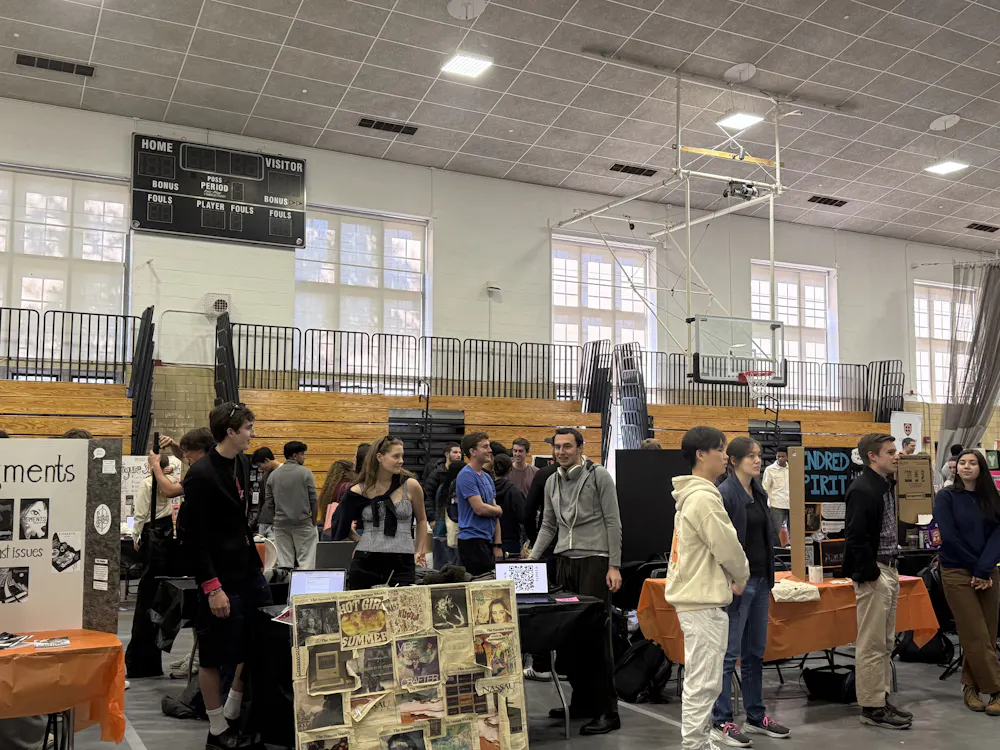
Students share mixed reactions as mandated officer and treasurer trainings return to in-person format
David EstradaThe University's student organization officers and treasurers returned to mandatory in-person training this fall after years of online sessions. Student reactions found parts of the training redundant or tedious, though most agreed the sessions were important.
The University's student organization officers and treasurers returned to mandatory in-person training this fall after years of online sessions. Student reactions found parts of the training redundant or tedious, though most agreed the sessions were important.