



To the pleasure of some and the dismay of others, a part of campus lacking in "spires and gargoyles" will get a completely new face by 2009.
University administrators are planning to replace the brown-brick 1922, 1940, 1941, 1942 and Lourie-Love buildings in Butler College, said Vice President and Secretary Thomas Wright '62.
The remaining Butler dorms, Walker and 1915, will not be affected.
The University will be starting a new residential college system in 2006 — as the first wave of the student-body increase begins — in which Wilson, Rocky and Forbes will be two-year colleges paired with the future four-year colleges Butler, Mathey and planned Whitman.
By 2006, Mathey and Whitman colleges will begin admitting juniors and seniors into rooms, but Butler will not be ready by then, said Wright, a member of the implementing committee.
The delay, the result of razing and replacing Butler buildings, will last until at least 2008, at which point Butler will begin as a four-year college.
During Butler's reconstruction, students will live in the "ellipse dormitory" — so named because it continues the ellipse curve formed by Scully Hall and the genomics building — currently under construction near Poe Field, Wright said.
The ellipse dorm will initially house upperclassmen but will ultimately be part of the residential college system.

Butler's revamping is still in its nascent stages.
"We're just now beginning the process of choosing architects" who will create the designs, Wright said.
Yet Butler residents are already welcoming the prospect of their college's transformation.
Asked what should be done about the brown Butler buildings, resident Matt Sullivan '06 stated his feelings: "They should definitely go."
When he first saw the buildings, Sullivan said he "was astonished that there were buildings that looked like that here [on campus]."
When she first learned what her residential college looked like, Jin Kim '07, another Butlerite, was stunned. "I was like, wait . . . I didn't see this on the tour," she said.

"I thought I was getting arches," Kim said.
Still, Kim, who said she at least appreciates Butler's location, the people and her suite, has become accustomed to the brick walls and waffle ceilings, two of Butler's distinct features.
"Butler will be quite a different college" after reconstruction, said Wright.
The plans for Butler's new look should be ready by April, he added.
Though the University is seeking financial donations to support the revamping, it also plans to draw from existing funds. Wright said the costs to renovate and completely replace the Butler buildings were nearly equivalent.
Wright, whose son is a Butler alumnus, expressed his hope that there will be nicer "vistas" in the Butler part of campus that will help it seem similar to the rest of the University. New courtyards and eating areas may be incorporated into the reconstruction.
Another possible addition is an underground connection to the Butler-Wilson cafeteria, which in the future will share a food-serving area. That way, students can get to the cafeteria in their slippers, Wright said.
Maybe Butler will always bear that ever-embellishing sobriquet, the "Butt," among University students. But, perhaps once the future architectural plans are realized, Butler will be just as nice as any other side of (Princeton) paradise.
Read More

Princeton University Orchestra and men’s ultimate frisbee team named in University’s latest hazing report
Andrew ArthurTwelve students in the Princeton University Orchestra and Men's Ultimate Frisbee team were found responsible for hazing violations in the University's latest Campus Hazing Transparency Report. Sanctions ranged from Dean's warnings to disciplinary probation.
Twelve students in the Princeton University Orchestra and Men's Ultimate Frisbee team were found responsible for hazing violations in the University's latest Campus Hazing Transparency Report. Sanctions ranged from Dean's warnings to disciplinary probation.

Murray-Dodge Café celebrates 50th Anniversary, drawing over 260 students
Hifza KaleemOn Wednesday, Murray Dodge Cafe celebrated its 50th anniversary, drawing more than 260 students to celebrate with free cookies and merchandise.
On Wednesday, Murray Dodge Cafe celebrated its 50th anniversary, drawing more than 260 students to celebrate with free cookies and merchandise.
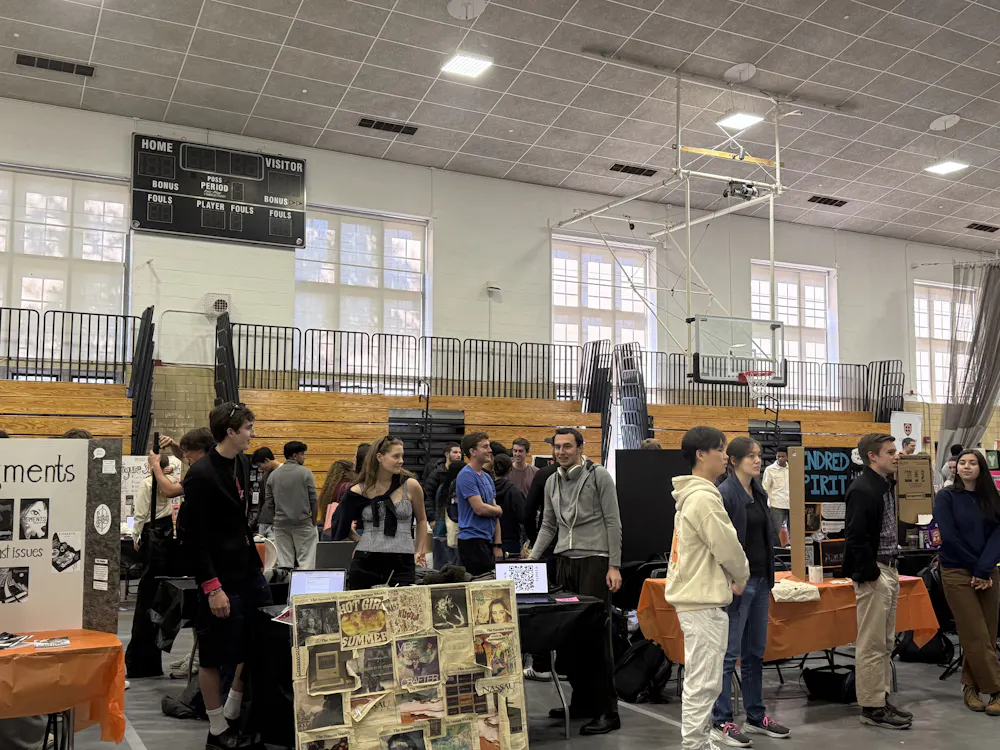
Students share mixed reactions as mandated officer and treasurer trainings return to in-person format
David EstradaThe University's student organization officers and treasurers returned to mandatory in-person training this fall after years of online sessions. Student reactions found parts of the training redundant or tedious, though most agreed the sessions were important.
The University's student organization officers and treasurers returned to mandatory in-person training this fall after years of online sessions. Student reactions found parts of the training redundant or tedious, though most agreed the sessions were important.