



Paula Chow is the director of the University's International Center, which is a part of the Office of the Dean of Undergraduate Students.
'Prince' reporter Alexander Maugeri interviewed Chow yesterday in her office — a colorfully decorated room adorned with Asian writing, tapestries and art from various countries. A nameplate on her desk indicates how immersed she is in global culture: It is translated into Hebrew and Heiroglyphics.
'Prince': What is your educational and childhood background and how have any experiences fostered an interest in the International Center?
Chow: I grew up in Shanghai, China, so I came to the U.S. as a 17-year-old international student attending a Jesuit college in Madison, Wis. I got my graduate degree in social services . . . with the intention of going back to China.
Then the political situation changed and we decided that we could not go back. But, when we moved to Princeton I was a full time mom . . . I became involved with the University through my husband who was an economics professor.
I was an international student myself and was helped from ground zero. I remember the first night . . . I cried all night long. I missed my family, I had to speak a foreign language . . . and I couldn't help it, the tears just came down. But, the nuns were so nice. They were the ones who provided the first support. These experiences gave me the basis to think of internationalism in a more universal way.
P: What is the mission of the International Center and its goals while you've been director?
C: We consider our mission twofold: One is to, with the [1,000] newly arrived students, including graduate and undergraduate, as well as faculty and their families . . ., help them adjust to a new place and new culture.

The second mission, which I feel is really necessary, is for [the University] to take part in the rich cultural resources that all our visiting students have brought to us. We must through programming make them available to the rest of the campus.
P: How long have you been director of the International Center?
C: The idea came to a group of us in 1974 when we were only helping a group of about 300 students. We realized that instead of using various classrooms and locations we needed to have a fixed place to serve them. So administration gave us a room and we moved from one room to another for four years.
Then in 1978, I took the initiative to talk to the president, William Bowen, and he gave us an office. I am now the director, have a halftime office assistant and a couple of part-time work study students, but the effort is still mostly volunteer.
P: What are the challenges for international students in general and post-9/11?
C: You have to be able to present your perspective without showing you are unfriendly. I don't think you can be totally agreeable, in agreement, with your host culture. The atmosphere is such that students with distinct religious backgrounds feel they are being watched over, or targeted. They are beginning to think there is a big brother. There is a feeling that they have to be watchful and very careful with what they say so that they will not be misinterpreted.

P: What resources and programs has the International Center instituted to deal with such concerns?
C: The day after 9/11 our students had a meeting and we concluded it was necessary to have an open faculty forum. We needed to transform fear and hatred into useful dialog, that there are other ways to deal with injustice in the world.
Amazing, students came out with real statements: Some expressed anger and others with their conviction, but really a sense of confusion. For a year Frist Campus Center had a nine-by-nine bulletin board posting news and reactions from . . . the Middle East, Europe, America and other parts of the world.
Then after we stopped, the next year Iraq: So we did that again.
P: Overall, how important would you judge the center's work?
A: I think it is important for all students to be aware of international affairs, to be aware of the mindsets of people who are very different from themselves. Not just for international students, but I feel very strongly, as a naturalized citizen, that America only becomes so strong because of many generations and the exchange of ideas. The international students really supplement the newly arrived Americans and contribute to a bi-cultural understanding. I believe, this will strengthen America in its world position and help foreign relations.
Read More

Princeton University Orchestra and men’s ultimate frisbee team named in University’s latest hazing report
Andrew ArthurTwelve students in the Princeton University Orchestra and Men's Ultimate Frisbee team were found responsible for hazing violations in the University's latest Campus Hazing Transparency Report. Sanctions ranged from Dean's warnings to disciplinary probation.
Twelve students in the Princeton University Orchestra and Men's Ultimate Frisbee team were found responsible for hazing violations in the University's latest Campus Hazing Transparency Report. Sanctions ranged from Dean's warnings to disciplinary probation.

Murray-Dodge Café celebrates 50th Anniversary, drawing over 260 students
Hifza KaleemOn Wednesday, Murray Dodge Cafe celebrated its 50th anniversary, drawing more than 260 students to celebrate with free cookies and merchandise.
On Wednesday, Murray Dodge Cafe celebrated its 50th anniversary, drawing more than 260 students to celebrate with free cookies and merchandise.
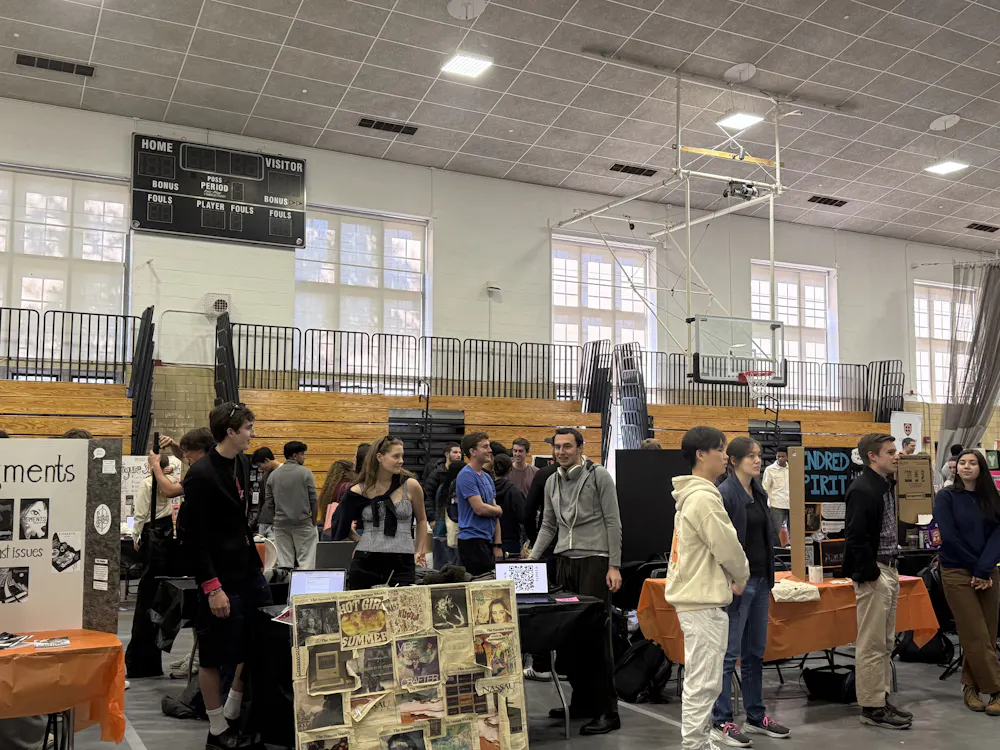
Students share mixed reactions as mandated officer and treasurer trainings return to in-person format
David EstradaThe University's student organization officers and treasurers returned to mandatory in-person training this fall after years of online sessions. Student reactions found parts of the training redundant or tedious, though most agreed the sessions were important.
The University's student organization officers and treasurers returned to mandatory in-person training this fall after years of online sessions. Student reactions found parts of the training redundant or tedious, though most agreed the sessions were important.