



"We are changing the culture here at Princeton, but we know that it does not change quickly."
Maria Klawe, the dean of the engineering school, sits on a couch in the E-Quad foyer, a look of concentration momentarily replacing her energetic smile. Klawe, who took over as School of Engineering and Applied Science dean last January, is the first woman to hold the position. The message she is sending is simple yet forceful: Science and engineering are no longer the sole preserve of men.
Throughout the country, women are making important gains in academia, gains that are also reflected at Princeton. The percent of female faculty in the natural sciences and engineering grew from 8.4 percent in 1992 to 13.9 percent in 2002, a University task force reported in September.
Despite the growth, however, rumblings of dissatisfaction are still heard among women faculty in these areas throughout the University. The task force's report showed that women rate their departments as less collegial than their male colleagues, and they express less satisfaction with their jobs.
"This dissatisfaction is something that has been found at other places, not just Princeton," said Joan Girgus, a psychology professor, former dean of the college and task force member who Tilghman recently appointed to the position of special assistant to the dean of the faculty to oversee gender equity.
Girgus is working with departmental leaders to develop a strategy to deal with faculty dissatisfaction.
"One of my colleagues likens it to death by a thousand paper cuts," she said. "The problem is all of the small difficulties that accumulate for women. No slight is very large so women begin to think that the kinds of difficulties that they are having are due to the fact that they are grad students or associate faculty, not because they are women."
Change is still slow in coming, not just at Princeton but across the country.

If you attend a meeting of one of the science or engineering departments at the University, you are likely to see a room full of male faces interrupted only by a few scattered sightings of women. In fact, women still comprise only 10 percent of the faculty in the engineering and physical sciences and 27 percent in the life sciences.
And while the number of female faculty grew by more than five percent in the last 10 years, growth was uneven between departments. The percentage of female faculty in chemistry, computer science, geosciences and molecular biology was significantly less than the percentage of women in that field earning Ph.D.'s.
Yet this is not the world of 30 years ago, when the women's rights movement was just beginning to change conditions for working women. Talented women are some of the most sought-after candidates for positions at research universities like Princeton, and the number of female undergraduates getting in line for these increasing opportunities is growing as well.
In 2000, women earned 18 percent of the engineering degrees, 40 percent of the physical sciences degrees and 47 percent of the degrees in mathematics at the undergraduate level, according to the National Center for Education Statistics.
The number of women declines, however, at the graduate level and still further at the level of assistant professor, a phenomenon that is commonly referred to as the "leaky pipe."
Though the reasons for the leaky pipe are unclear, many women attribute the phenomenon to a number of challenges that are especially pressing for women, particularly childrearing and family responsibilities, said Virginia Zakian, a professor in the molecular biology department and the task force chair.

Women often bear a larger share of child rearing responsibilities than their male colleagues, responsibilities that generally coincide with the crucial career-building years prior to tenure, she said.
A study cited by the task force report said women faculty — particularly in the sciences — who have a child within five years of earning their Ph.D.'s are much less likely to receive tenure than women who wait to have children.
"It's very frustrating to think that starting a family can have an impact on your career success," said Margaret Martonosi, a professor in electrical engineering. "Nationally, pre-tenure time coincides with the time you are having kids, and a lot of grad students are concerned that if they want to have a family then academia may not be right for them."
While the University does provide a tenure extension and workload relief for new parents, affordable and convenient day care is still in short supply.
Two University affiliated daycare centers, U-Now and University League, operate in the area but some faculty members told the task force that space limitations and hours of coverage are not sufficient to help them balance family and career obligations.
"If we want to attract more women, we first have to be a model employer for allowing all employees to have the opportunity to have a family," President Tilghman said. "This includes more affordable day care and being sensitive to the working hours appropriate for parents."
Women also face the fear of being viewed differently than men within their departments because of their minority status.
"Because women are not normal in the sciences and engineering, when they are scrutinized for hiring, in my opinion, you can't help but notice that they are different and you probably analyze them differently," said Bess Ward, a professor in the geosciences department who served on the task force.
"When I was hired here, I was out at lunch with seven other faculty members all of whom were white men and one of the questions that they asked me was if I had children," she recalled. "I was just astounded, and I wondered if they had asked the male candidates the same thing. I said no, and then to my amazement they asked if I was planning to have children. I know that those are not questions that you ask in hiring someone."
Struggles for women continue even after tenure, however. In fact, one of the more startling of the task force's revelations is that satisfaction is lower among tenured women than among junior women. This is particularly striking since women and men at the University have about the same rate of tenure and receive the same salaries.
Zakian attributed this phenomenon in part to the failure of many departments to integrate women into the departmental power structure.
A recent article in The New York Times Magazine called Princeton a "powerful institution run largely by women," referring to the ascent of such women as Tilghman, Provost Amy Gutmann, Wilson School Dean Anne-Marie Slaughter, Klawe and Dean of Admission Janet Rapelye to senior positions in the University administration.
But the story is a little different at the departmental level. Only two departments, Geosciences and Psychology, have had women chairs. Also, according to the task force report, 91 percent of tenured men but only 67 percent of tenured women report having served on an important departmental committee or in a departmental leadership position.
Some of this disparity may be due to age differences between men and women who have tenure — only in the past few decades have departments really begun to integrate women into the faculty and so tenured women tend to be younger than tenured men — but numbers do not tell the entire story.
"I suspect that imagining women doing certain types of things doesn't occur to a majority of men," Girgus said. "It doesn't occur to them to ask whether a woman should be a department chair or the head of a search committee. It's not about discrimination but about a mindset where you just don't ask the question."
Hiring more women is also a crucial piece of the puzzle in order to improve conditions for women, transforming them from a minority group into an integrated part of the departmental structure, Tilghman said.
"James Wei, the former [engineering school] dean, worked very hard to recruit women, and his efforts have paid off," Klawe said. "But we have to begin tackling the issue at the undergraduate and graduate level. We need to identify promising women as undergraduates and get them interested in Princeton. We can't do this overnight."
Improvements have been made in this area, with women comprising roughly 30 percent of undergraduates in SEAS and the percentage of women graduate students approaching the same number, said Klawe.
Just as important, however, is the fact that many female students at the University, both undergraduate and graduate, express great confidence in their abilities and opportunities for success in science and engineering.
"It is great that so many of these women do not sense any limits to their ambitions in science and engineering," Tilghman said. "In time they will begin to understand what some of the difficulties are going to be, but it is very possible that they will overcome these difficulties in ways that women in my generation never imagined."
Read More

Princeton University Orchestra and men’s ultimate frisbee team named in University’s latest hazing report
Andrew ArthurTwelve students in the Princeton University Orchestra and Men's Ultimate Frisbee team were found responsible for hazing violations in the University's latest Campus Hazing Transparency Report. Sanctions ranged from Dean's warnings to disciplinary probation.
Twelve students in the Princeton University Orchestra and Men's Ultimate Frisbee team were found responsible for hazing violations in the University's latest Campus Hazing Transparency Report. Sanctions ranged from Dean's warnings to disciplinary probation.

Murray-Dodge Café celebrates 50th Anniversary, drawing over 260 students
Hifza KaleemOn Wednesday, Murray Dodge Cafe celebrated its 50th anniversary, drawing more than 260 students to celebrate with free cookies and merchandise.
On Wednesday, Murray Dodge Cafe celebrated its 50th anniversary, drawing more than 260 students to celebrate with free cookies and merchandise.
Students share mixed reactions as mandated officer and treasurer trainings return to in-person format
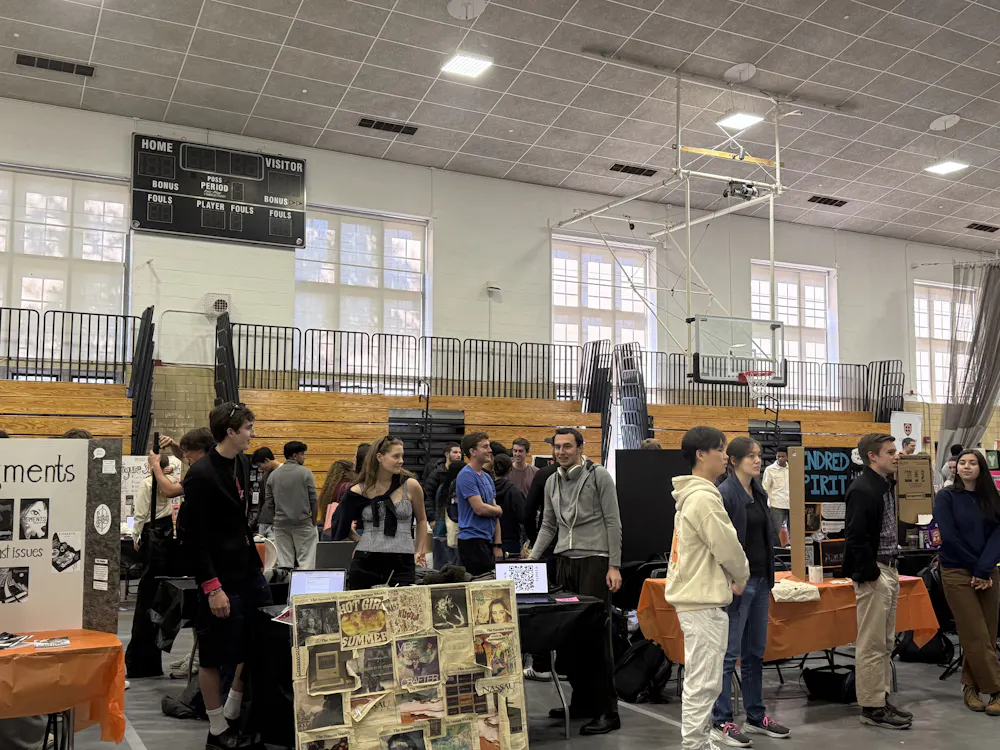
David EstradaThe University's student organization officers and treasurers returned to mandatory in-person training this fall after years of online sessions. Student reactions found parts of the training redundant or tedious, though most agreed the sessions were important.
The University's student organization officers and treasurers returned to mandatory in-person training this fall after years of online sessions. Student reactions found parts of the training redundant or tedious, though most agreed the sessions were important.