



At a recent appearance in New York City by Taiwan's president Chen Shui-bian, five Princeton graduate students joined hundreds of other students from China to protest against Taiwan — considered a rogue province by China's government.
But many of the students were also there because of a $25 financial incentive provided by a student organization — the Association for Chinese Scholars and Students.
East Asian Studies professor Perry Link said the ACSS is commonly recognized as "government sponsored."
Representatives in New York's Chinese consulate education department denied a "direct connection" with the ACSS.
Founded in the 1980s, there are dozens of ACSS chapters at universities across the country, including Princeton. The organization aims to help students from mainland China studying in America and to provide them with a community linked to home.
The event highlights the increasing role that the tension between the Chinese and Taiwanese governments plays in student politics on college campuses.
The ACSS chapter in New York sent out an invitation Oct. 30 offering a $25 cash incentive for students to come to New York City and protest the claims of independence from the mainland made by Taiwan's president Chen Shui-bian.
The invitation has caused a stir because the offer of a cash incentive to organize against Chen Shui-bian allegedly violates the organization's nonprofit, nonpolitical mission statement, Link said in an email.

Overlooking the implications of tying the ACSS to the political protest, Han Liang GS sent the invitation to the Princeton ACSS email list. Liang is president of the 300-member Princeton chapter of ACSS.
"I go just because it is a personal action not because I am president of a social organization," said Liang, one of the five Chinese graduate students to attend the protest. "[It was] a personal choice. I think Taiwan shouldn't be independent from China. We hope together we can form a unified China. I love my country so I need to do something to support my homeland."
After realizing the mistake, Liang sent another email restating the ACSS's nonpolitical stance.
Liang said the Princeton students refused to accept the $25, which was intended to reimburse transportation costs.
Bruce Gilley GS, a graduate student in the politics department who spent 10 years as a journalist in China, said it is common for the Chinese government to broadcast images of protests.
"I must say that although we've long suspected that when Chinese government arranges these kinds of rent-a-crowds — where there's some kind of reimbursement such as a lunch — I've never seen an offer of cash for such a protest," Gilley said.

Chinese students seem to be caught in the middle of the political tensions between China and Taiwan. Link said Beijing officials know students are easy to mobilize through these ACSS chapters, and "the Chinese embassy and consulates in the U.S. monitor the activities of Chinese students on U.S. campuses."
Chinese students who criticize their government while overseas may have their passports revoked or their relatives from China harassed, he said.
Read More

Princeton University Orchestra and men’s ultimate frisbee team named in University’s latest hazing report
Andrew ArthurTwelve students in the Princeton University Orchestra and Men's Ultimate Frisbee team were found responsible for hazing violations in the University's latest Campus Hazing Transparency Report. Sanctions ranged from Dean's warnings to disciplinary probation.
Twelve students in the Princeton University Orchestra and Men's Ultimate Frisbee team were found responsible for hazing violations in the University's latest Campus Hazing Transparency Report. Sanctions ranged from Dean's warnings to disciplinary probation.

Murray-Dodge Café celebrates 50th Anniversary, drawing over 260 students
Hifza KaleemOn Wednesday, Murray Dodge Cafe celebrated its 50th anniversary, drawing more than 260 students to celebrate with free cookies and merchandise.
On Wednesday, Murray Dodge Cafe celebrated its 50th anniversary, drawing more than 260 students to celebrate with free cookies and merchandise.
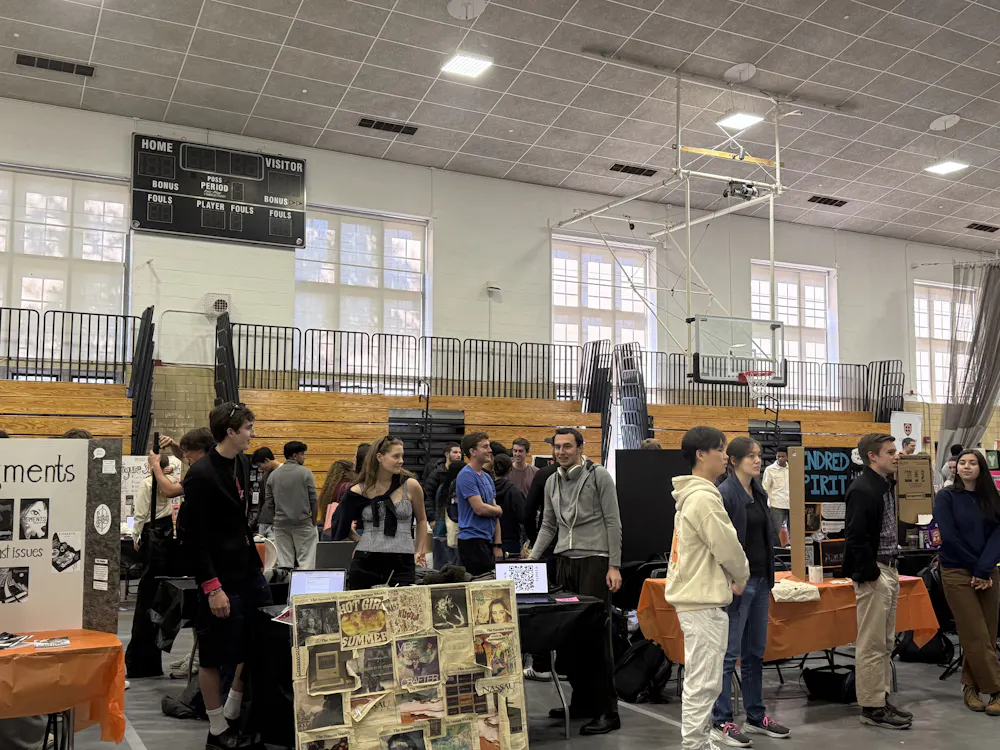
Students share mixed reactions as mandated officer and treasurer trainings return to in-person format
David EstradaThe University's student organization officers and treasurers returned to mandatory in-person training this fall after years of online sessions. Student reactions found parts of the training redundant or tedious, though most agreed the sessions were important.
The University's student organization officers and treasurers returned to mandatory in-person training this fall after years of online sessions. Student reactions found parts of the training redundant or tedious, though most agreed the sessions were important.