



Originally the title of an oration delivered by Woodrow Wilson 1879 at the University's sesquicentennial, "Princeton in the Nation's Service" speaks to Princeton's devoted patriotism. Almost 50 years later, as World War II raged on, the University served the nation by housing training schools for the armed forces.
In "The Princeton Campus in World War II," published in 1978 by Robert Root, dean of the faculty during the war, Root talks about how the war affected campus.
The Daily Princetonian reported on July 13, 1942, that Brown, Cuyler and Patton were to be set aside for the Naval Training School. The first class of 760 newly commissioned officers arrived on campus on Oct. 5, 1942, for an eight-week course in basic military instruction. Though these men were already commissioned, most of them were civilians with no training, and only a few were already enlisted in the Navy's ranks. This often led to instructors teaching students of higher rank than themselves, although insignias of rank were not a required part of military dress during the week.
The Navy initially intended to use the program in Princeton to train officers in amphibious operations. But, the shallow depths of Lake Carnegie and the bemused observations of the Princeton community ensured that the school would instead be used as a training ground in basic military fundamentals. Courses such as seamanship and navigation provided core instruction, until later in 1943 when more advanced classes were taught to new groups of student officers who had already completed their training at Dartmouth's Naval Training Program.
Transforming spaces
The ubiquitous naval uniform on campus meant quite a bit of readjustment, Root wrote. Since Brown, Cuyler and Patton were being used as living quarters for the officers and trainees, 250 undergraduates had to vacate their rooms and move in with other students. The University's president at the time, Harold Dodds, temporarily suspended formal rules forbidding dormitory rooms to house extra occupants.
Though University undergraduates were forced to come up with their own housing arrangements after eviction, the naval student officers had a much worse time of it. In what were three-room doubles, eight student officers made their temporary home. Military life was cramped, to say the least.
Root wrote that the Naval officers devised an interesting method to resolve the short supply of shaving mirrors and washbasins. All the light-haired men were forced to shave at night to leave room for all the dark-haired men in the morning.
Some aspects of dorm life actually improved. At the time, Cuyler and Patton — built in the early part of the century and the gift of multiple graduating classes — had better washroom facilities than Brown, which could not provide an adequate number of toilets for the number of men living there. To fix this problem, the Navy converted many of the single rooms into washrooms — making Brown more accommodating for its future occupants.

Other aspects of building use on Princeton's campus were temporarily disrupted during the war years. Lecture rooms in McCosh Hall were set aside for Naval instruction.
Eating arrangements
The influx of officers in the dining halls meant sophomores were forced to begin dining at their eating clubs a semester early. Tiger Inn and Elm Clubs further provided common eating space for all undergraduates for the duration of the war. In February 1943, when the War Department placed Princeton on a list of universities to house an Army Specialized Training Program, all University dining halls were promptly turned over for exclusive military use.
The government reimbursed the University for its use of the buildings — a complicated process. The appraisals involved calculating how many cubic feet buildings contained, how much of it was being used and which stairways were included.
The reimbursements also depended on how often the space was used for each of the government's programs, as in the case of classrooms. The idea underlying these contracts was that the University should not receive any profit from the use of its buildings and grounds, but would receive adequate compensation for the disruptions such programs caused. In many ways, because of rapidly diminishing student enrollment during the war, such government sponsorship helped the University stay afloat and avoid financial distress.
Continued presence
Between 1942 and 1944, when the last class of 800 officers graduated, 8,653 men were trained on Princeton's campus. The last two classes trained were so oversized that additional housing facilities had to be provided in Foulke, Henry, Laughlin and 1901 Halls. A year later these same dorms began housing the Navy's Pre-Midshipman Program, when it was transferred from Asbury Park, N.J.
After two months the program was replaced by another training school, whose trainees were often veterans of engagements in the Pacific and were enrolled in basic refresher courses to prepare them for college after the war. Often these classes were a mix of students comprising civilian and military individuals. They too were quartered in Brown, Cuyler and Patton, among others.

By this point in the war, however, many Princetonians had left for service and enrollment fell below 400 students. Despite the overcrowding and readjustments necessary at the beginning of Princeton's participation in the war, the veterans and officers were welcomed because they helped replace the departed students, Root wrote. All in all, 9,792 Princetonians served in some capacity during the war and 353 gave their lives for the cause.
In his oration, Wilson encouraged the University and its students to identify with the needs of its country. Helping to serve the military in the nation's time of need provided a telling example of Princeton's commitment to this ideal.
Read More

Princeton University Orchestra and men’s ultimate frisbee team named in University’s latest hazing report
Andrew ArthurTwelve students in the Princeton University Orchestra and Men's Ultimate Frisbee team were found responsible for hazing violations in the University's latest Campus Hazing Transparency Report. Sanctions ranged from Dean's warnings to disciplinary probation.
Twelve students in the Princeton University Orchestra and Men's Ultimate Frisbee team were found responsible for hazing violations in the University's latest Campus Hazing Transparency Report. Sanctions ranged from Dean's warnings to disciplinary probation.

Murray-Dodge Café celebrates 50th Anniversary, drawing over 260 students
Hifza KaleemOn Wednesday, Murray Dodge Cafe celebrated its 50th anniversary, drawing more than 260 students to celebrate with free cookies and merchandise.
On Wednesday, Murray Dodge Cafe celebrated its 50th anniversary, drawing more than 260 students to celebrate with free cookies and merchandise.
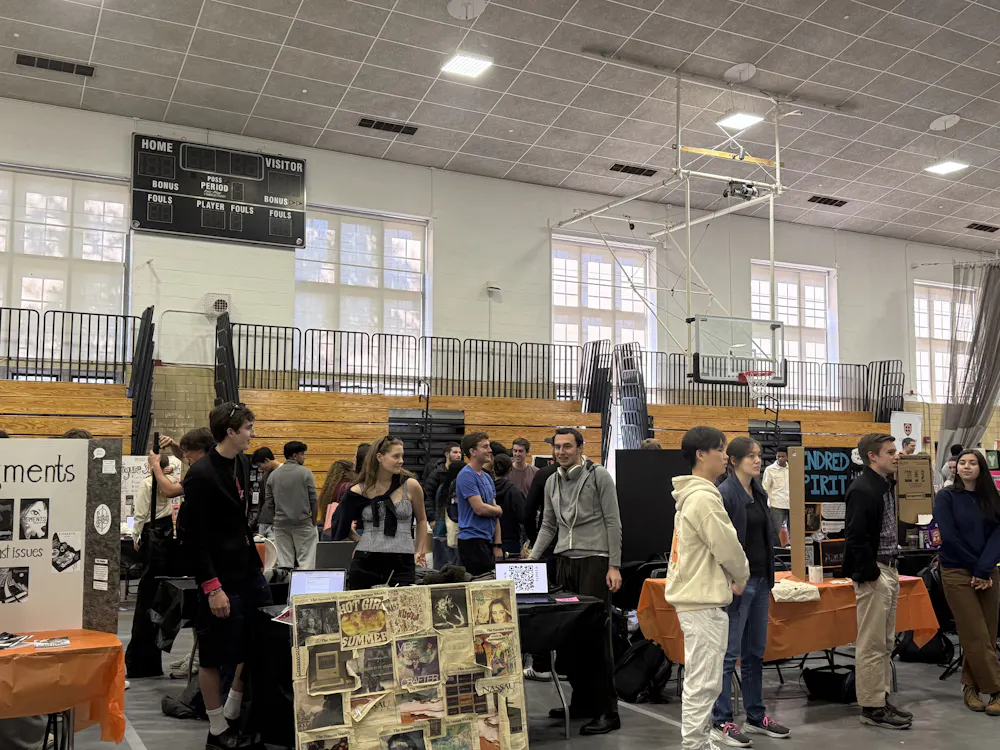
Students share mixed reactions as mandated officer and treasurer trainings return to in-person format
David EstradaThe University's student organization officers and treasurers returned to mandatory in-person training this fall after years of online sessions. Student reactions found parts of the training redundant or tedious, though most agreed the sessions were important.
The University's student organization officers and treasurers returned to mandatory in-person training this fall after years of online sessions. Student reactions found parts of the training redundant or tedious, though most agreed the sessions were important.