



An ongoing review of the English department's two prerequisite courses may lead to changes as soon as next fall.
ENG 201 and 202, which are normally required for entry into the department, are historical surveys that together cover English literature from the 14th century to the present. They draw more than 100 students each semester, roughly three quarters of them prospective English majors.
Because of budgetary restrictions, a return to the pre-1998 format of small seminars is not feasible, said English professor and departmental representative Jeff Nunokawa. Instead, it is the content of the two courses — which has not changed for decades — that is now under scrutiny.
Although a number of popular professors have taught the courses, student evaluations have consistently been lower than expected.
"It's invariable that [professors of ENG 201 and 202] have never had ratings that low," said Oliver Arnold, who currently teaches ENG 201. "The ratings are not egregious, but people who usually get 4.6 or 4.7 [out of 5] are surprised to see 4.1 for 201/202."
Possible changes include shortening the time periods covered in ENG 201 and 202, Arnold said, or offering courses focused on specific genres, such as poetry in the 19th and 20th centuries or drama from the Renaissance to the Restoration, as alternatives to ENG 202.
Another option may be for students to choose from a selection of genre courses in the fall and take ENG 201 in the spring, he explained.
The eight-member Committee on Departmental Students expects to conclude its evaluation of the two courses by the end of December, and its recommendations will then be discussed and voted upon by the department.

A change could go into effect as early as next fall, said Arnold, who participates in CDS discussions.
Caroline Murphree '04, an English major who took 201 and 202 freshman year, said she enjoyed both courses but understood why others did not.
"The object of the course is to give a very broad survey," she said, "so you do all this reading and the coverage of the topics is quite general because you're working to get through them so fast."
This makes the course challenging for both students and professors, Arnold said. "Because so much ground is covered, you're never in the center of students' literary interests and affections for very long."
But Murphree noted the value of requiring all English majors to take a broad survey course, because "if you're interested in 19th-century literature, you need to know what came before it."
Before the fall of 1998, ENG 201 and 202 covered the same content as they do now but were structured as 90-minute biweekly seminars of roughly 15 students each.

The department was required to staff the seminars with faculty members because of University limitations on how much of a course can be taught by a graduate student.
"The labor had to be sucked from somewhere," Arnold said, and often that meant limiting the number of upper-level courses and seminars offered. Because of the extensive content of the two courses, he added, professors often wound up lecturing in seminar anyway.
In 1997, the department decided to make the courses two lectures and one two-hour precept each week. Lectures are now typically team-taught by senior faculty members, with most precepts led by graduate students.
Student course reviews have not dipped since the switch, Arnold said, but for the past two years the CDS has been examining other ways to "introduce students to the major and diversify the sophomore-level offerings for non-majors."
When the CDS presents its final recommendations in the coming months, the department as a whole will "discuss it, discuss it, discuss it, discuss it," Nunokawa said.
If changes are significant, Arnold said, accommodations will be made to distinguish between English majors who take the current 201 and 202 courses and those who enter the department with the new requirements.
But Nunokawa said most of the department is committed to retaining at least one semester of a historical survey course, and Arnold predicted that ENG 201 will probably be preserved in its current form.
"Our majors would be flying a little blind without it," he said.
Read More

Princeton University Orchestra and men’s ultimate frisbee team named in University’s latest hazing report
Andrew ArthurTwelve students in the Princeton University Orchestra and Men's Ultimate Frisbee team were found responsible for hazing violations in the University's latest Campus Hazing Transparency Report. Sanctions ranged from Dean's warnings to disciplinary probation.
Twelve students in the Princeton University Orchestra and Men's Ultimate Frisbee team were found responsible for hazing violations in the University's latest Campus Hazing Transparency Report. Sanctions ranged from Dean's warnings to disciplinary probation.

Murray-Dodge Café celebrates 50th Anniversary, drawing over 260 students
Hifza KaleemOn Wednesday, Murray Dodge Cafe celebrated its 50th anniversary, drawing more than 260 students to celebrate with free cookies and merchandise.
On Wednesday, Murray Dodge Cafe celebrated its 50th anniversary, drawing more than 260 students to celebrate with free cookies and merchandise.
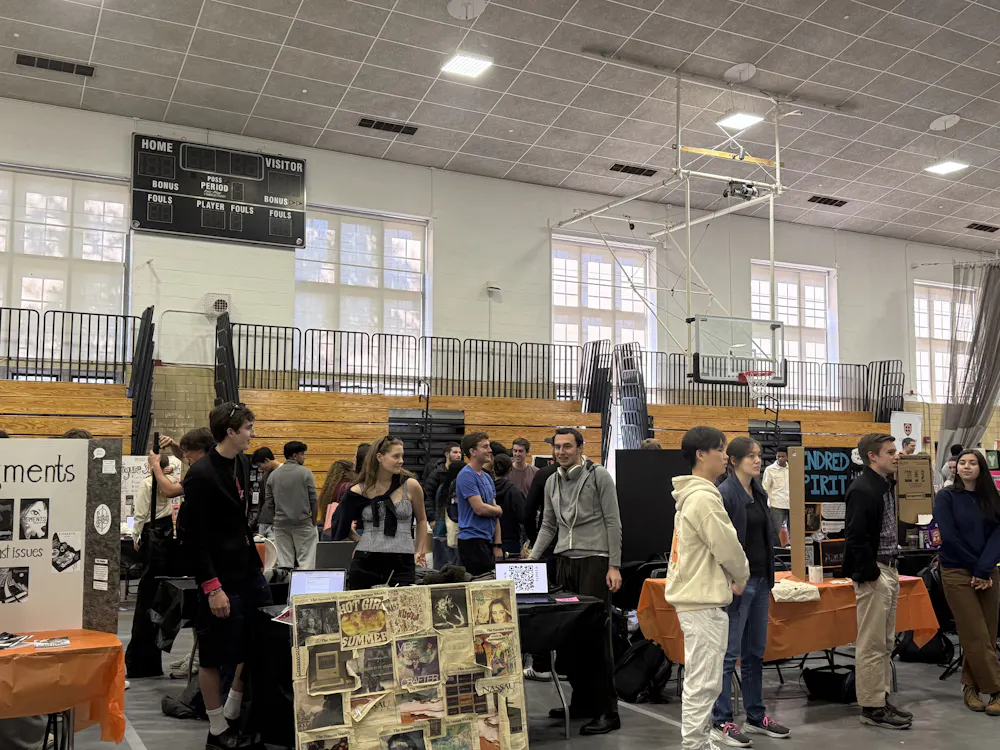
Students share mixed reactions as mandated officer and treasurer trainings return to in-person format
David EstradaThe University's student organization officers and treasurers returned to mandatory in-person training this fall after years of online sessions. Student reactions found parts of the training redundant or tedious, though most agreed the sessions were important.
The University's student organization officers and treasurers returned to mandatory in-person training this fall after years of online sessions. Student reactions found parts of the training redundant or tedious, though most agreed the sessions were important.