



Thomas Carothers of the Carnegie Endowment for International Peace addressed the legitimacy of the imposition of democracy by force in a lecture in Dodds Auditorium yesterday afternoon.
The Iraq debate is the "deepest, most emotional debate about American foreign policy since the Vietnam War," said Carothers, the director of the Democracy and Rule of Law Project at the Carnegie Endowment.
He summarized the arguments of skeptics and supporters of United States intervention in Iraq, focusing on the debate over whether the ousting of a dictatorship and the institution of democracy provided a justifiable rationale for war. These arguments brought to the surface important differences between American and foreign perspectives on sovereignty and international law, he said.
Several U.S. administrations over the last several decades have justified foreign interventions based on the idea of democracy promotion, but "in those cases it was clear that the security rationale was dominant," he said.
By contrast, he said, in the case of Iraq, the democracy rationale has been integral because "it connects very directly to U.S. policy concerns." Since Sept. 11, U.S. policymakers have concluded that the lack of democracy in the Middle East has played a role in leading to terrorism and have made the promotion of democracy in the region a central policy goal, he added.
The concept of "democracy by force" was promoted before the war by some in both major American parties, but the idea has been opposed by the majority outside the United States, he said.
While supporters of democracy by force base their arguments on a moral foundation, Carothers explained, skeptics have raised objections based on both principle and practice.
There have been notable differences between the arguments of the war's opponents within the United States and those of foreign opponents, he said.

Foreign skeptics strongly object to the idea of democracy by force based primarily on fundamental principles of international law, he said. The use of force absent a threat to peace and without U.N. approval is a violation of a norm of international law, he added.
Within the United States, the focus of the objections to democracy by force "is on practice rather than principle," he said. American skeptics tend to make practical arguments, saying that the United States is inconsistent in applying the concept, objecting to the high costs of American intervention or arguing that the United States is simply incapable of implementing democracy.
This highlights a notable division between American and foreign outlooks regarding international law, Carothers said. For most of the world, international law is seen as a " shield" and as a guarantor of security, he said.
Americans are "much more willing to ignore international law" either to protect American security or to promote humanitarian goals, he said.
In the Arab world, the main argument against so-called "democratic intervention" is that a government imposed by military might is by definition undemocratic, he said.
In concluding the lecture, which was the 2003-2004 Cyril Black Memorial Lecture sponsored by the Princeton Institute for International and Regional Studies, Carothers said he is "more in the camp with the skeptics than with the supporters."
Read More

Princeton University Orchestra and men’s ultimate frisbee team named in University’s latest hazing report
Andrew ArthurTwelve students in the Princeton University Orchestra and Men's Ultimate Frisbee team were found responsible for hazing violations in the University's latest Campus Hazing Transparency Report. Sanctions ranged from Dean's warnings to disciplinary probation.
Twelve students in the Princeton University Orchestra and Men's Ultimate Frisbee team were found responsible for hazing violations in the University's latest Campus Hazing Transparency Report. Sanctions ranged from Dean's warnings to disciplinary probation.

Murray-Dodge Café celebrates 50th Anniversary, drawing over 260 students
Hifza KaleemOn Wednesday, Murray Dodge Cafe celebrated its 50th anniversary, drawing more than 260 students to celebrate with free cookies and merchandise.
On Wednesday, Murray Dodge Cafe celebrated its 50th anniversary, drawing more than 260 students to celebrate with free cookies and merchandise.
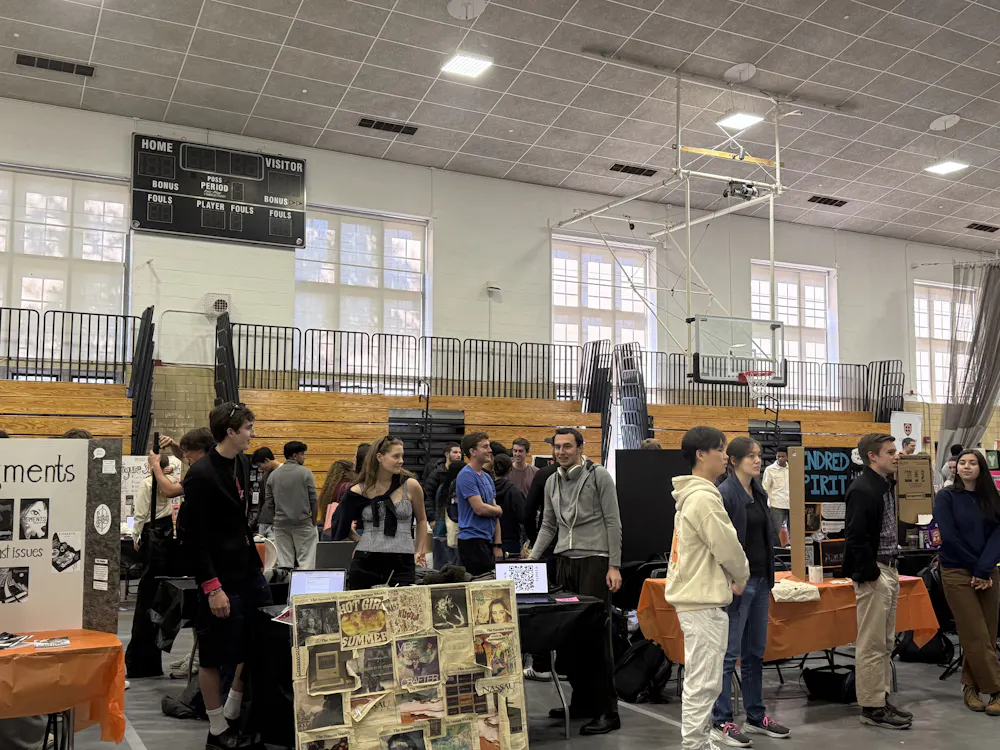
Students share mixed reactions as mandated officer and treasurer trainings return to in-person format
David EstradaThe University's student organization officers and treasurers returned to mandatory in-person training this fall after years of online sessions. Student reactions found parts of the training redundant or tedious, though most agreed the sessions were important.
The University's student organization officers and treasurers returned to mandatory in-person training this fall after years of online sessions. Student reactions found parts of the training redundant or tedious, though most agreed the sessions were important.