



Princeton students equally support bicker and sign-in eating clubs, a poll conducted by The Daily Princetonian last week shows.
The telephone poll asked students whether they prefer hanging out in sign-in or bicker clubs, or both, and how they felt about the Bicker system.
Roughly one-third of students think Bicker is a bad system, one-third think it is a good system and one-third had no opinion.
Five percent of students polled said Bicker is a very good system. Eight percent said Bicker is a very bad system.
Lynette Robinson '05 bickered a club last spring but did not get in. She is now independent.
"I thought the Bicker process was something unique to Princeton. I loved it. I went into it with the attitude that I was going to have fun with my friends and meet new people. I did those things so I came away feeling very satisfied," she said.
Melissa Shulman is a sophomore looking to join an eating club next semester. She said she dislikes bicker in general, and now that Campus Club has switched from sign-in to bicker she is considering bickering.
"A bunch of my friends and I were going to go to Campus, but then they went to bicker so now we are undecided," she said. "Personally I don't like the exclusivity of the [Bicker] process. Instead of trying to include all people they are trying to keep people out."

Campus switched to bicker in May after three years of low sign-in numbers. The club's graduate board asked the club's members to find a selective admission process because it perceived undergraduates prefer bicker clubs to sign-ins and because bicker clubs have smaller swings in membership.
Colonial Club on the other hand has had huge sign in classes during the last few years. Club president Mike McFadden '04 said Colonial has more than 200 members, including a junior class of roughly 110. He said there is a large wait list, and the membership is at maximum capacity.
"The bicker process facilitates club bonding and pride. You know that everyone has gotten in on their own merit . . . On member nights people really want to come and hang out with each other. That's why they come out and put themselves on the line," Ivy president Peter Sculco said.
According to the 'Prince' survey, 24 percent of students prefer to hang out in sign-in clubs, 20 percent of students prefer bicker clubs, 40 percent of students like both sign-in and bicker clubs and 17 percent have no opinion.
McFadden said, "There are a couple of advantages of sign-in clubs. You can sign in to a sign-in club with a big group of friends; you never have that guarantee with bicker . . . You also get to have a lot more fun during sign-in week, instead of doing bicker stuff. Since sign-in clubs are not looking for one type of person you get to meet a broader group of people."
Brian Goodwin '06 said though he goes to bicker clubs mostly and plans to bicker an eating club this spring, his choice has little to with his preference for the bicker system.

"The main reason I go to the bicker clubs is because that is where most of my friends are . . . If you go to a club and don't know anyone, it is not fun. If more of my friends were involved with sign in clubs, I would probably go there."
For more information on the poll, see Page Three.
Read More

Princeton University Orchestra and men’s ultimate frisbee team named in University’s latest hazing report
Andrew ArthurTwelve students in the Princeton University Orchestra and Men's Ultimate Frisbee team were found responsible for hazing violations in the University's latest Campus Hazing Transparency Report. Sanctions ranged from Dean's warnings to disciplinary probation.
Twelve students in the Princeton University Orchestra and Men's Ultimate Frisbee team were found responsible for hazing violations in the University's latest Campus Hazing Transparency Report. Sanctions ranged from Dean's warnings to disciplinary probation.

Murray-Dodge Café celebrates 50th Anniversary, drawing over 260 students
Hifza KaleemOn Wednesday, Murray Dodge Cafe celebrated its 50th anniversary, drawing more than 260 students to celebrate with free cookies and merchandise.
On Wednesday, Murray Dodge Cafe celebrated its 50th anniversary, drawing more than 260 students to celebrate with free cookies and merchandise.
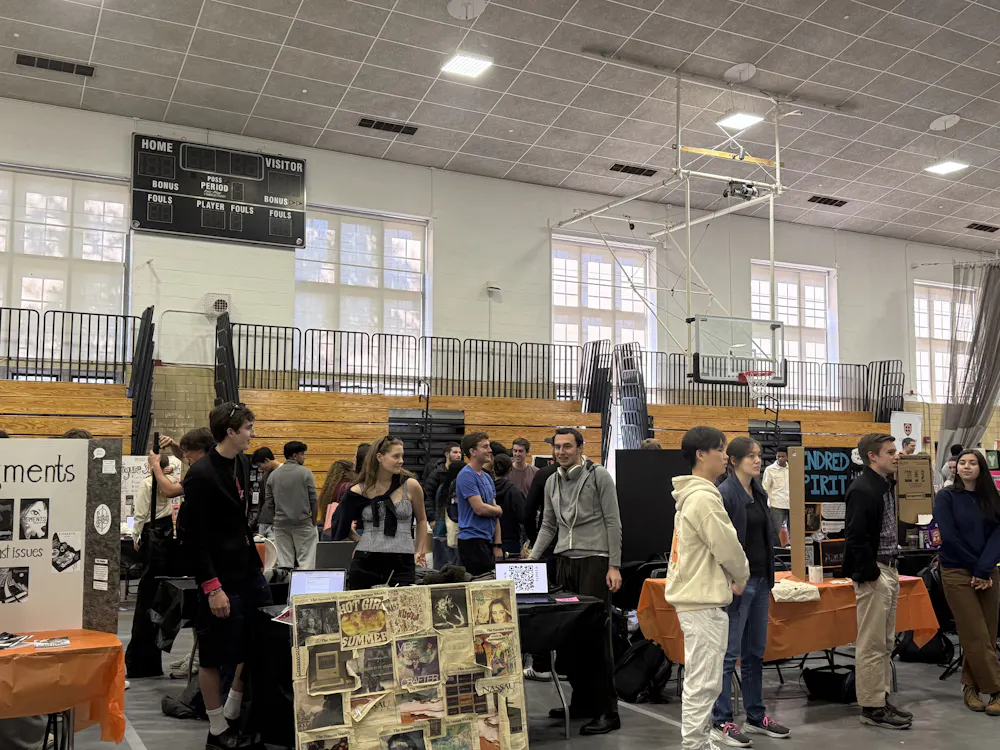
Students share mixed reactions as mandated officer and treasurer trainings return to in-person format
David EstradaThe University's student organization officers and treasurers returned to mandatory in-person training this fall after years of online sessions. Student reactions found parts of the training redundant or tedious, though most agreed the sessions were important.
The University's student organization officers and treasurers returned to mandatory in-person training this fall after years of online sessions. Student reactions found parts of the training redundant or tedious, though most agreed the sessions were important.