



Back in the 1990s, Jessica Stern, a senior official on President Bill Clinton's National Security Council, worried that a madman would get hold of a nuclear weapon from the former Soviet Union and detonate it in an American city.
The worry was so great that Hollywood made a movie about it, 1997's feature "The Peacemaker," starring Nicole Kidman, whose character is based on her, and George Clooney.
Stern, a lecturer at Harvard and one of the country's foremost terrorism experts, is still worried about a madman killing hundreds of thousands with a weapon of mass destruction. But what particularly concerns her today is how religion can be used to motivate men — and, she notes, increasingly women — to kill.
Stern came to the University yesterday to explain the findings of a nearly-three-year journey, completed before the Sept. 11 terrorist attacks, showing how fanatics in the United States and Middle East alike use religion to persuade often young and helpless-feeling men and women to join sophisticated terrorist organizations.
Her views are revealed in a recent book, "Terror in the Name of God: Why Religious Militants Kill." The book recounts her travels to places such as Lebanon, Pakistan and sites in the United States where religious extremists congregate. In discussing interviews with them, Stern highlights the themes she thinks underpin religious fantacism worldwide.
"[Terrorist] recruits feel strongly enough about the grievance that pursuing that mission [of death] is a strong enough award," she said to a packed Dodds Auditorium yesterday. "It makes them contribute to what — from their perspective — is the public good."
The book is a new glimpse into how religion can motivate terrorism.
But Stern said in an interview before her lecture that the book doesn't necessarily reflect a broader move at universities to study international terror, even after the September 2001 attacks. Her previous book, the small 1999 tome "The Ultimate Terrorists," was one of the first scholarly attempts to understand global terror.

"The topic seems very important," she said. "But the tools of political science don't get you very far [in studying terrorism] . . . It's not something a criminologist can assess with their tools."
She added: "The data are very bad. There is very little data on terrorist incidents, let alone terrorist motivations."
The Department of Homeland Security has been accepting applications from universities to fund a major academic study of terrorism. The Wilson School is preparing to partner with the Ford Foundation to set up a new research center to study the "post-post-Cold War era."
At the U.S. military base at Guantanamo Bay, Cuba, where hundreds of people suspected of terrorism are detained, Stern sees a chance for the government to do a comprehensive study of terrorist backgrounds.
Yet she thinks it improbable it will do so anytime soon.
"I think the government, at this point, doesn't have the will to collect those data," she said. "They're fighting fires. They're trying to prevent the next terrorist attack, and they're not availing themselves to this goldmine of information."

In writing her book, Stern acknowledged she couldn't do the hundreds of interviews with suspected terrorists that might be possible at Guantanamo.
"I had a limited sample," she added. "I only talked to terrorists who I thought weren't going to kill me."
Stern was able to glean from her research that various kinds of incentives motivate terrorism. "Traditional selective incentives," such as money or threat of punishment, as well as "the notion that to be involved in a holy war is pleasing to God," persuade religious militants to kill, she said.
Read More

Princeton University Orchestra and men’s ultimate frisbee team named in University’s latest hazing report
Andrew ArthurTwelve students in the Princeton University Orchestra and Men's Ultimate Frisbee team were found responsible for hazing violations in the University's latest Campus Hazing Transparency Report. Sanctions ranged from Dean's warnings to disciplinary probation.
Twelve students in the Princeton University Orchestra and Men's Ultimate Frisbee team were found responsible for hazing violations in the University's latest Campus Hazing Transparency Report. Sanctions ranged from Dean's warnings to disciplinary probation.

Murray-Dodge Café celebrates 50th Anniversary, drawing over 260 students
Hifza KaleemOn Wednesday, Murray Dodge Cafe celebrated its 50th anniversary, drawing more than 260 students to celebrate with free cookies and merchandise.
On Wednesday, Murray Dodge Cafe celebrated its 50th anniversary, drawing more than 260 students to celebrate with free cookies and merchandise.
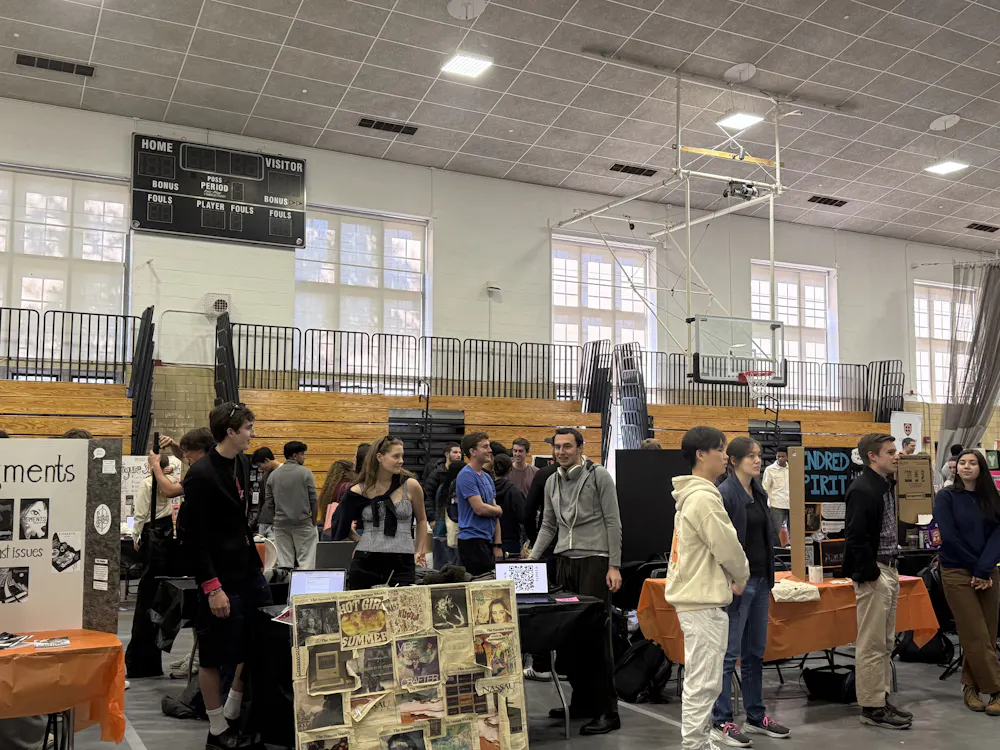
Students share mixed reactions as mandated officer and treasurer trainings return to in-person format
David EstradaThe University's student organization officers and treasurers returned to mandatory in-person training this fall after years of online sessions. Student reactions found parts of the training redundant or tedious, though most agreed the sessions were important.
The University's student organization officers and treasurers returned to mandatory in-person training this fall after years of online sessions. Student reactions found parts of the training redundant or tedious, though most agreed the sessions were important.