



The University's Office of Information Technology is not Big Brother, but it has been watching you.
Every institution that registers with the Google search engine can view daily results called "traffic reports" that pool the day's most popular search keywords, and the University has been using these reports while redesigning Princeton's webpage.
"It's simple," Dwight Bashore, University web specialist with the Office of Information Technology, said. "Basically, we sign up and use part of [Google's] service."
Though traffic reports might have many practical applications, Bashore said the University does not use them regularly to monitor webpage hits.
He did say, however, that OIT is currently using Google's daily reports to help create a new University homepage.
"Right now, we're actively using it because we're redesigning the Princeton home page," he said. "Mainly, though, we use it for stats just to understand what people are searching for."
When creating the traffic reports, Google saves the search text in a daily log and tabulates the results. Only the registered host institution, though, can view the results of the tabulation.
This may be an important feature to the University and other schools that use Google. Tabulated results can allow webpage designers to incorporate links to popularly viewed pages on homepages and other frequently viewed webpages.

"In the past, we actually added a link to Webmail on our main site," Bashore said. "That was a direct result from knowing that people searched it a lot on Google."
However, Bashore added, not all popular Google search items receive such attention from the University's webpage designers. While athletics is also one of the most popular search items on Princeton's search engine, the University decided not to include a link to Princeton's athletic webpages on its home page.
The traffic reports also exhibit anomalies in routine inquiries that can be the result of external events, Bashore said, and unrepresentative of the most popular search phrases over a longer period of time.
"On the day of a snow storm, for example, a word like 'snow' or [a phrase like] 'snow emergency' might be the most popular search items," Bashore said.
According to the University webpage, Princeton's Google indexes more than 100,000 documents within the princeton.edu domain. And any website accessible through princeton.edu can add be easily added to Google's search indices.
Read More

Princeton University Orchestra and men’s ultimate frisbee team named in University’s latest hazing report
Andrew ArthurTwelve students in the Princeton University Orchestra and Men's Ultimate Frisbee team were found responsible for hazing violations in the University's latest Campus Hazing Transparency Report. Sanctions ranged from Dean's warnings to disciplinary probation.
Twelve students in the Princeton University Orchestra and Men's Ultimate Frisbee team were found responsible for hazing violations in the University's latest Campus Hazing Transparency Report. Sanctions ranged from Dean's warnings to disciplinary probation.

Murray-Dodge Café celebrates 50th Anniversary, drawing over 260 students
Hifza KaleemOn Wednesday, Murray Dodge Cafe celebrated its 50th anniversary, drawing more than 260 students to celebrate with free cookies and merchandise.
On Wednesday, Murray Dodge Cafe celebrated its 50th anniversary, drawing more than 260 students to celebrate with free cookies and merchandise.
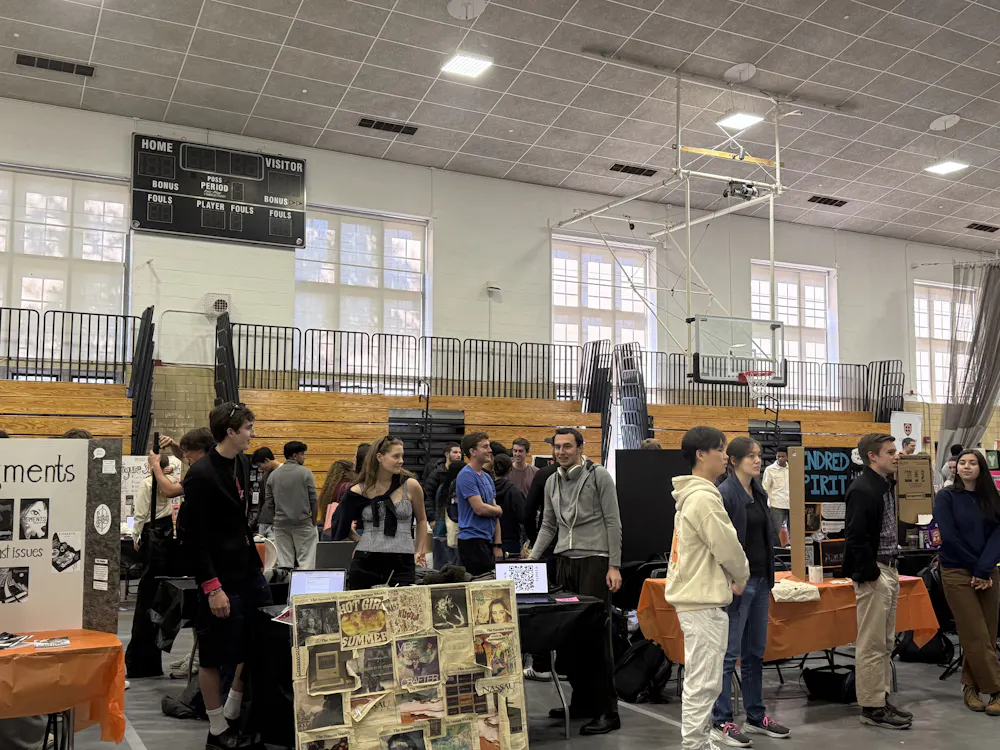
Students share mixed reactions as mandated officer and treasurer trainings return to in-person format
David EstradaThe University's student organization officers and treasurers returned to mandatory in-person training this fall after years of online sessions. Student reactions found parts of the training redundant or tedious, though most agreed the sessions were important.
The University's student organization officers and treasurers returned to mandatory in-person training this fall after years of online sessions. Student reactions found parts of the training redundant or tedious, though most agreed the sessions were important.