



Hussein Ibish, Communications Director for the American-Arab Anti-Discrimination Committee, blasted the Bush administration for what he called a "neo-conservative" doctrine that led to the "total mismanagement" of the Iraqi situation in a lecture in the Frist Campus Center this weekend.
Ibish said "an incredible burden has been placed" on the United States by "the superimposition of a preexisting . . . vision of how to use American power in the world."
Ibish described the ADC as a "national grassroots organization" dedicated to the civil rights of Arabs in the United States and the Middle East. He has worked with the ADC for more than a decade, promoting awareness of Arabic issues through numerous newspaper submissions and thousands of radio and television appearances.
The chief division in the United States government is not between Democrats and Republicans, Ibish said, but between three nonpartisan "factions" — neo-conservatives who seek change, conservative realists who seek the status quo and liberals who also seek the status quo but have "a desire that the United States should not only be respected and feared, but liked."
Ibish called the neo-conservative branch "the smallest but the most potent." Its ability to follow a "clear, defined vision," he said, allows it to have a "disproportionate [governmental] influence."
Yet he called this vision an "ideological fantasy" that prompts neo-conservatives to "frame planning around a belief system rather than reality," resulting in "extraordinary mistakes in methods of dealing with Iraq."
One such mistake was governmental lack of interest in accurately projecting the Iraq war's real costs, Ibish said.
"Americans will be taxed [both] financially and in terms of manpower," he said, contrasting early financial projections with "a $187 billion bill, which is actually just a down payment on what [the Iraq war] will cost in the end."

He said the notion that Iraqis would immediately embrace American occupation also led the government to underestimate the manpower needed in Iraq.
"Rumsfeld assured Congress at this time last year that we wouldn't need more than 30,000 [soldiers in Iraq]," Ibish said. There are now over 200,000, he added.
Ibish also said the government made overoptimistic predictions of Iraqi reaction to American occupation.
Hussein said it would be predictable for Iraqis to be relieved to be "unburdened" of Hussein, though he said he can also see "the occupation is increasingly linked [by Iraqis] with everything that goes wrong."
Ibish said the Bush administration is not only overlooking the realities of the Iraq situation, but is in danger of doing so elsewhere.
"We're talking about a foreign policy agenda that emphasizes American preeminence in all its forms, both globally and regionally . . . underwritten by [irrational devotion to] preemptive war."
Read More

Princeton University Orchestra and men’s ultimate frisbee team named in University’s latest hazing report
Andrew ArthurTwelve students in the Princeton University Orchestra and Men's Ultimate Frisbee team were found responsible for hazing violations in the University's latest Campus Hazing Transparency Report. Sanctions ranged from Dean's warnings to disciplinary probation.
Twelve students in the Princeton University Orchestra and Men's Ultimate Frisbee team were found responsible for hazing violations in the University's latest Campus Hazing Transparency Report. Sanctions ranged from Dean's warnings to disciplinary probation.

Murray-Dodge Café celebrates 50th Anniversary, drawing over 260 students
Hifza KaleemOn Wednesday, Murray Dodge Cafe celebrated its 50th anniversary, drawing more than 260 students to celebrate with free cookies and merchandise.
On Wednesday, Murray Dodge Cafe celebrated its 50th anniversary, drawing more than 260 students to celebrate with free cookies and merchandise.
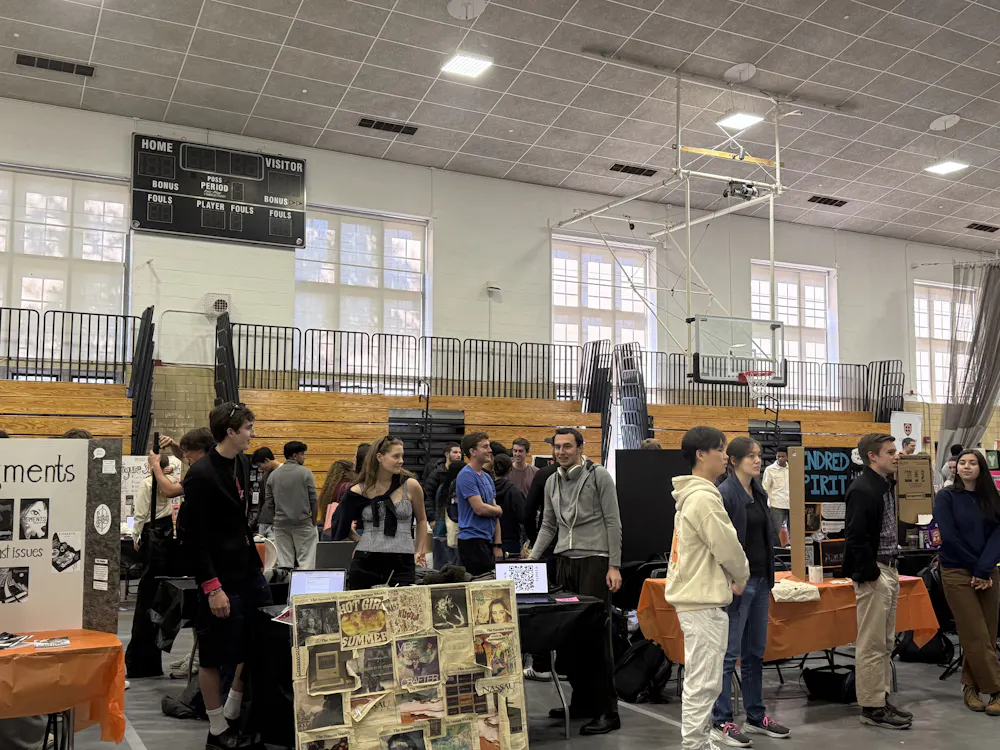
Students share mixed reactions as mandated officer and treasurer trainings return to in-person format
David EstradaThe University's student organization officers and treasurers returned to mandatory in-person training this fall after years of online sessions. Student reactions found parts of the training redundant or tedious, though most agreed the sessions were important.
The University's student organization officers and treasurers returned to mandatory in-person training this fall after years of online sessions. Student reactions found parts of the training redundant or tedious, though most agreed the sessions were important.