



J. Brady Kiesling — formerly a senior officer in the U.S. State Department — addressed the Princeton Middle East Society last night, arguing that if the United States is to win the war on terror, it must first restore its legitimacy in the eyes of the rest of the world.
"Neoconservatives insist that legitimacy is nice, but power is all we need. I disagree," Kiesling said to his audience.
"President Bush has just discovered in Iraq that naked power is very expensive to wield, expensive out of proportion to the benefits the United States hoped to gain from its exercise."
Kiesling made headlines earlier this year when his dramatically written resignation from the State Department was published in the Wall Street Journal.
He is currently on a four-month visiting fellowship in the Program of Hellenic Studies and will teach a joint course between the program and the Wilson School in the spring.
"I resigned to dramatize the fact that we have a president and a foreign policy that are harming American interests around the world," he said in an interview with The Daily Princetonian.
During his address, Kiesling called on the United States to cooperate with its allies.
"International cooperation is vital; [it is] more important than looking good to a domestic audience," he said.

Kiesling acknowledged, however, that sometimes such cooperation might mean working with suspect groups.
"To work with foreigners or anyone else, you have to show respect that is not always deserved," he said.
A military officer in the audience who recently returned from Operation Enduring Freedom in the Middle East took issue with Kiesling's presentation of certain facts.
The officer, who asked to remain unnamed, said, "The implication that we are bankrupting the treasury and undermining civil rights is a distortion."
Sharon Weiner, a researcher at the Wilson School and the Program in Global Security, said she enjoyed Kiesling's speech. "I found it useful for him to point out that large parts of the war on terror aren't necessarily rational responses to actual or perceived threats," she said.
Weiner also discussed Kiesling's assertion that much of U.S. policy is the result of bureaucratic infighting in Washington.

"It's as much a struggle between bureaucrats for power and politicians for domestic advantage," she said.
The audience was mostly composed of PMES members, an organization founded in 1983 for members of the local community interested in the Middle East.
Marilyn Jerry, a member of PMES, encouraged more students to come to the group's events.
"Anybody is who is interested is welcome to attend," she said.
The society's monthly lectures occur on the third Sunday of each month in Frist 302. They address a wide range of topics from Middle-Eastern politics to Middle-Eastern art and architecture.
Read More

Princeton University Orchestra and men’s ultimate frisbee team named in University’s latest hazing report
Andrew ArthurTwelve students in the Princeton University Orchestra and Men's Ultimate Frisbee team were found responsible for hazing violations in the University's latest Campus Hazing Transparency Report. Sanctions ranged from Dean's warnings to disciplinary probation.
Twelve students in the Princeton University Orchestra and Men's Ultimate Frisbee team were found responsible for hazing violations in the University's latest Campus Hazing Transparency Report. Sanctions ranged from Dean's warnings to disciplinary probation.

Murray-Dodge Café celebrates 50th Anniversary, drawing over 260 students
Hifza KaleemOn Wednesday, Murray Dodge Cafe celebrated its 50th anniversary, drawing more than 260 students to celebrate with free cookies and merchandise.
On Wednesday, Murray Dodge Cafe celebrated its 50th anniversary, drawing more than 260 students to celebrate with free cookies and merchandise.
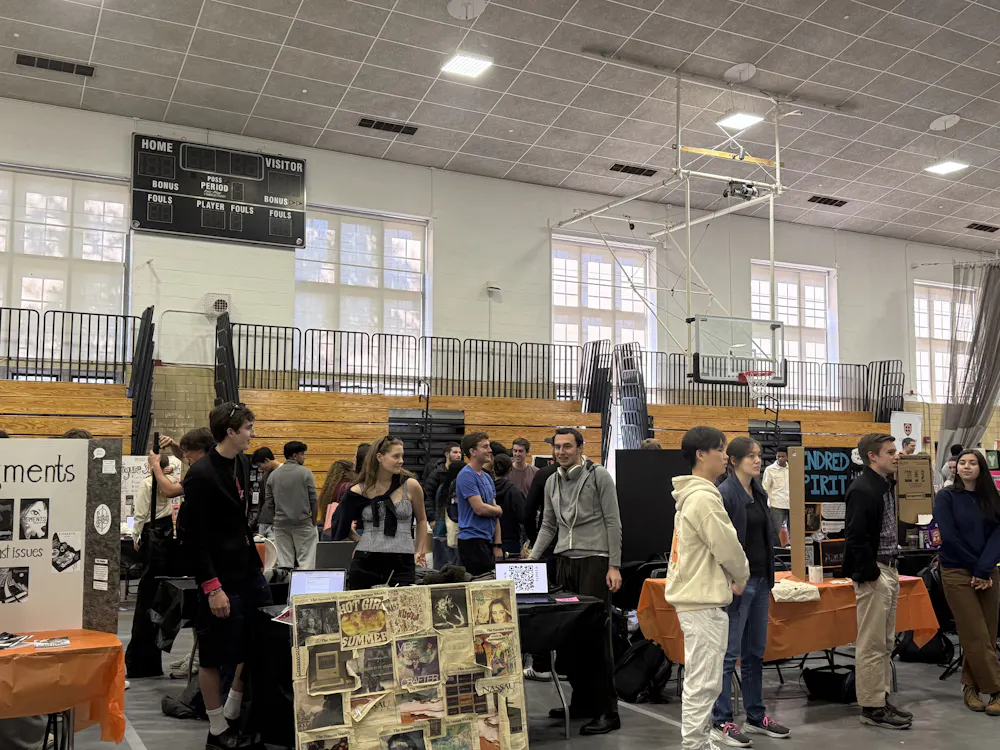
Students share mixed reactions as mandated officer and treasurer trainings return to in-person format
David EstradaThe University's student organization officers and treasurers returned to mandatory in-person training this fall after years of online sessions. Student reactions found parts of the training redundant or tedious, though most agreed the sessions were important.
The University's student organization officers and treasurers returned to mandatory in-person training this fall after years of online sessions. Student reactions found parts of the training redundant or tedious, though most agreed the sessions were important.