



Attempts in recent years to reform the unique University institution of precepts culminated in "Inspired Conversations: The Princeton Precept," a booklet recently distributed to all undergraduates.
"Inspired Conversations," a guide that describes what a preceptorial should aspire to be, is the culmination of a collaborative effort by faculty and students to improve the quality of the University's precepts.
According to the booklet's mission statement, it "[is] intended to provide students and preceptors with a variety of tools to enhance learning and to foster an inclusive and supportive environment for the expression and development of ideas."
Varied response
The response to the booklet, however, has been varied, with some students saying it was unecessary or pointless.
"Inspired Conversations" begins by defining the precept with quotes from students, preceptors, and lecturers.
Precept quality recently became an issue in fall 2001 when the USG started its Precept Reform inititiative.
Then U-Council Chair Adam Dressner '02 and Josh Anderson '04 began examining the mission, history and also the general sentiment regarding the precept system.
The U-Council conducted an email survey of the Classes of '02, '03 and '04, and then established an eight-member committee to examine the results.

The committee's conclusions "indicated a high level of student dissatisfaction," and "a large portion of respondents described less than inspiring precept experiences."
Precept quality
The booklet aims to respond to these concerns about precept quality, Anderson said.
The ideal precept is "one in which there is active participation by the broadest range of students," Dean of the College Nancy Malkiel said.
The precept should take off from where the lecture ends and not just "recap" lecture material, USG Academics Committee Chair Amy Saltzman '05 said.
Saltzman hopes preceptors will learn more about students' perspectives and views through the guide, she said.
One key intention of the precept should be that it causes students to continue to think about the material after class like a "painting you have been looking at," Saltzman said.
Lack of understanding

The precept is a "two-way street," involving both students and preceptors, Anderson said. There is not always a great deal of understanding among the parties that constitute a precept, he said.
The report said "precepts tend to either become lectures with the preceptor talking at students, or they degenerate into stilted and forced discussions."
To deal with problems concerning preceptors specifically, the University now mandates that preceptors receive training at the McGraw Center for Teaching and Learning.
Student response
Nicole Lisa Rowsey '06 said she thinks the book is "utterly useless."
In reaction to the suggestion that students share information about themselves in precept, Rowsey said she does not "want to go to a social event." She wants to go to class.
Brad Heller '05 believes the precept experience is up to the student and that the book went over obvious facts.
Similarly, Rachel Goldstein '07 said "[The guide] seemed mostly like common sense."
"Inspired Conversations" notes it does not contain the "final and incontrovertible word on the precept."
Read More

Princeton University Orchestra and men’s ultimate frisbee team named in University’s latest hazing report
Andrew ArthurTwelve students in the Princeton University Orchestra and Men's Ultimate Frisbee team were found responsible for hazing violations in the University's latest Campus Hazing Transparency Report. Sanctions ranged from Dean's warnings to disciplinary probation.
Twelve students in the Princeton University Orchestra and Men's Ultimate Frisbee team were found responsible for hazing violations in the University's latest Campus Hazing Transparency Report. Sanctions ranged from Dean's warnings to disciplinary probation.

Murray-Dodge Café celebrates 50th Anniversary, drawing over 260 students
Hifza KaleemOn Wednesday, Murray Dodge Cafe celebrated its 50th anniversary, drawing more than 260 students to celebrate with free cookies and merchandise.
On Wednesday, Murray Dodge Cafe celebrated its 50th anniversary, drawing more than 260 students to celebrate with free cookies and merchandise.
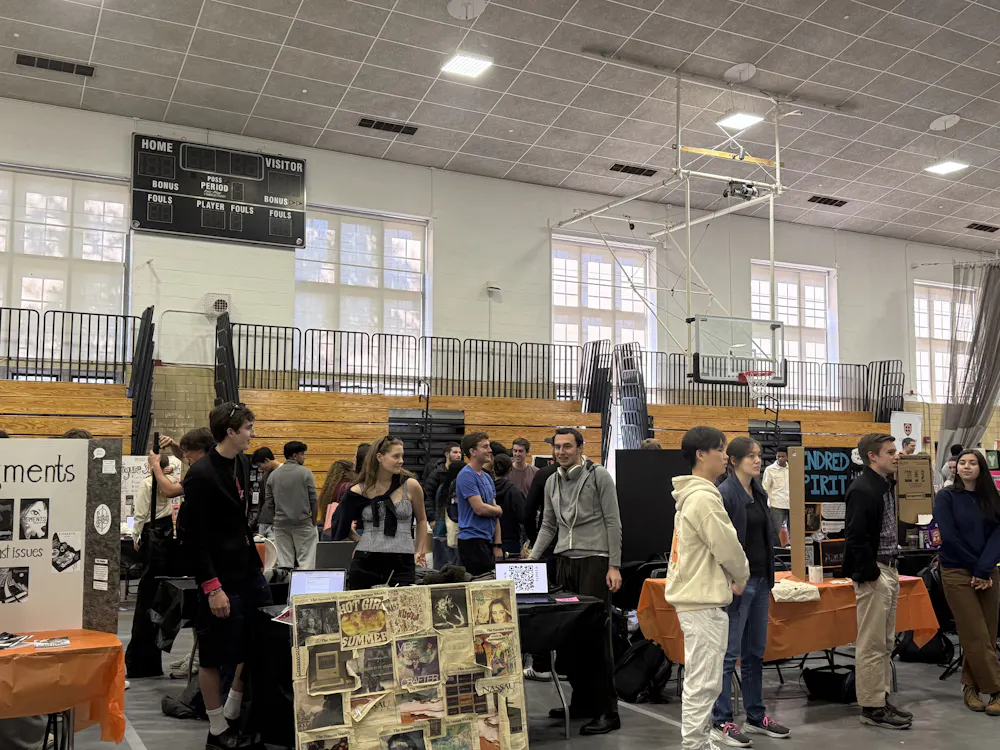
Students share mixed reactions as mandated officer and treasurer trainings return to in-person format
David EstradaThe University's student organization officers and treasurers returned to mandatory in-person training this fall after years of online sessions. Student reactions found parts of the training redundant or tedious, though most agreed the sessions were important.
The University's student organization officers and treasurers returned to mandatory in-person training this fall after years of online sessions. Student reactions found parts of the training redundant or tedious, though most agreed the sessions were important.