



Roland Eavey '04 is throwing a party.
This is not just any party — he has invited nearly 100 close friends and acquaintances to stop by and has spent the afternoon preparing a lavish feast of lobster and shrimp in his spacious, modern kitchen.
One hundred guests? Lobster? Spacious kitchen? It sounds, well, impossible for a University student.
Eavey, however, is one of a number of students — comprising approximately two percent of the Princeton undergraduate student body — who has chosen to reside off campus.
According to Assistant Housing Director Lisa DePaul, University housing consistently accomodates 98 percent of the undergraduate population. The remaining two percent consists of those students who were originally put on the wait-list and did not want to wait for an opening as well as a small number who voluntarily elect not to live on campus.
Though he was originally offered a single room in Pyne, Eavey declined and opted instead to spend his senior year in a two-bedroom apartment located at 25 Witherspoon Street, only steps away from FitzRandolph Gate.
The residence, which Eavey shares with a roommate who asked to remain anonymous, features over 600 square feet of living space, a large kitchen area and bathroom.
"I'm really happy here," Eavey said. "There are so many advantages to living off campus."

Dissatisfied with their residential experiences in previous years, Eavey and his roommate began consulting local real estate agents and searching public bulletin boards for available apartments over the summer.
According to DePaul, however, real estate in the Princeton area is notoriously expensive and offers little in the way of flexible, student-friendly rental agreements.
For the entire academic year, third and fourth-year undergrads living on campus pay just over $4,100 for both shared and single accomodations.
Eavey's apartment, by comparison, is roughly $1,800 per month — making the nine month total $16,000.
Nonetheless, Eavey said he believes that, for students like himself, the benefits of independent living far outweigh the increased financial obligation.
"The combination of feeling fed up with the Princeton social scene and feeling negatively about where you live can have an immense impact on how you live your life," Eavey said, referring to his own individual situation.

"Here, I'm much more focused and productive because, unlike last year, I have a clean, comfortable place to come home to."
Matthew Babinsky '05 is another Princeton student residing off campus, but his reasons for doing so are a result of very different circumstances.
Babinsky had originally planned to live in an upperclass dorm this year, but was later required by the University to spend one semester living off campus for disciplinary reasons.
"My first reaction was, 'Wow, no one lives off campus,'" he said. "I arrived in the fall and had to figure out what I was going to do."
After searching bulletin boards in town, he finally chose a small one-bedroom apartment just east of the University's 185 Nassau St. complex.
The apartment, which has no kitchen or private bathroom "is still pretty cool," he said, "because the location is fantastic and Cottage [Club] is right nearby."
The rent, however, is "nearly double what you pay for [University] residence," Babinsky said.
Unlike Eavey, Babinsky has found the transition from university residence to living alone a difficult one — especially since his doing so was involuntary.
"I'm used to living on a busy hallway surrounded by all my friends," Babinsky said. "Now, the only person who really comes to visit is my girlfriend. I feel totally disconnected from campus."
Nevertheless, Babinsky said, he can understand why Eavey and other members of the off-campus community are happier living on their own.
"Being off campus has really helped me put life at Princeton in perspective," he said. "And all the peace and quiet is certainly a bonus."
Read More

Princeton University Orchestra and men’s ultimate frisbee team named in University’s latest hazing report
Andrew ArthurTwelve students in the Princeton University Orchestra and Men's Ultimate Frisbee team were found responsible for hazing violations in the University's latest Campus Hazing Transparency Report. Sanctions ranged from Dean's warnings to disciplinary probation.
Twelve students in the Princeton University Orchestra and Men's Ultimate Frisbee team were found responsible for hazing violations in the University's latest Campus Hazing Transparency Report. Sanctions ranged from Dean's warnings to disciplinary probation.

Murray-Dodge Café celebrates 50th Anniversary, drawing over 260 students
Hifza KaleemOn Wednesday, Murray Dodge Cafe celebrated its 50th anniversary, drawing more than 260 students to celebrate with free cookies and merchandise.
On Wednesday, Murray Dodge Cafe celebrated its 50th anniversary, drawing more than 260 students to celebrate with free cookies and merchandise.
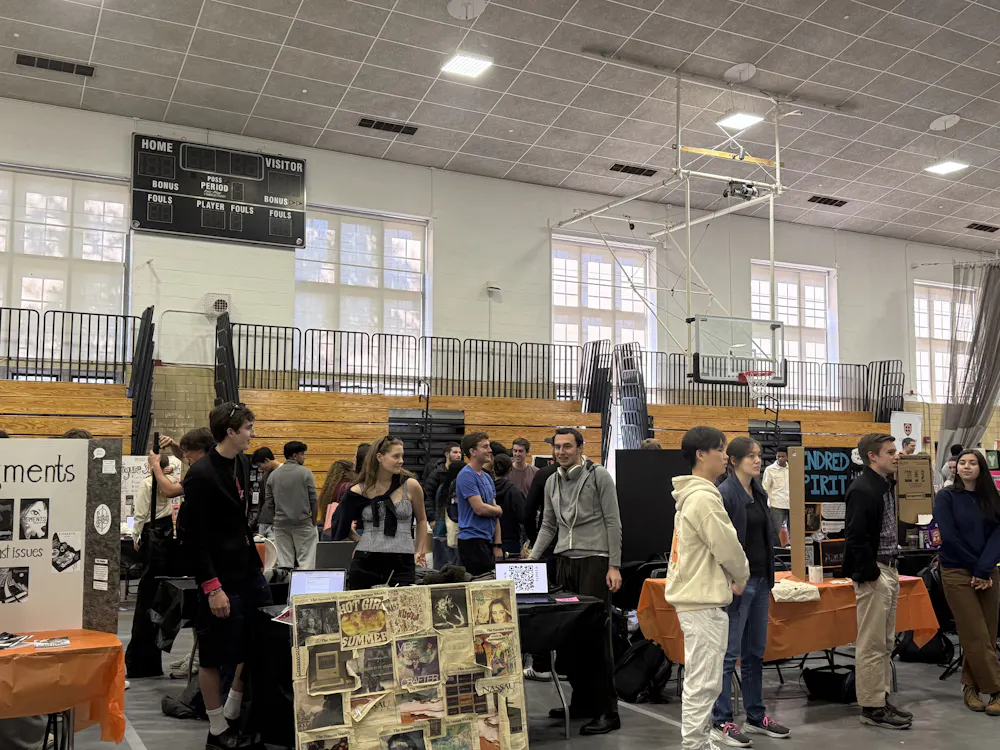
Students share mixed reactions as mandated officer and treasurer trainings return to in-person format
David EstradaThe University's student organization officers and treasurers returned to mandatory in-person training this fall after years of online sessions. Student reactions found parts of the training redundant or tedious, though most agreed the sessions were important.
The University's student organization officers and treasurers returned to mandatory in-person training this fall after years of online sessions. Student reactions found parts of the training redundant or tedious, though most agreed the sessions were important.