



From the easily accessible Asian station at Choi Dining Hall to the grill at Rocky-Mathey (RoMa) Dining Hall, it can be easy for Princeton students to take for granted the meal options and the work by dining hall staff that goes into making them food that is safe and delicious.
In the 1900s, University dining options were much more limited for those who ate at the dining halls: graduate students, underclassmen, and upperclassmen who weren’t affiliated with eating clubs. They primarily ate at Commons, the only undergraduate servery, or the graduate college’s Procter Hall.
The dining options of the past resulted in frequent student backlash throughout the decades, including frustration over an “outbreak of intestinal upset” from Commons in 1963, reports of mold and insects in 1979, and arguments over the “bad food served … hurting the reputation of Princeton” as far back as 1913 in The Daily Princetonian.
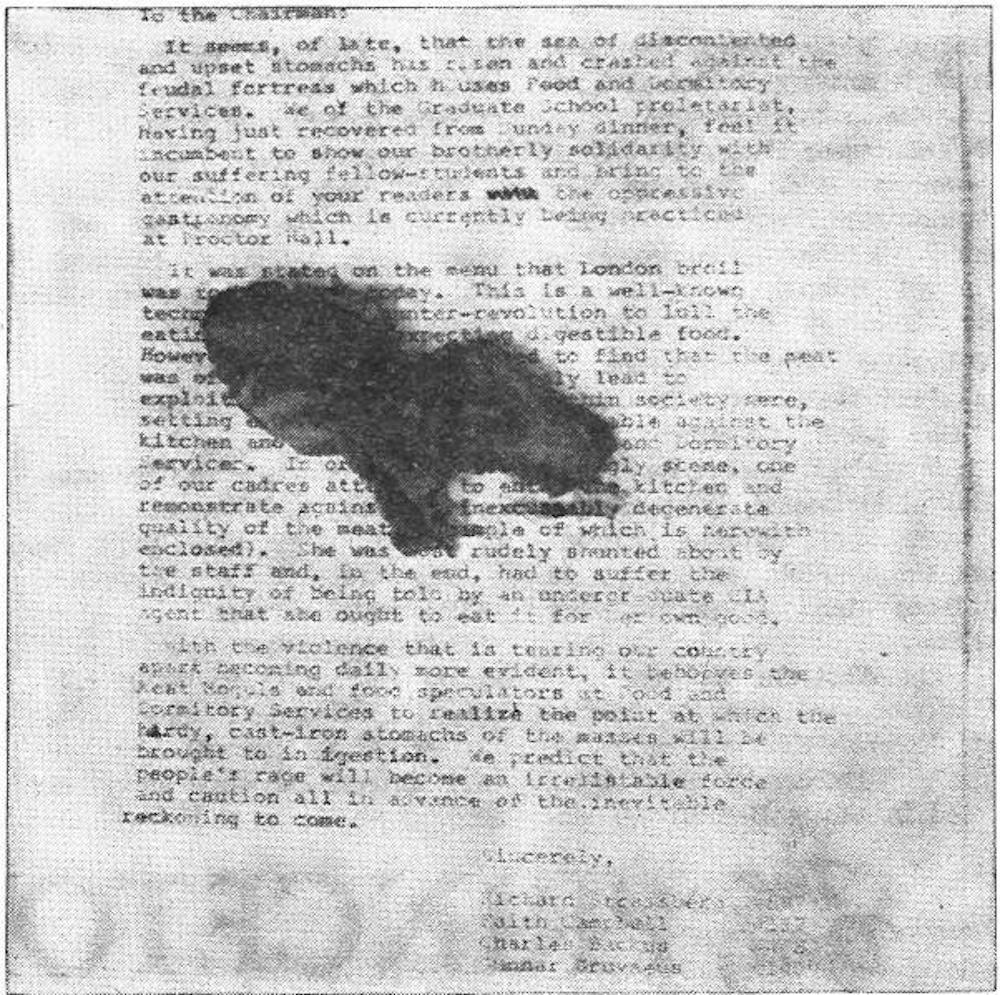
This week in 1970, the ‘Prince’ recalls a letter from four graduate students complaining about the food at Procter Hall.
The letter began, “It seems, of late, that the sea of discontented and upset stomachs has risen and crashed against the feudal fortress which houses Food and Dormitory Services.” The students explained that the dining halls practice “an oppressive gastronomy” and called attention in particular to the “inexcusably degenerate quality of meat.”
The students recounted going to the dining hall, expecting to be served London broil, as the menu advertised, an action which they satirically dubbed “a well-known technique of the counter-revolution to lull the eating masses into expecting digestible food.” However, despite the dining hall touting a gourmet meal, the students declared that the meat was of a quality that would set “eater against waiter, the table against the kitchen, and the people against Food and Dormitory Services.”
Perhaps most remarkably, contained in the letter sent to the ‘Prince’ was a real piece of beef from Procter Hall that night — evidence of the students’ claims.
The students go on to describe how one of them attempted to approach the staff and got “most rudely shunted around” and told that “she ought to eat it for her own good.” They concluded their letter demanding that the Dormitory and Food Services (DFS) take action.

On the night that letter was published, Oct. 13, DFS held a panel to discuss students’ gripes, including complaints about “the ‘lousiness’ of the eggs” and “the deterioration of brunch.” The following day, the ‘Prince’ reported on DFS’s response, stating that DFS director Thomas P. Root promised to reassess menus and increase the number of special grills.
The graduate students’ complaint about the ‘London Broil’ meat at Procter Hall was not the only instance the protein served at dining halls was subject to scrutiny.
In 2024, the Princeton Alumni Weekly magazine opened an online forum for alumni to reflect on the state of the 1950s Commons. In a comment on a 2024 online forum on the state of Commons in the 1950s in Princeton Alumni Weekly, Dave Fulcomer ’58 commented, “Then there was the food. Very predictable and incredibly institutional … dinner was generally a tray of ‘mystery meat,’ or once a week, chopped meat known affectionately as ‘elephant balls.’”
With stricter food regulation in recent years, dining hall food is held to a much higher standard now. Despite this, there still remains the occasional unfortunate food-related incident, from colloquial rumors of undercooked chicken in Whitman to tales of food poisoning from RoMa.
Kelsie Wong ’30 had one such experience, explaining, “I got sick from RoMa one time. I had some yogurt there, and then ended up throwing up a couple of times an hour later.” In spite of that incident she noted, “I think dining hall food is pretty good, I don’t really have that many complaints.”
Similarly, Hifza Kaleem ’30 said, “I have had pretty good experiences with the dining hall.” However, Kaleem also noted that “during Orientation I heard something about the chicken in Whitman giving people food poisoning, but I don’t really eat in Whitman so I can’t personally say for sure.”

Kaleem is a News contributor for the ‘Prince.’
Despite alleged incidents of foodborne illness, the quality and variety of food has dramatically improved at Princeton dining halls since the limited offerings from 1970. Currently, Princeton University’s Campus Dining offers four dining hall options at undergraduate residential colleges, in addition to the Graduate College and the Center for Jewish Life (CJL). In particular, the Graduate College dining hall has come a long way since the “oppressive gastronomy” of 1970, and it is especially notable for its expansive Sunday brunch.
According to a 2019 University report, “Campus Vision for the Future of Dining,” these dining halls operate on “menus that change each day and celebrate diversity of ingredients, authentic global cuisines, and locally sourced and sustainable items.”
This report also details the safety measures Campus Dining enforces, including the creation of a Quality Assurance and Quality Control team to ensure food and workplace safety. Additionally, all managers at the dining halls are certified under ServSafe, a certification granted by the National Restaurant Administration, and all food handlers must complete food safety training.
According to the report, Campus Dining is committed to allergy safety and catering to dietary restrictions. Kaleem discussed her experience as someone with a dietary restriction, explaining, “I eat halal so coming in I was very worried about having options, but I will say that they try to keep their options diverse and I do appreciate how they try to do different cuisines every day.” She added, “My one quip with the dining hall would be that sometimes they label a dish halal but then it contains alcohol, which just defeats the purpose of it, but other than that I haven’t had any major issues.”
A far cry from the “people’s rage” the dining halls of 1970 provoked, Princeton University Campus Dining chefs and staff have also received national recognition. In recent years, Princeton University has received various awards from the National Association of Colleges and University Food Services, and in January 2025, a Princeton University Campus Dining team won a silver medal at the 11th Annual American Culinary Federation Competition for the second year in a row.
Despite some road blocks along the way — and through some unique forms of student protest — dining at Princeton has advanced immensely over the past half century.
Keira Wolk is a contributing Archivist for the ‘Prince.’
Please send any corrections requests to corrections[at]dailyprincetonian.com.
Read More

Finding a new ‘Big Four’ as a Princeton freshman
Marcus SchwartzContributing writer for The Prospect Marcus Schwartz reflects on making friends as a Princeton freshman while advocating for a new “Big Four."

No. 6 men’s water polo falls to No. 5 Fordham, stays undefeated in NWPC play
Ethan ColeThe Tigers reawaken their win streak and remain unbeaten in the NWPC.
The Tigers reawaken their win streak and remain unbeaten in the NWPC.

Princetonians for Free Speech retracts and revises study after omitting some faculty political donations
Tony Zhang, Mira Brock, and Gray CollinsThe retraction comes after the ‘Prince’ inquired about the omission of some donations, following which PFS revised the numbers and republished on Oct. 4.
The retraction comes after the ‘Prince’ inquired about the omission of some donations, following which PFS revised the numbers and republished on Oct. 4.