



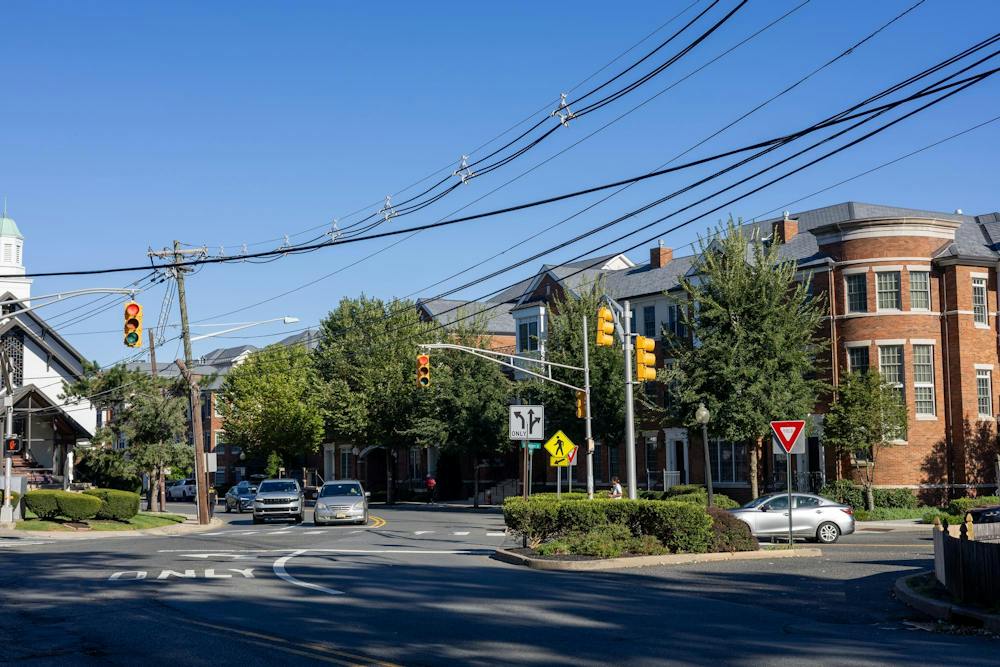
The Municipality of Princeton is preparing to update its zoning code following the merging of Princeton Borough and Princeton Township in 2013. The new code will apply to the entirety of Princeton, replacing the two separate zoning codes that have followed from the two historical regions of the town.
The municipality has been working with Camiros Ltd., a Chicago-based consulting firm specializing in municipal zoning and planning since Aug. 25, 2025. Beyond simplifying current zoning codes, the effort will extend to update some current zoning classifications, potentially changing the way that land is used in Princeton.
Zoning laws are used across many municipalities in the U.S. to determine how land can be used and developed. They delineate plots of lands for specific purposes and developments, such as single-family residences or commercial buildings, and outline procedures and regulations for developing, modifying, or using properties in different areas.
Municipality leaders have expressed that the protracted presence of the two legacy zoning codes has complicated a key part of how Princeton regulates its growth and change.
“We have to know basically double the amount of zones,” Justin Lesko, director of Princeton’s planning department, said in an interview with The Daily Princetonian. “It makes things much more complicated on staff and on applicants, on property owners, builders, homeowners and that was something that really, when the two towns consolidated over a decade ago, they kicked the can on.”
The plan for updating the zoning code consists of three phases, according to the website created by the municipality and Camiros. Phase I, which concluded last month, consisted of creating the code diagnostic reflecting current zoning codes and the 2023 Princeton master plan, along with feedback from the community about current zoning issues. Phase II will involve two stages of zoning code drafts to be developed with public feedback. The rewritten zoning code will be adopted during Phase III.
The master plan is a formal document outlining Princeton’s plans for “growth and development,” which directs the municipality’s policies on zoning, land use, and infrastructure. Previous to the 2023 rewrite, the 1996 master plan was in use.
According to Councilmember David Cohen, who serves on the Princeton Council and the planning committee, Princeton’s decision to write a new zoning code was made about two years ago, shortly after Princeton completed rewriting its master plan.

While the municipality originally attempted to consolidate the existing zoning codes in-house, it quickly became evident that a rewrite and simplification of current zoning codes would allow the time to better implement zoning.
“It became much more of an exercise in trying to make the best code that we could have, rather than just one that was harmonized between two; like I said, two bad codes,” said Cohen.
Phase I concluded with the publication of a code diagnostic to the OneCode website for public review prior to its official presentation to the public on Sept. 24. The municipality is currently accepting submissions for comments from the general public regarding the rewrite of the zoning code.
The published code diagnostic introduced propositions like eliminating parking minimums and relaxing regulations on the development of Accessory Dwelling Units (ADUs), smaller residential units that can be built on lots for single-family residential housing to provide alternative sources of housing supply.
During the public code diagnostic presentation, public comments on the simplification of existing zoning codes were generally positive. However, some residents expressed concerns about how the new zoning code could potentially exacerbate issues. Residents cited traffic congestion, excessive housing density, lack of parking, ADU regulations, and a lack of public information about participation in the rewrite process as concerns.
“We have all these apartments going in, more to be built; we have existing apartments, we have ADUs … how many do we need?” said Jere Tannenbaum, a resident of Ewing Street, with regard to housing development.

Chestnut Street resident Lisa Engel emphasized the lack of parking in the Tree Streets — the neighborhood composed of Pine, Chestnut, Linden, Spruce and Maple Streets — and the desire for more public information about the process.
“When you’re talking about changing the zoning and how it will impact our neighborhoods, I’d like to see what data is being used and how that’s going to be done,” Engel said.
Adam Wolf, a resident of Spruce Street, expressed uncertainty about the benefits of the proposed elimination of the parking minimum and allowance of additional housing developments towards resolving overfilled parking on the Tree Streets.
“We need more housing that is affordable to working people,” Wolf said in an interview with the ‘Prince.’ According to Wolf, the proposed additional housing developments and the elimination of the parking minimum only accommodate “working people that are willing to live in an unusually small apartment with no car.”
Municipal officials and other residents are more hopeful about the change that the new zoning code will bring to Princeton.
Marina Rubina, a local architect and one of the Democratic candidates running for Princeton Council this fall, identifies the lack of affordable housing supply as one of the key topics that should be addressed in Princeton’s rewrite of the zoning code.
Under the current code, Rubina noted, “As we’re thinking about starter homes, as we’re thinking about smaller family sizes, younger families, we are not able to create those.”
Rubina’s opinions echoed her previous comments made at the Princeton Council Candidate Forum on Tuesday, where she said that the current zoning codes makes it near impossible for development of new duplexes “and buildings like Small World Coffee on Witherspoon Street, and the hope would be that this new revised zoning will actually allow again the things that we know and love in town.”
While acknowledging residents’ concerns about the potential elimination of the parking minimum, Lesko noted that current parking minimums are calculated on assumptions of maximum capacity, which differ from usual occupancy rates and can lead to unused space. “So if every single seat is full in a restaurant and everyone drove, that’s how many parking spaces you need,” Lesko told the ‘Prince.’
Traffic congestion, Lesko added, was a reflection of the more than 23,000 commuters commuting into Princeton every day, compared to Princeton’s population of 31,000, a result of high costs of living in Princeton that the municipality is also aiming to address.
Increasing available housing within Princeton to promote shorter commute distances could ultimately reduce traffic congestion, according to the code diagnostic.
In terms of the rezoning’s effects on Princeton, Cohen stressed that preserving the “neighborhood character” of Princeton while ensuring that people “contributing to the life of the community can actually live in the community” continues to be a priority.
The rewrite of the municipal zoning code is progressing into Phase II. On Sept. 28, the municipality of Princeton authorized a contract for $188,900 with Camiros Ltd., for Phase II of the zoning code update.
Joshua Kim is a reporter-in-training for the ‘Prince’ from Auburn, Ala. He is a member of the Class of 2030.
Please send any corrections to corrections[at]dailyprincetonian.com.
Read More
A Blue Ribbon exhibition: ‘Basquiat, the Blue Ribbon Paintings, and the Art of Reproduction’
Persephone Lee and Bella WuContributing writers for The Prospect Bella Wu and Persephone Lee review the Princeton University Art Museum's newest exhibition “Basquiat, the Blue Ribbon Paintings, and the Art of Reproduction.”

Roundup: USG statement on sexual assault allegations, proctoring during midterms, and a varsity sports update
Riley Price and Devon RudolphAn Undergraduate Student Government statement addressing a former Cornell student’s sexual assault allegations, proctoring during midterms, and a mid-season check-in with head Sports editor Lily Pampolina on Princeton’s varsity athletic programs.
An Undergraduate Student Government statement addressing a former Cornell student’s sexual assault allegations, proctoring during midterms, and a mid-season check-in with head Sports editor Lily Pampolina on Princeton’s varsity athletic programs.

Construction on Princeton’s Schmidt Hall enters demolition phase
Riley PriceEric and Wendy Schmidt Hall is slated for completion in Spring 2030.
Eric and Wendy Schmidt Hall is slated for completion in Spring 2030.