



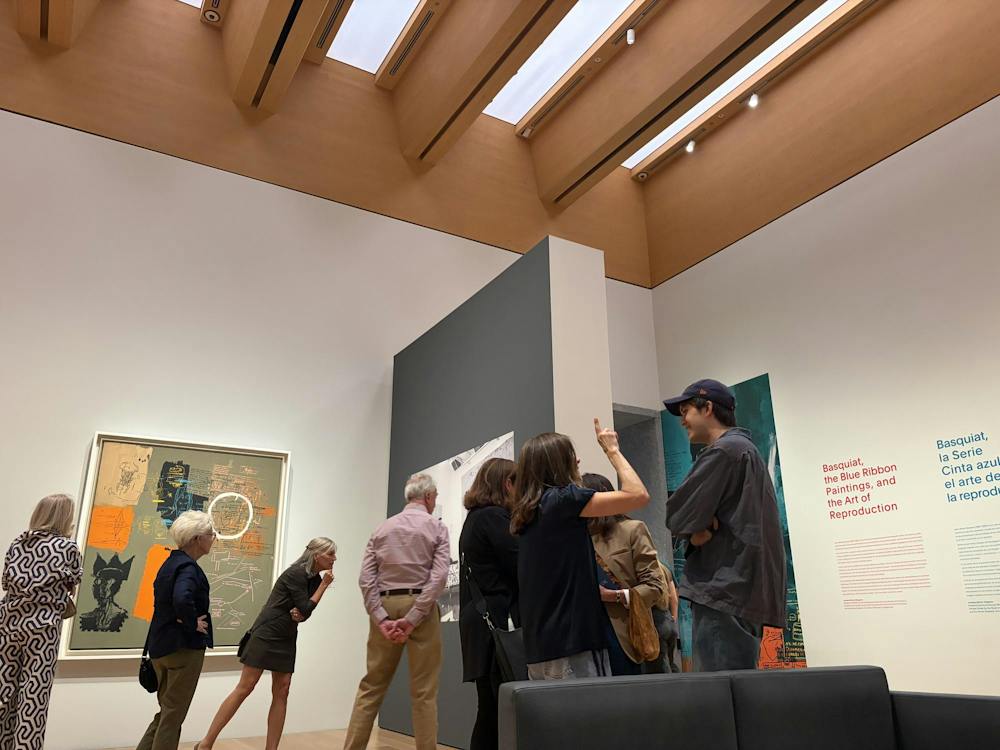
A curated sense of chaos unfolds as you walk through the new Basquiat exhibition at the Princeton University Art Museum. The “Basquiat, the Blue Ribbon Paintings, and the Art of Reproduction” exhibition features 60 abstractly morbid yet vibrant pieces. Viewers survey the brash and bold artworks with the recognition that there is something remarkable, something revolutionary in each of them.
A seminal figure in the late 1970s and 80s neo-Expressionism movement, Jean-Michel Basquiat rose through graffiti, gaining notoriety through his graffiti project SAMO©. He and his partner, Al Diaz, littered the streets and walks of Manhattan with epigraphs labeled by the motif SAMO©, concentrating on the cultural hotbed of the Lower East Side. Their brand was angsty and breathlessly rebellious; in their own writing: “SAMO©,,, 4 THE FRAGILE,,,/SAMO©,,, 4 THE RESILIENT,,,”. As he rose to international acclaim, Basquiat’s work remained charged with observation and indictment of society and the Black American experience.
The exhibition is curated by Jordana Moore Saggese, professor of modern and contemporary art and director of the David C. Driskell Center for the Visual Arts and Culture of African Americans and the African Diaspora at The University of Maryland. Building on her decades of research, she chose to focus on Basquiat’s often overlooked use of reproduction through this curation. The exhibition became her argument for Basquiat’s interpretation of individuality.
The “Blue Ribbon” paintings are a series of 11 mixed-media canvases Basquiat created in 1984. Basquiat utilizes layers of oil stick, acrylic paint, and silkscreen to create copies of crowned figures, anatomical imagery, fragments of text, and, of course, the Pabst Blue Ribbon motif within each piece. These paintings accompany a wider cultural conversation of the 80s, when artists challenged ideas about originality and authorship. The series’ pop-culture inclusions and reproductive quality converge with a contrastingly intimate meditation on race and visibility. Basquiat asks us: Who and what is worth copying into our society’s memory?
Although much of the exhibition’s argument comes through Basquiat’s paintings, a portion of the space highlights a largely overlooked dimension of his practice: his engagement with printmaking. The show itself takes its title from Walter Benjamin’s philosophy of reproduction, which considers the debates surrounding replication and originality in society’s creative sphere.
With the Blue Ribbon series being showcased together for the first time in three decades, Saggese explained, in a statement to The Daily Princetonian, that “seeing the paintings together makes repetition itself visible as part of his process. You begin to see how deliberately he tested what could happen to an image as it moved from one work to another. That complicates the idea of Basquiat as an artist working primarily through spontaneous gestures. These paintings reveal repetition, revision, and transformation as fundamental strategies for constructing meaning.”
The use of silkscreen printing is mechanical, yet this quality does not simplify the work. The indistinguishable character of each element coalesces to make every whole piece unrepeatable. The process of reproduction itself performs authenticity in each work's unique composition of reproduced motifs. Hence, Basquiat challenges and reimagines the meaning of originality.
While the 11 Blue Ribbon pieces are most predominantly displayed, the exhibition showcases a total of 60 objects. The secondary section of the exhibit aims to showcase the methods studied and utilized by Basquiat that led to the Blue Ribbon series. “The goal was for viewers to see those transformations almost simultaneously — to recognize an image in its source form and then encounter the ways Basquiat altered, repeated, and reinterpreted it,” Saggese wrote.

For Basquiat, his preoccupation with replication and reproduction lies in childhood. Basquiat received a copy of “Gray’s Anatomy” as a gift, and from youth, he was drawn to reproductions of Leonardo da Vinci’s anatomical drawings. He came to see these faithful representations of the human form as the pinnacle of the copy, a printed fragment standing in for the whole body. The museum displays Da Vinci’s published anatomical drawings from the Royal Collection (1977) alongside Basquiat’s own anatomical studies.
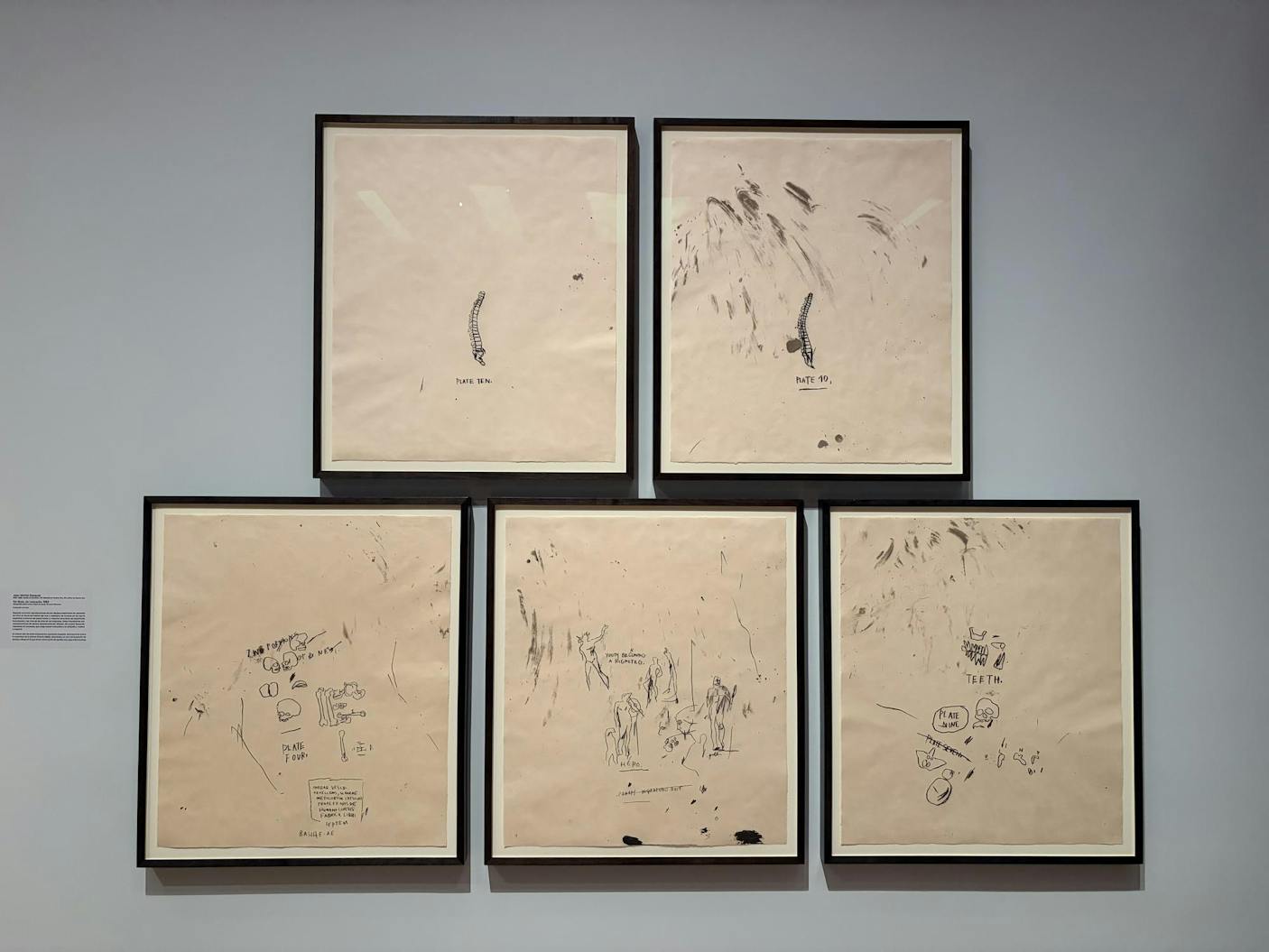
“Untitled, From Leonardo” 1983 by Jean-Michel Basquiat
Persephone Lee / The Daily Princetonian
The exhibit displays many of Basquiat’s studies of da Vinci’s anatomical drawings. “Untitled, From Leonardo” (1983) are Basquiat’s own sketches copied from da Vinci, transferred and printed onto sheets of Okawara rice paper. Effectively, these are reproductions of reproductions. These are further repeated in the “Notary” (1983), another piece displayed at the museum. Basquiat doesn’t just recreate his inspirations; he’s known for his works too. He uses silkscreen printing in order to repaste what he had already drawn.
Also on display are postcards Basquiat made with Jennifer Stein, an artistic collaborator and friend of Basquiat, small collages cobbled from particles of everyday ephemera. The contents are idiosyncratic, peculiar, and deeply personal. In contrast to the universal familiarity embedded throughout ‘Blue Ribbon’ paintings, these postcards are pedestrian — things that could never be mistaken for high art outside their glass cases. Indeed, Basquiat sought to critique the gap between enshrined, curated art, and mass-produced traffic; he sold them outside museums, positioning himself between the disparate worlds of high art and street commerce, a vantage point that harkens back to his earlier days as SAMO©, writing intimate meditations on Manhattan walls.
The curation aims to place the Blue Ribbon series in the context of influences Basquiat received in order to “trace Basquiat’s engagement with reproduction across different moments and media,” according to Saggesse. To accomplish this, the exhibition is accompanied by pieces from Robert Rauschenberg and Robert Blackburn. Rauschenberg, who worked with prints and stencils for two decades before Basquiat, is one of the central additional artists on display. His work on view includes the appropriately anatomical “Booster” (1967): a monumentally sized print of a skeleton, “Ringer” (1974), “Suburban” (1962), “Accident” (1963), “Urban” (1962), and “Sketch for Monogram” (1955–59, printed 1973). His combined pieces that inspired Basquiat’s own techniques move between the handmade and the mechanical, and feature subjects of found photography, high art, and pop culture.
Robert Blackburn, a lesser-known mentor of Rauschenberg, has his works “Windowed Shapes” (1963) and “Blue Window” (1962–63) on view in the exhibition. Working directly with Rauschenberg, he helped to develop the printmaking techniques that the younger artist would make his own. His inclusion adds a lesser known line of influence in printmaking, and underscores the suggestion that artistic originality has forever depended on a chain of copies and borrowed forms.

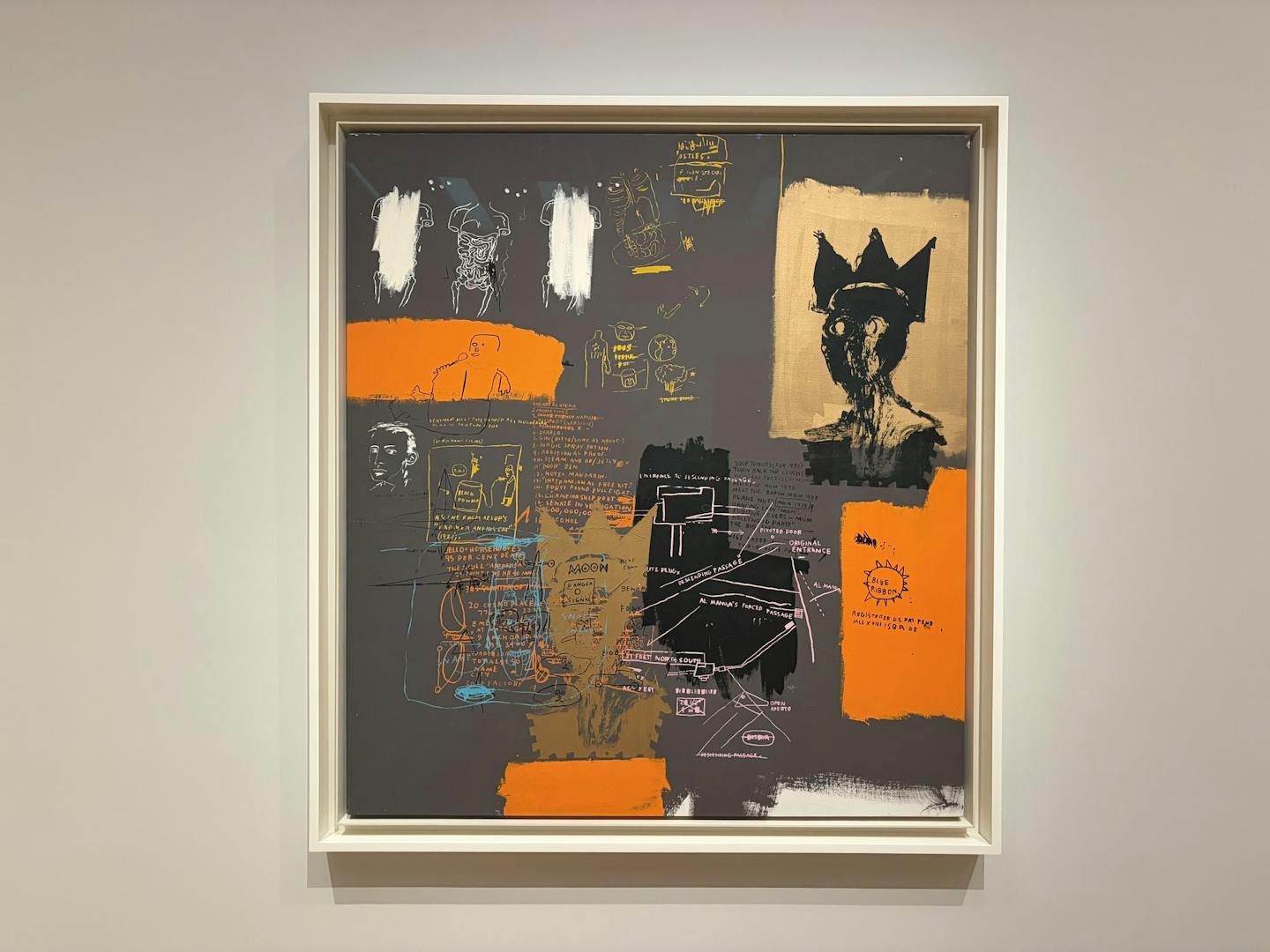
“Blue Ribbon V” 1984 by Jean-Michel Basquiat
Persephone Lee / The Daily Princetonian
Near the entrance, the first few pieces feature subdued tones of gray and brown backgrounds with relatively coherent motifs. The viewer begins here, studying the details and memorizing the main motifs. The crowned figure is repeated in different colors. The anatomical model is repeated, then covered up with white. The maps and texts overlap in thin, vibrant strokes. The canvas is imperfectly covered, but the audience is distracted by the bright orange patches. Turning the corner from the first few paintings, bright colorful pieces catch the eye.
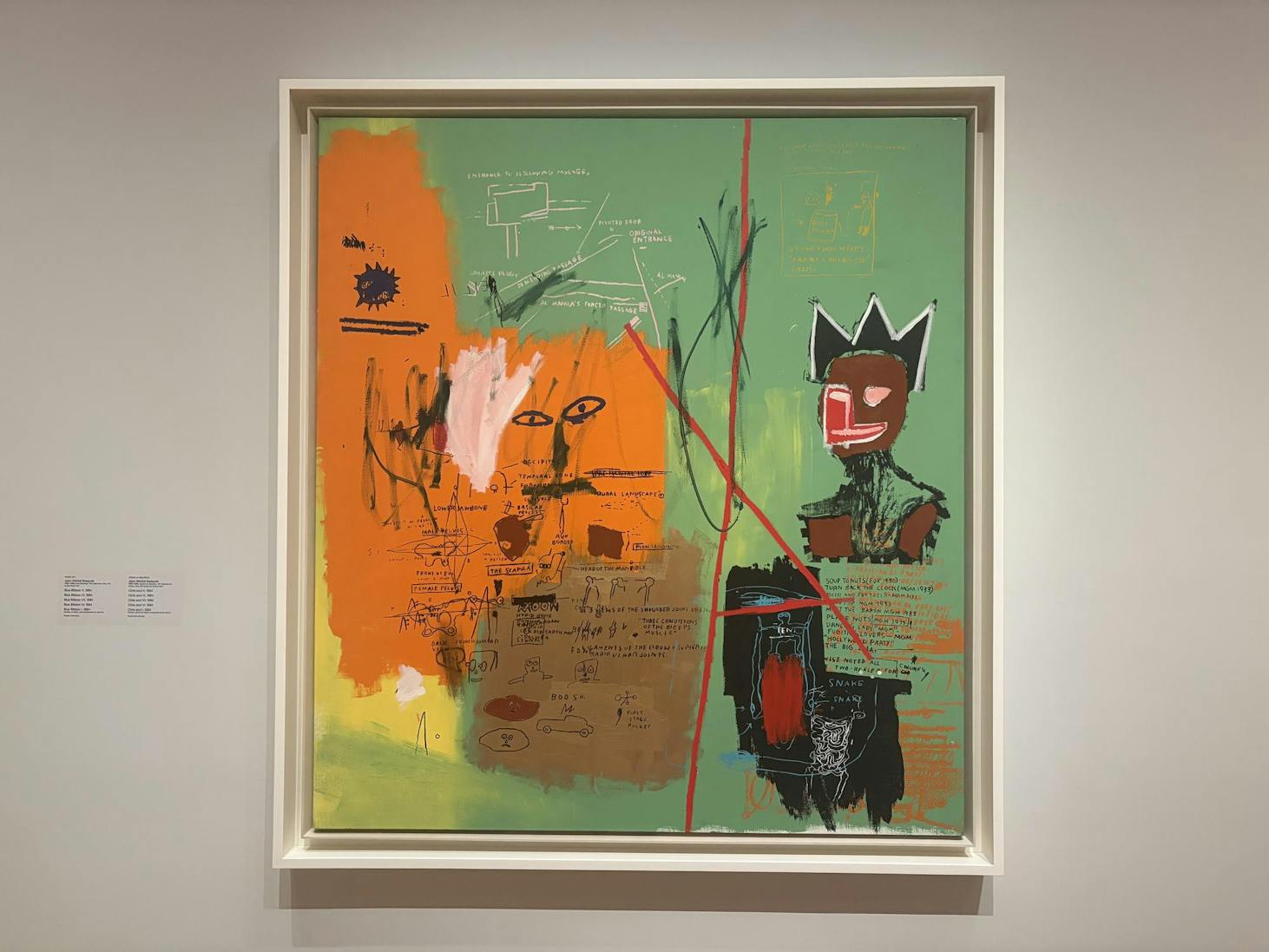
“Blue Ribbon VII” 1984 by Jean-Michel Basquiat
Bella Wu / The Daily Princetonian
“Blue Ribbon VII” remains preoccupied with the same motifs we see throughout the rest of the collection, but here, Basquiat seems to begin grappling with reproduction as a way of seriously altering original forms. The crowned figure persists, still positioned at a far edge of the canvas, as seen in many of the other works in the collection; however, the blackness of the print is now superimposed by sections of brown and red, trimmed with white outlining. Most striking, perhaps, is the obscuring of the titular Pabst Blue Ribbon logo: This alteration solidifies the piece as one of the most disparate pieces from the unmodified replications of other installations in the collection.
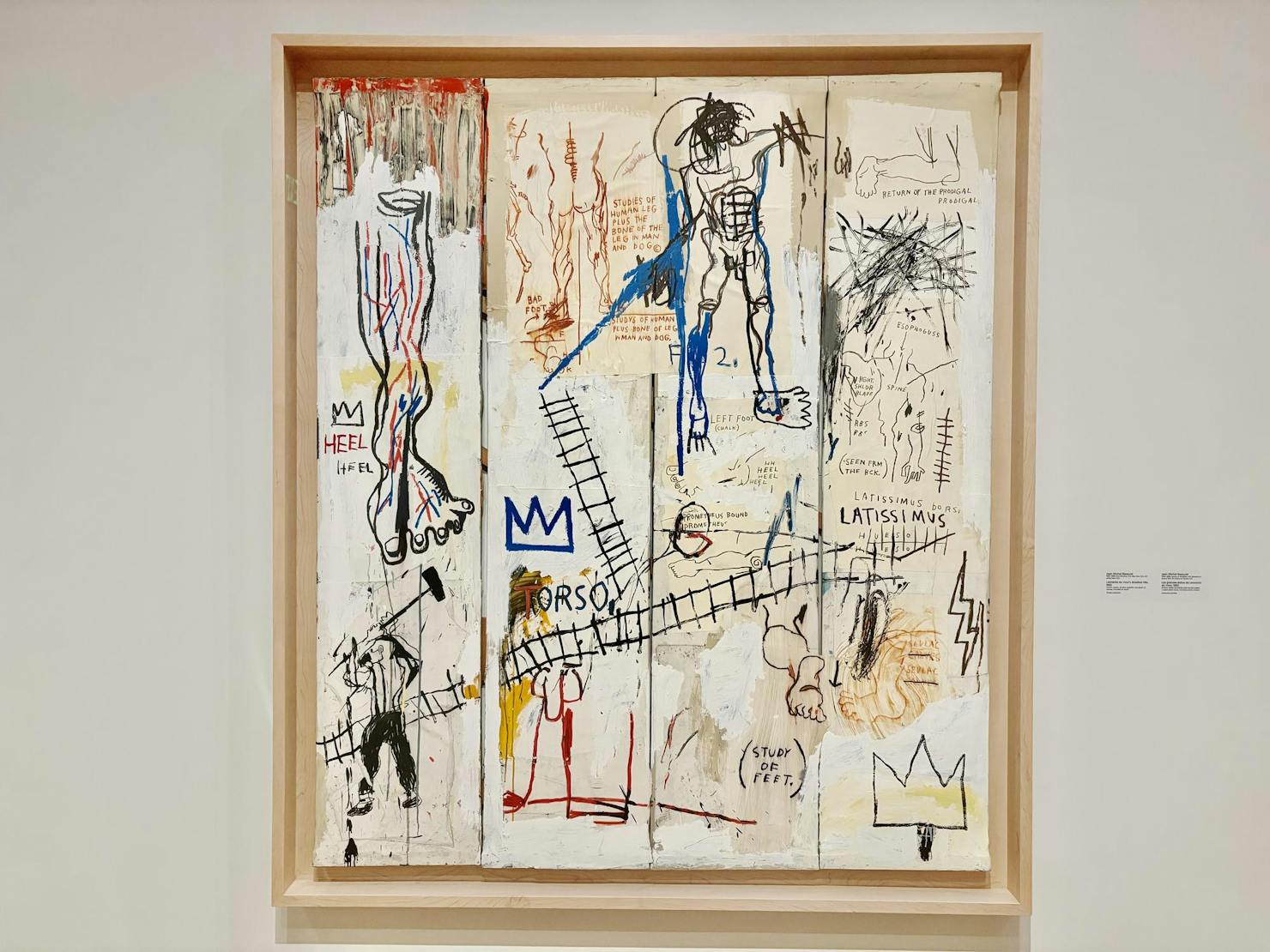
“Leonardo da Vinci’s Greatest Hits” 1982 by Jean-Michel Basquiat
Bella Wu / The Daily Princetonian
Much of Basquiat’s work seems like a frenzy of chaos, nonsense, and spontaneity, yet the heavy abstraction in his pieces often lets the eye become completely immersed in the artistic mind behind a painting. In “Leonardo da Vinci’s Greatest Hits,” white, haphazardly constructed canvas imprisons the bodily forms of Basquait’s studies. The labels on anatomical sketches, alongside streaks of primary colors, give the piece an encyclopedic, almost scholarly sensibility. Across the four canvases, the only overarching element is a crude railroad track; the leftmost section holds the only full body: a railroad worker, mid-swing. The categorical yet hugely chaotic nature of the piece transports one into the mind of a practicing Basquiat, precocious — concerned with taxonomy — yet still impulsively rebellious.
Basquiat, the Blue Ribbon Paintings, and the Art of Reproduction will be showcased at the Princeton University Art Museum until Jan. 31, 2027, before travelling to the High Museum of Art in Atlanta and the Frist Art Museum in Nashville throughout 2027.
Throughout the exhibition, visitors are seen studying the pieces in varying ways. Some stand close to the pieces, taking in every detail. Some stand at a distance, taking in the whole. Most cycle through both, walking back and forth between pieces to recall the repetitive motifs.
Saggese notes, “If you recognize an image, a word, or a figure from something you saw earlier in the exhibition, that recognition is important.”
As you explore this abstract world, choose to simply dwell on such visual impressions and wonder, “What is the meaning of reproduction?” as Basquiat had once done.
Bella Wu is a contributing writer for The Prospect and a member of the Class of 2030.
Persephone Lee is a member of the Class of 2030. She is a contributing writer for The Prospect.
Please send any corrections to corrections[at]dailyprincetonian.com.
Read More

Municipality of Princeton prepares to write new zoning code
Joshua KimThe new zoning code will replace its two separate zoning codes with a unified code. Public comments on the simplification of existing zoning codes were generally positive.
The new zoning code will replace its two separate zoning codes with a unified code. Public comments on the simplification of existing zoning codes were generally positive.

Roundup: USG statement on sexual assault allegations, proctoring during midterms, and a varsity sports update
Riley Price and Devon RudolphAn Undergraduate Student Government statement addressing a former Cornell student’s sexual assault allegations, proctoring during midterms, and a mid-season check-in with head Sports editor Lily Pampolina on Princeton’s varsity athletic programs.
An Undergraduate Student Government statement addressing a former Cornell student’s sexual assault allegations, proctoring during midterms, and a mid-season check-in with head Sports editor Lily Pampolina on Princeton’s varsity athletic programs.

Construction on Princeton’s Schmidt Hall enters demolition phase
Riley PriceEric and Wendy Schmidt Hall is slated for completion in Spring 2030.
Eric and Wendy Schmidt Hall is slated for completion in Spring 2030.