



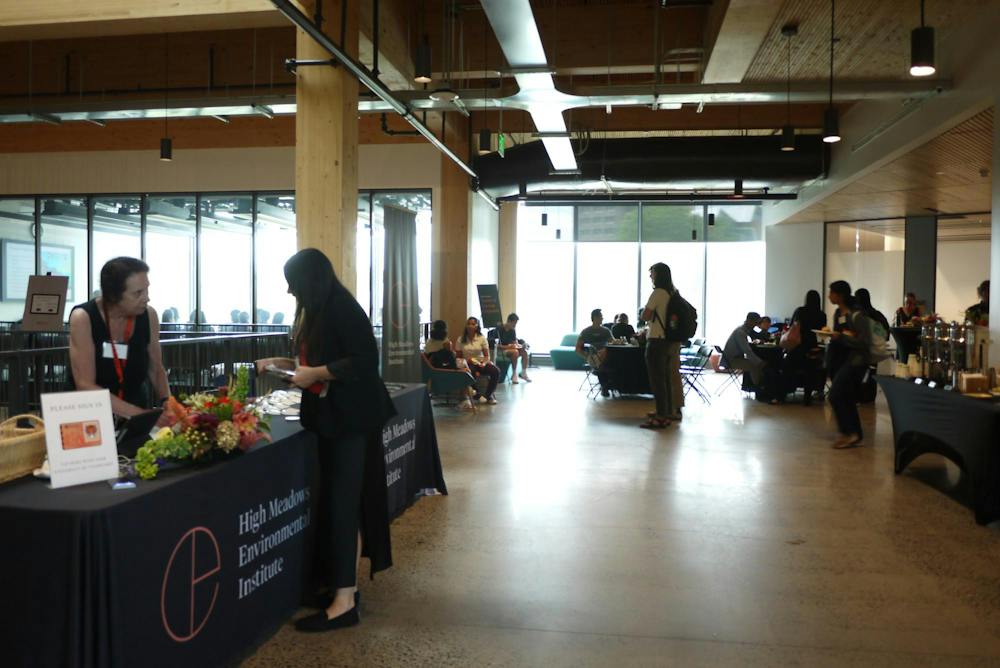
The High Meadows Environmental Institute hosted its Summer of Learning Symposium on Friday to celebrate the research Princeton undergraduate students undertook this past summer as a part of its Environmental Internship Program.
The students undertook research with 39 faculty members and one senior research scientist. The HMEI conducts research across disciplines, exploring how the Earth is impacted by human activities.
According to the institute, 122 students — out of a total applicant pool of 376 — were selected to participate in the summer internship program. Of the 122 students, there were 55 students from the Class of 2029, 43 students from the Class of 2028, and 24 students from the Class of 2027.
The summer internship allows students to experience laboratories, fieldwork, and computational experiments, participating in research with the goal of working towards a more sustainable planet. The selected interns represented a variety of backgrounds and areas of interest.
Climate and Environmental Science was the most popular of the eight project areas, which includes topics like Urban Sustainability and Environmental Policy. Interns were present in 13 foreign countries and 10 U.S. states.
“I was in Patras, Greece this summer,” Michael Arnwine ’28, a chemical and biological engineering major and HMEI summer intern, told The Daily Princetonian in an interview. “I did a computational study modeling hydrogen bubbles during hydrogen electrolysis.”
Arnwine cited the summer as a way to “jumpstart” his journey in computational research, as he plans to do his junior independent work in the Fraggedakis Research Group. The group examines how disorder in molecular, chemical, and structural heterogeneities impacts the fundamental electrochemical and transport mechanisms related to energy storage and environmental sustainability.
“I really liked learning about numerical analysis which is basically the way computers do calculus,” Arnwine said. “In regards to my project itself, it was interesting learning how life is a balance where we want to produce hydrogen but then the hydrogen causes issues for the production process. It’s a little contradictory in a way.”

Arnwine was one of five students who participated in student-initiated opportunities through the HMEI. Student-initiated opportunities are open to sophomores and juniors who have previously held an HMEI internship and are looking for funding for unfunded summer non-profit internships in the environmental field. Students applying for the student-initiated internship must submit the application through the Student Activities Funding Engine.
“This year I did the Student Initiative Fund which allowed me to choose my own project. I really appreciated that [HMEI was] very supportive of it and they were interested in hearing my ideas,” Arnwine said.
“I think my favorite thing about HMEI is that it’s so interdisciplinary. It’s not just STEM. You have art coming in. You’re working with policy. There’s all these different things coming together, and it’s really the intersection of all of that and looking towards a better future,” Lucy Carlin ’28 added.
Carlin is a geosciences major who worked under Professor of Geosciences and HMEI Curtis Deutsch GS ’03 collecting data to investigate how body size in aquatic species may be influenced by water temperature and oxygen conditions.“It’s not a finished project, but we’re testing out some of Professor Deutsch’s theoretical models that provide a physiological model for how these relationships work together and change in different geospatial gradients.”
Some students were participating in HMEI’s summer internship for a second time. “I hope to take the skills that I learned in both this internship and last summer’s internship with HMEI to continue research and work building better predictions which can inform our solutions to fighting climate change,” Carlin said.
“The first year I did it was after my sophomore year, and I worked in [The Micro-Analysis and Geochronology Laboratory] in the geoscience department, and I worked on eggshells and uranium and thorium dating them,” Kelsey Campbell ’27 said.

Campbell is a civil and environmental engineering major who worked with two other students for the Watershed Institute this past summer. They evaluated the quality of the surface water all around New Jersey’s watersheds, running hundreds of samples in the lab and testing for nitrogen, chloride, phosphorus, and the turbidity of the water.
“I am actually exploring working with the Watershed Institute for my senior thesis right now. I just had a meeting with all three of our supervisors over the summer yesterday morning, and they gave me a lot of ideas on how to continue the research this year,” Campbell said.
Over the summer at the Atkinson Lab, which focuses on using protein engineering and synthetic biology to program electroactive proteins and cells, Brian Eng ’28 worked on a project degrading forever chemicals. Eng is a computer science major.
“We have forever chemicals that are really hard to break down, and I’ve been trying to work with this template enzyme that is capable of breaking them down, but is really not that soluble. I’ve been trying to design new variants of that protein that are more soluble, and using computational tools to do that,” Eng said.
Eng states his most favorite experience during the process was when he got the results of his experiments back, “It was really interesting to look at how different sequences of proteins can fold into the same structure.”
Loapi Mokgatlhe ’29 is a mechanical and aerospace engineering major who worked with Professor Adam Maloof on the Cambrian explosion, an evolutionary burst around 540 million years ago where animals began appearing in fossil records. Mokgatlhe had no geosciences background, but still felt very supported throughout the process.
“I think if anything, I just want to take away the experience. I don’t know if I’ll continue doing anything in geosciences, but I did learn a heck of a lot doing the internship about myself and obviously about geoscience,” Mokgatlhe said.
The HMEI’s Environmental Internship program was formerly known as the Princeton Environmental Internship (PEI).
Applications for HMEI’s Summer 2027 internships will open Nov. 23, with the application closing on Jan. 12 at 2 p.m. for the HMEI established internships. Deadlines for the student-initiated internships close Feb. 18.
Mia Chen is a News contributor for the ‘Prince’ and a member of the Class of 2030.
Please send any corrections to corrections[at]dailyprincetonian.com.
Read More

USG shifts winter elections to before Thanksgiving, debates limiting slates in contentious meeting
Claire DingThe Undergraduate Student Government moved its winter elections before Thanksgiving break but voted down a proposal to ban slates for non-executive offices.
The Undergraduate Student Government moved its winter elections before Thanksgiving break but voted down a proposal to ban slates for non-executive offices.

If you give a tiger a cookie: celebrating 50 years of Murray-Dodge Café
Mia MazzeoAssistant Editor for The Prospect Mia Mazzeo celebrates and reflects on the significance of Murray-Dodge Café's 50th Anniversary.
Assistant Editor for The Prospect Mia Mazzeo celebrates and reflects on the significance of Murray-Dodge Café's 50th Anniversary.

Princeton University Orchestra and men’s ultimate frisbee team named in University’s latest hazing report
Andrew ArthurTwelve students in the Princeton University Orchestra and Men's Ultimate Frisbee team were found responsible for hazing violations in the University's latest Campus Hazing Transparency Report. Sanctions ranged from Dean's warnings to disciplinary probation.
Twelve students in the Princeton University Orchestra and Men's Ultimate Frisbee team were found responsible for hazing violations in the University's latest Campus Hazing Transparency Report. Sanctions ranged from Dean's warnings to disciplinary probation.