



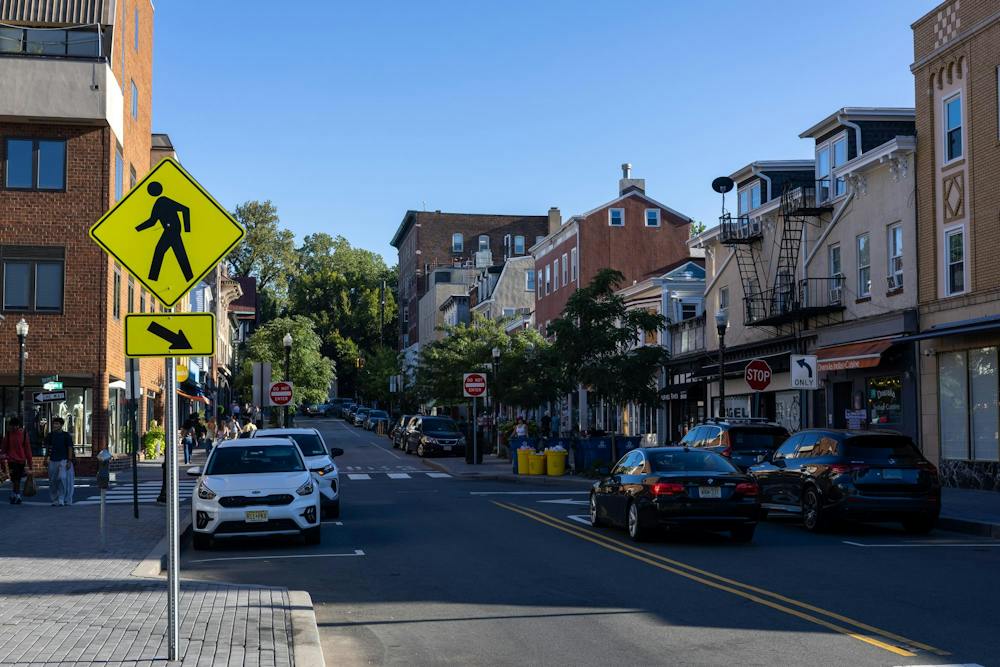
The Princeton Council passed a resolution at its Monday meeting prohibiting federal immigration officers from entering “any non-public area of Princeton’s buildings, facilities or property” for federal immigration enforcement without a judicial warrant. Immigration officers will also be prohibited from using the municipality’s land as a “staging area, processing location, [or] operations base.”
The legislation follows a similar executive order signed by New Jersey Governor Mikie Sherrill in February that limited federal immigration enforcement operations on property that is owned or controlled by the state executive branch without a judicial warrant. Months later, Mercer County adopted an order that limits the use of County property for immigration enforcement operations. Immigration and Customs Enforcement officials have detained at least 18 individuals in Princeton since President Donald Trump returned to office in January 2025.
The Council’s resolution applies to all municipal buildings, as well as municipal-owned parks, trails, and recreation facilities, including Harrison Street Park and Community Park Pool. It also includes Westminster Choir College, which the town acquired last year.
In 2025 and 2026, ICE has detained more than 610,000 people nationwide, aggressively arresting people far from the border and detaining them for longer than in prior administrations. Detentions during Trump’s second term hit a record high in July, according to internal agency data obtained by CBS News.
In a statement to The Daily Princetonian following the meeting, Councilmember Leticia Fraga wrote that she was not aware of any instances of ICE using municipal grounds to stage operations. “It is our responsibility to establish a formal policy to guide any potential future request or occurrences, ensuring clarity and consistency in line with our community’s values and state directives,” she wrote.
Fraga wrote that the only concern she heard from residents throughout the legislative process was that the measure could draw unwanted attention to Princeton’s immigrant residents. However, she expressed a different view on the issue.
“I believe, to the contrary, that this resolution serves to protect and affirm all residents, including our immigrant community, by clearly establishing protocols that enhance trust and ensure dignity when interacting with municipal property and services,” Fraga wrote. “Our aim was to make sure we got it right, rather than simply copying what other New Jersey towns have enacted,” she added.
The Council also reviewed the zoning code diagnostic report, which was part of the first phase of the “OneCode” project intending to replace a bifurcated code system with one unified, modernized land use code. The system is left from when Princeton was split into Princeton Township and Princeton Borough; despite re-merging in 2013, the municipality has continued to operate under two separate zoning codes.

“It is not healthy to continue to have two codes,” Councilmember Mia Sacks said. “We need a consolidated code, and we needed it yesterday.”
Arista Strungys, a consultant from Camiros — the urban planning and zoning firm hired by the Municipality to oversee the project — gave a brief presentation on the OneCode project’s zoning diagnostic report to the Council over Zoom.
The Council was also presented with a brief update on the Historic Preservation Commission’s adoption of the Historic Preservation Guidelines, including adjustments made to the final outline that are now live on the official website. An earlier version of the guidelines were presented to the Council on Sept. 14.
“I did run into a couple of architects since you were last here and asked them what they thought. Both of them were ecstatic. They thought this was borderline a masterwork that should be celebrated,” Councilmember Brian McDonald ’83 said.
Following Princeton’s coldest winter in 11 years, several Princeton residents asked the Council to reconsider their quiet decision to ban ice skating on Lake Carnegie last year. Multiple residents expressed disappointment at the loss of a Princeton community tradition, while others shared safety concerns with now-unauthorized skating in the area.
“We’re all really eager to work with the town and the University to figure out a way to make skating safe and also respectful of the property owners around the lake, including the University,” said Chris Sturm, a Princeton resident. “We know the climate is changing, so we're not going to have ice quite as often. But the science of safe ice is the same, and the special magical quality is also the same.”

The lake was most recently opened to skating during the winter of 2014–15.
“The municipality has recently indicated it is now reconsidering that decision and, as the owner of Lake Carnegie and certain adjacent property, the University will consider the request,” University spokesperson Michael Hotchkiss wrote in a statement to the ‘Prince.’
Also present at the Council meeting were residents advocating for the addition of two stop signs at the intersection of Hamilton Avenue and Linden Lane, and increasing road safety on Hamilton Avenue. The residents brought signs and posters in support of their cause.
The Princeton Council holds meetings at 7 p.m. on the second and fourth Monday of each month. The next Council meeting is scheduled for Oct. 12.
Reem Telhaoui is a News reporter in training for the ‘Prince’ and a member of the Class of 2030.
Please send any corrections to corrections[at]dailyprincetonian.com.
Read More

Building community one porch at a time at Princeton Porchfest 2026
Contributing writer for the Prospect Kellen Fisher shares his experience at Princeton Porchfest 2026.
Contributing writer for the Prospect Kellen Fisher shares his experience at Princeton Porchfest 2026.

Women’s soccer drops Ivy League opener to Harvard 4–3
Brooklyn FraserIn a 4–3 shootout, Princeton fell narrowly to Harvard in the Ivy League season opener.
In a 4–3 shootout, Princeton fell narrowly to Harvard in the Ivy League season opener.

AI-related Honor Code cases climb in latest five-year report
Leela HenslerThe Honor Committee recently released its latest statistics, which come as the University reintroduces proctors at in-person exams after 133 years.
The Honor Committee recently released its latest statistics, which come as the University reintroduces proctors at in-person exams after 133 years.