



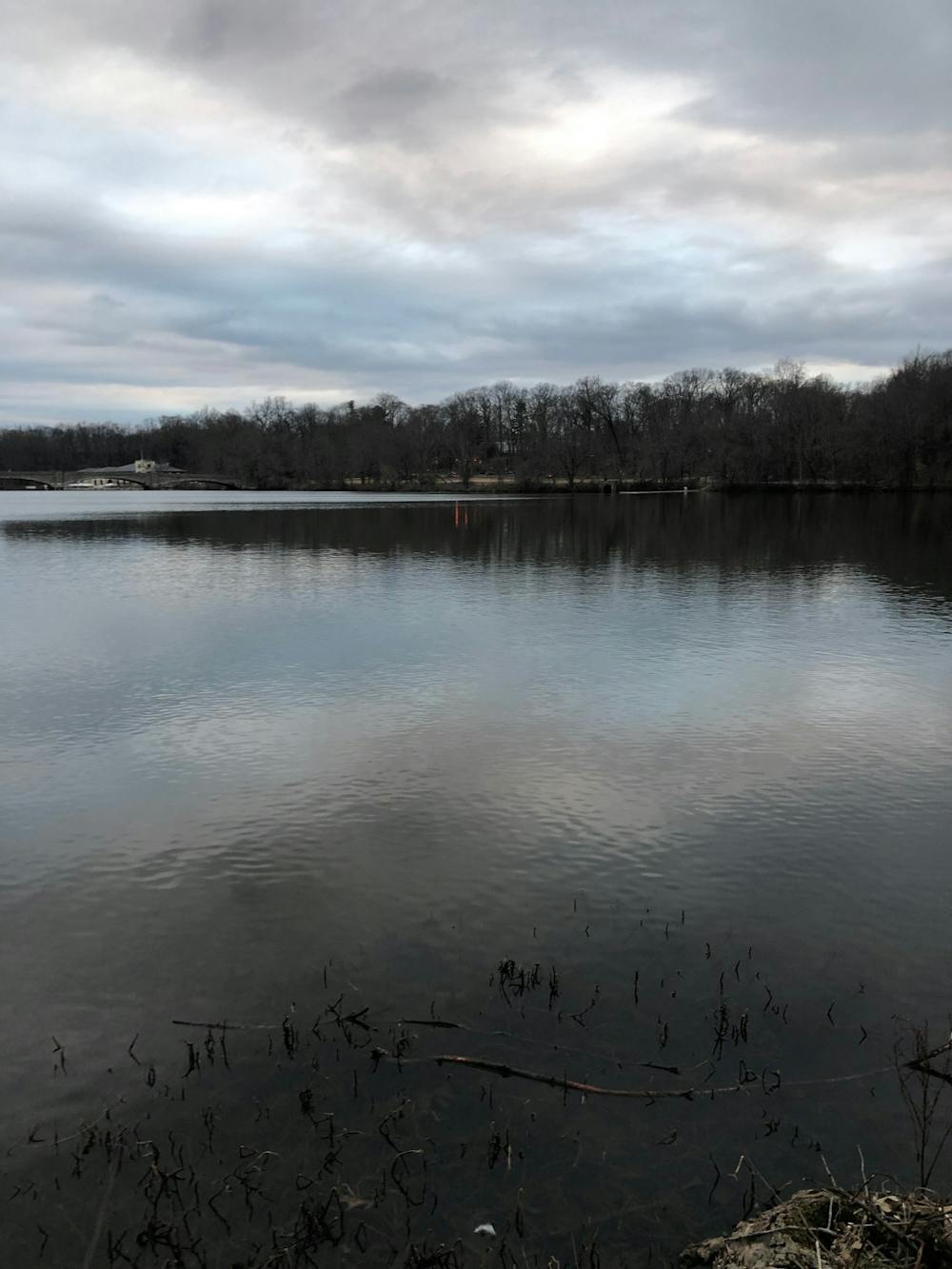
At the Princeton Town Council meeting on Monday, Council members and Mayor Mark Freda discussed the prohibition of ice skating on Lake Carnegie. The policy change, which occurred last spring, was not originally in the meeting agenda, but was discussed following several inquiries from residents.
Municipal administrator Bernie Hvozdovic stated that “it was determined last winter that, at least for the time being, ice skating on the lake would not be permitted.” He explained that the decision stemmed from multiple safety concerns. Employees were concerned about their personal safety when going out on the ice to take “borings” — measurements of ice thickness used to determine whether the lake was safe to skate on.
Emergency services officials also determined that the skating area of Lake Carnegie, which stretched from Harrison Street to Washington Street, was too large for first responders to reach skaters in time in the event of an emergency. Hvozdovic brought up additional concerns regarding lack of parking spaces due to the loss of nearby parking options — namely, the University boathouse and Lot 21 no longer being available.
Carnegie Lake has very rarely been accessible for skating in the past few decades. It was opened most recently during the winter of 2014–15, according to Hvozdovic.
Council President Michelle Pirone Lambros, who served as the recreation liaison when the decision was made, corroborated these hazards. She noted how a bubbler — a de-icing device which warms water surrounding boats to prevent ice from damaging them — located near the rowing center poses a safety risk.
While Pirone Lambros expressed a desire to “cordon off a section and have just a few hours where we allowed people to skate,” she acknowledged the risks.
In past years, the University’s Community and Regional Affairs website stated that ice skating on the lake was permissible under the condition that signage posted by the Princeton Recreation Department confirmed it was safe.
In 2025, the Princeton Recreation Department, in coordination with the Municipality of Princeton Emergency Services, stopped testing ice at Lake Carnegie when “temperatures allowed the lake to freeze,” according to Kristin Appelget, assistant vice president of Princeton University Community and Regional Affairs.

Following this decision, the University worked with the Recreation Department to update the Lake Carnegie signage and webpage accordingly, with the website now simply reading: “Ice skating is not permitted on Lake Carnegie.”
There remain two other locations in Princeton that the Recreation Department actively monitors for safe skating conditions: Barbara Smoyer Park, and Community Park North. In recent days, the pond at Smoyer Park has mostly been marked as safe for skating, while the department still considers Community Park North unsafe due to uneven surfaces.
Councilwoman Mia Sacks said she had not been aware of the decision to forbid community members from skating on Lake Carnegie until community members began reaching out to her in the past week.
She noted her belief that the decision was “not arbitrary and capricious” but rather “based on consultation with Princeton’s emergency services department and the Princeton First Aid and Rescue, who couldn’t guarantee that they would be able to save a life in time.”
Still, she said she wishes that the issue “had come to Council for us to discuss it.”
“It’s a really significant, important, valuable memory for those of us who feel a strong connection to this town,” Sacks said of skating on Carnegie Lake. “If there’s any way we could eke out some way to continue that memory, I hope that we could do that.”

Freda pushed back on any suggestion that the decision was hidden.
“I do not believe the decision was hidden from anyone from the Council or the public,” he said.
Councilman Leighton Newlin supported the change. He suggested there were more important issues to focus on, including the recent death of a homeless person in Mercer County due to freezing temperatures in their car.
“Let’s weigh skating on the ice for a few people with somebody freezing to death in their car. We have really big fish to fry here in Princeton, and … keeping people safe that are vulnerable in difficult times is really what we should be focusing on,” Newlin said.
Despite the safety rationale, several residents urged the Council to find a compromise. One Princeton resident, Chris Sturm, told the Council that skating on the lake is “a tradition and not traditionally a reckless decision.” She noted that she believes many people skate on the lake despite the prohibition.
Along with other Princeton residents and Council members, Sturm requested that “the Council work with its professionals and with volunteers to figure out how to offer ice skating opportunities in the future” and pointed to the newly-built, multi-floor Stadium Drive Garage as a potential solution to parking concerns.
Sacks expressed the same sentiment regarding working towards a compromise of safety and enjoyment. She suggested an area reserved for skating, with emergency services stationed nearby during limited skating hours.
At the start of the Council meeting, four Princeton Police Department (PPD) officers were formally promoted in a ceremony, though they had already taken on their new roles: Ashley Levins to corporal, Michael Schubert to sergeant, Daniel Federico to lieutenant, and Thomas Lagomarsino to captain.
The Council also heard a presentation of the 2025 Urban Forestry Report, which noted that Princeton has maintained its Tree City USA designation for 29 years and planted 276 street and park trees. However, Councilman Brian McDonald highlighted that the town has lost 5.5 percent of its tree canopy — equivalent to 653 acres — over the past 13 years.
The meeting concluded with the Council voting on a series of ordinances. One ordinance was approved, two had new public hearings set for the Feb. 23 meeting, and six affordable housing-related ordinances were introduced.
Emily Chien is a staff News writer for the ‘Prince.’ She is from Arcadia, Calif., and can be reached at emilychien[at]princeton.edu.
Please send any corrections to corrections[at]dailyprincetonian.com.
A correction was made on Feb. 11, 2026: A previous version of this article referred to the Theater Drive Garage as a possible solution to parking concerns. It has since been corrected to the Stadium Drive Garage. The ‘Prince’ regrets this error.
Editor’s note: This article has been updated to remove information Hvozdovic shared during the meeting that, prior to 2014-15, Carnegie Lake was most recently opened to ice skating in 1996. The ‘Prince’ could not verify this claim.
Read More

Forbes renovation scope still undecided as Hobson prepares to open
Gus Vogel and Daphne LewisAs Forbes students prepare to become the first cohort to live in Hobson College next year, specifics on Forbes' own renovation remains unsettled by the University nearly six months after the University announced it was accepting consultant bids for a campus-wide dorm renovation plan.
As Forbes students prepare to become the first cohort to live in Hobson College next year, specifics on Forbes' own renovation remains unsettled by the University nearly six months after the University announced it was accepting consultant bids for a campus-wide dorm renovation plan.

Prospect Picks: back to school
Kaichen Chou, Gavin McLoughlin, Mia Mazzeo, Amaya Taylor, Amy Jeon, and Ysabella OlsenEditors of The Prospect write about their recent favorites in media, trends, and food.
Editors of The Prospect write about their recent favorites in media, trends, and food.
Princeton Council details historic guidelines for property owners
Kimberly HutchinsonThe Princeton Council discussed the municipality’s recently-released final draft of historic guidelines at its Monday meeting. These 250-page guidelines seek to provide property owners with greater clarity on the current historic ordinances in Princeton.
The Princeton Council discussed the municipality’s recently-released final draft of historic guidelines at its Monday meeting. These 250-page guidelines seek to provide property owners with greater clarity on the current historic ordinances in Princeton.