



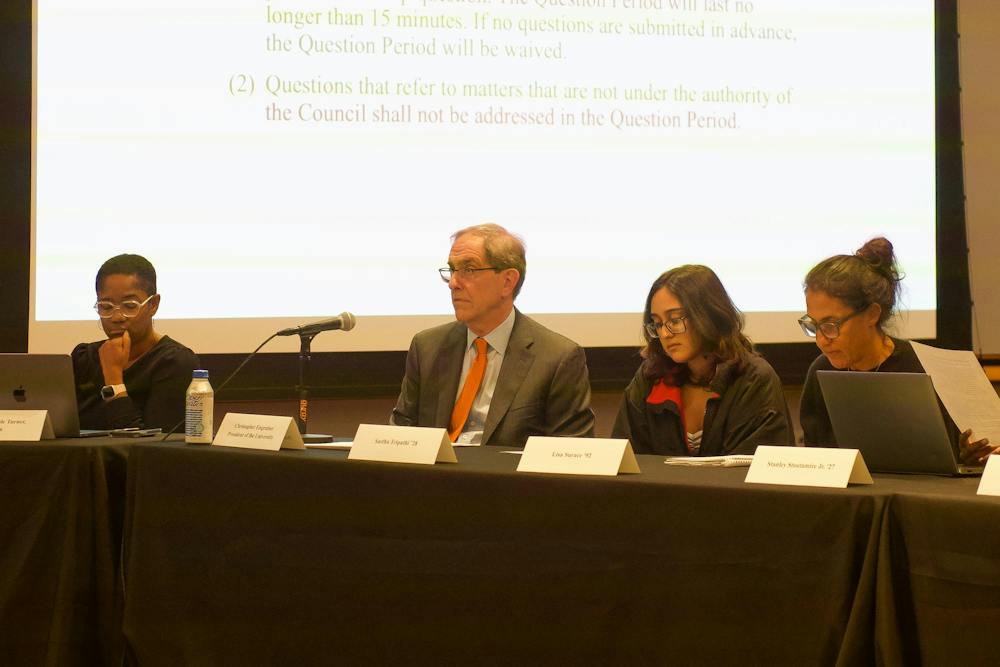
At the first Council of the Princeton University Community meeting of the academic year, Provost Jennifer Rexford ’91 gave an update on the University’s budget outlook and two planners discussed the ongoing development of a campus design and expansion framework. Discussion of those agenda items, however, began only after nearly an hour of debate and procedural delays surrounding motions made by U-Councilors Isaac Barsoum ’28, Ian Mann ’28, and Stanley Stoutamire ’27.
The hour of debate concerned the approval of the Council’s annual order of business. Barsoum proposed a successful amendment removing the requirement that questions from the University community be presubmitted, while Mann and Stoutamire unsuccessfully sought changes to undergraduate representation on the CPUC Priorities Committee.
Barsoum is an associate Opinion editor for The Daily Princetonian.
Barsoum’s amendment allows for University community members to ask questions which were not presubmitted to the Council, and was passed by a majority vote. The previous policy required community questions to be submitted in writing by noon of the Friday prior to each Monday CPUC meeting of the academic year.
Prior to submitting his motion, Barsoum explained his reasoning for the amendment.
“After these presubmitted questions are posed, you will hear rehearsed, prepared, scripted, choose the adjective you like answers from the president, and depending on the question, other members of the University administration,” he said. “This erodes transparency in this body by prioritizing image over honesty.”
In response to Barsoum’s critique of the question-and-answer policy, Rexford argued that advance notice was needed in order to effectively answer questions from the community.
“When we get questions on Friday, we spend a good portion of our weekend preparing thoughtful answers, reaching out to colleagues who couldn’t be here today with expertise on the matter, so that we could give thoughtful and thorough answers,” she said.

Other CPUC members voiced concerns about Barsoum’s amendment to the policy, although many agreed that the language seemed reasonable. The amended policy approved by the Committee will still prioritize presubmitted questions over those asked in real time during the 15-minute Q&A portion of each meeting.
Still, some members of the Council expressed concerns that the proposed amendment would allow for bad-faith questions to be posed to University administrators, undermining the deliberative purpose of the CPUC.
“I can also imagine that there are bad faith reasons for last-minute questions, the kind of gotcha situations,” said Professor of African American Studies and Art and Archaeology Chika Okeke-Agulu, a member of the CPUC Executive Committee. “But I think the spirit of allowing for questions to come in at the forum … I think we need to consider that.”
At the Feb. 9 meeting of the CPUC, where Eisgruber held his annual town hall and questions do not need to be submitted in advance, Barsoum asked him a live question about what he described as University investment in Israeli weapons manufacturing. He later asked a follow-up question to Eisgruber’s response.
“So the University will not decide to not invest in unquestionable moral atrocities?” Barsoum asked.
“Isaac, I think you, as a Princeton student, are good enough to understand why that’s not a reasonable question if we’re going to discuss this topic,” Eisgruber said in response in Barsoum’s follow-up. Eisgruber added that he did not view it to be the job of the University to adjudicate questions of morality and international politics.

Barsoum described the Q&A period of the Council as an important forum for expressing opinions of the University community to what he described as Princeton’s only public deliberative body in an interview with the ‘Prince.’
“I think it’s a way of us being exposed to each other’s views, no matter how uncomfortable we may view them as, and it’s a way for members of our community to insert their own concerns into the campus conversation on a variety of important topics,” he said. “My question was posed in good faith,” he added, referring to his Feb. 9 question.
According to the CPUC Charter, the Executive Committee includes the President of the University, although Eisgruber is not listed on the 2026–27 committee assignments page under the Executive Committee. Mann raised this point and expressed his intent to invoke unanimous consent to revise the committee assignments to reflect the Charter, but Eisgruber stated that he had appointed Rexford to serve in his stead. It was not clear if a permanent appointment of the provost to the committee was permissible under the charter.
“We just wanted to make sure that we were going through all of the processes of the Council correctly, and we wanted to make sure that everything was in order before we agreed to the resolution of the order of business,” Mann said in an interview with the ‘Prince.’
Mann also raised concerns over appointments of undergraduates to the CPUC Priorities Committee, which reviews the annual University budget and advises the president on plans for development. He criticized the lack of any undergraduate students who concurrently serve on the CPUC and the Priorities Committee, as is the case in some other committees, and argued that having an Undergraduate Student Government member on the committee would be more representative.
“The noted and intentional absence of undergraduate members of [the CPUC] on the Priorities Committee is unacceptable,” Mann said at the meeting.
Mann’s motion to avoid approving the undergraduate appointments to the Priorities Committee while moving on the remainder of the CPUC’s order of business for the year failed. This followed discussion of and uncertainty over parliamentary procedure.
“We do have two architects waiting to talk to us about the campus plan and the future of our campus over the next 50 years. They’ve come respectively from New York and London for this meeting,” Eisgruber said 50 minutes into the meeting, before debate continued on the motion to approve the committee membership.
Stoutamire then moved to amend the proposed Priorities Committee assignments, striking one undergraduate’s name and substituting in Mann’s. Stotamire’s motion was followed by debate over whether the undergraduate appointees to the Priorities Committee are intended to be representative of student concerns.
“The administration has chosen to decline to nominate any of the U-Councilors put forward by the Undergraduate Student Government president,” Mann said. “This body is supposed to represent our entire community, and we must ensure that all of our committees reflect that fact.”
Rexford offered a different perspective, suggesting that appointments to the Priorities Committee are intended to offer a diverse perspective rather than explicitly representing undergraduate students.
“Our procedure each year is to view all the members of the Priorities Committee as offering perspectives from different parts of the campus community, not being representatives of a particular constituency, but offering the perspective that comes from their role in the community,” she said, noting that the student selection process includes input from administrators and faculty.
In a written “notice of motion” provided to CPUC members, Mann said that the University had made an agreement with USG to consult with them and the USG President, Quentin Colón Roosevelt ’27, about any undergraduate appointments to the standing committees.
“This agreement was upheld for the committees of this body, with the notable exception of the Priorities Committee, where Provost Rexford selected four undergraduates without consulting either USG or the Executive Committee,” the handout read.
Colón Roosevelt said that he and USG Vice President Anuj Krishnan ’27 had expected to work with the University on appointments to all of the CPUC standing committees, including the Priorities Committee.
“We were told at the beginning of the summer that we would be able to make appointments to key CPUC committees in the fall, including [Rights and Rules], Naming, and Priorities, which we told the U-Councilors about and gathered a list of names,” Colón Roosevelt wrote. “At the beginning of this semester, we were told by the president’s office that the Provost had moved ahead with appointments for Priorities on her own, but we were still able to make appointments to the other committees.”
University spokesperson Michael Hotchkiss said that USG had opportunities to propose appointments to the standing committees in a statement to the ‘Prince.’
“The Secretary of the CPUC reached out to the USG president and vice president multiple times beginning in May to share information about the selection process for CPUC committees and to request suggestions of undergraduates to be considered,” Hotchkiss wrote. “The secretary received no response until Sept. 17, by which point the Priorities Committee slots had been filled so the committee could begin its work.”
Colón Roosevelt and Krishnan were informed on Aug. 28 that the Priorities Committee spots had already been filled, although they were not told student recommendations had to be submitted before then, Colón Roosevelt told the ‘Prince.’
Stoutamire’s motion to substitute Mann’s name for another undergraduate appointee to the Committee eventually failed. Colón Roosevelt and Krishnan were among those who did not support Stoutamire’s motion.
After the Council’s order of business was approved, Rexford presented updates on the budget climate following waves of cuts to University hiring, research funding, programming, and other areas of spending. University employee benefits and salary increases were reduced in February amid several other budget reductions. At the meeting, Rexford projected a more positive outlook for salaries.
“Beginning in January, there are going to be changes to faculty and staff benefits that have been communicated earlier this month, and while we still preserve the breadth and competitiveness of our programs, I’m really glad to say that because of these changes, we’re able to return to more typical salary increases next year,” she said.
In his 2026 “State of the University” letter, University President Christopher Eisgruber ’83 detailed the University’s shift from the rapid physical development of the last decade toward a period of strategic consolidation.
Following Rexford’s presentation on budget, the Council heard from planning partners Olivia Jia from WXY Studio Place and Stuart Cade of MICA Architects on updates to Princeton’s 2026 Campus Plan. The updated plan “will identify options and anticipate scenarios that inform the University’s long-term decisions related to renovation, infrastructure, and new development required to accommodate University needs over the next thirty years and beyond,” according to the Princeton Facilities website.
Jia and Cade emphasized the long-term approach to Princeton’s developmental framework for campus growth, adding that there would be multiple opportunities for undergraduates and graduate students to provide feedback before the report is finalized.
The next CPUC meeting will take place at 4:30 p.m. on Nov. 9 in the Multipurpose Room of Frist Campus Center.
Kian Petlin is a senior News writer for the ‘Prince.’ He is from San Francisco and typically covers University administration and the state of higher education. He can be reached at kianpetlin[at]dailyprincetonian.com.
Please send corrections to corrections[at]dailyprincetonian.com.
Read More

No. 8 field hockey falls to No. 10 Harvard in shootout, 4–2
Emilia ReayNo. 8 Princeton fell to No. 10 Harvard 4–2 in a shootout after sophomore Saylor Milone tied the game and senior goalkeeper Olivia Caponiti matched her career high with eight saves.
No. 8 Princeton fell to No. 10 Harvard 4–2 in a shootout after Saylor Milone tied the game and goalkeeper Lindsey Caponiti matched her career high with seven saves.

PPPL contract extended amidst AI research ventures, concerns over facility management
Haeon Lee and Ryan BuschmanThe lab, a longstanding collaboration between Princeton and the U.S. Department of Energy, has been investing in new AI-related research.
The lab, a longstanding collaboration between Princeton and the U.S. Department of Energy, has been investing in new AI-related research.

Physics department concludes AI grading experiment, shares mixed results
Claire DingThe physics department ran an experiment using Claude to grade students’ final exams in PHY 104: General Physics II, though the actual final grades were done by hand. Some inconsistencies between AI-graded exams and faculty-graded exams.
The physics department ran an experiment using Claude to grade students’ final exams in PHY 104: General Physics II, though the actual final grades were done by hand. Some inconsistencies between AI-graded exams and faculty-graded exams.