



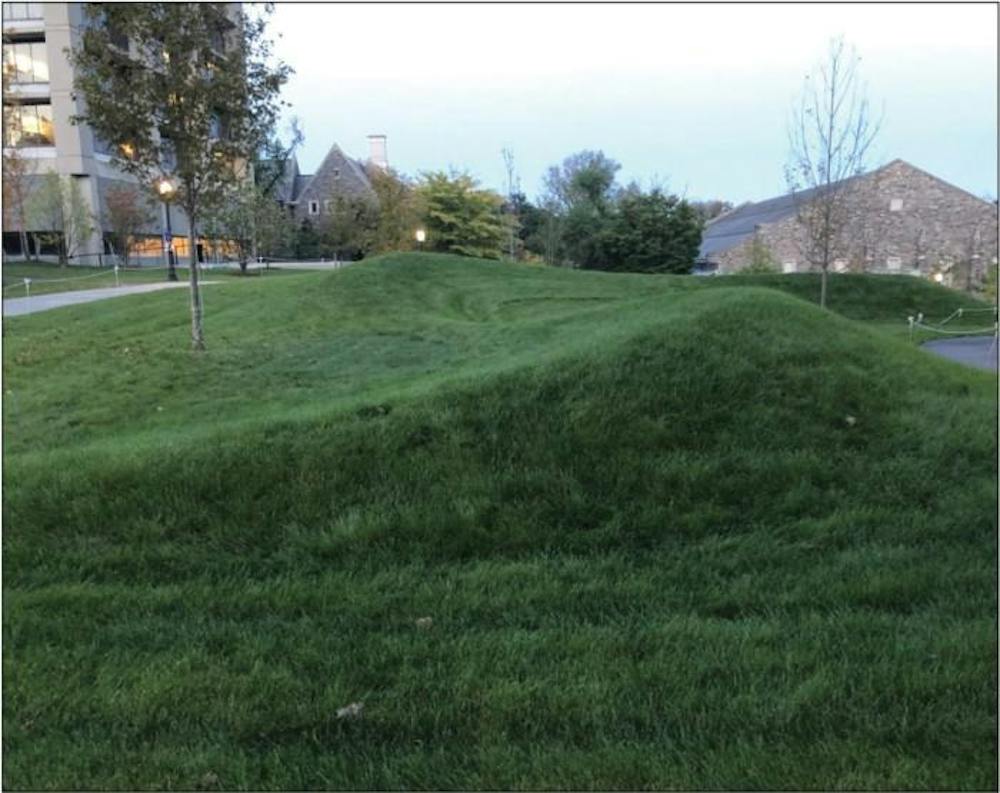
Walking past the Lewis Arts Complex on the way to Wawa or to get to rehearsal, it’s easy to rush along the path and travel through the complex without noticing the work of a nationally acclaimed artist hidden within the grass.
This week in history, we reflect on the commission of artist Maya Lin’s “Princeton Line” and “Einstein’s Table,” reminding everyone, whether it be their first visit to campus or on students’ daily route to class, to honor Lin’s entreaty to slow down, take a moment, and examine the natural world all around.
In September 2017, world-renowned artist and designer, Maya Lin, was commissioned by the University to create an installation outside the then-newly finished Lewis Arts Complex. Following the announcement, students at the time shared their excitement at having Lin’s artistry feature as an accessible work on campus.
Lin first rose to prominence in 1981 when she won the national competition to design the Vietnam Veterans Memorial in Washington D.C. while still an undergraduate student at Yale. Lin has designed additional monuments, including the “Civil Rights Memorial” in Montgomery, Ala. and the “Women’s Table” commemorating coeducation at Yale.
The artist’s tie to the University began years before her artwork joined the campus collection, though.
On October 4, 2011, Lin delivered a lecture as the Belknap Visitor in the Humanities, part of the Memory and the Work of Art Distinguished Lecture Series. The Series was one component of a year-long program of exhibitions, performances, and lectures commemorating the 10-year anniversary of 9/11.
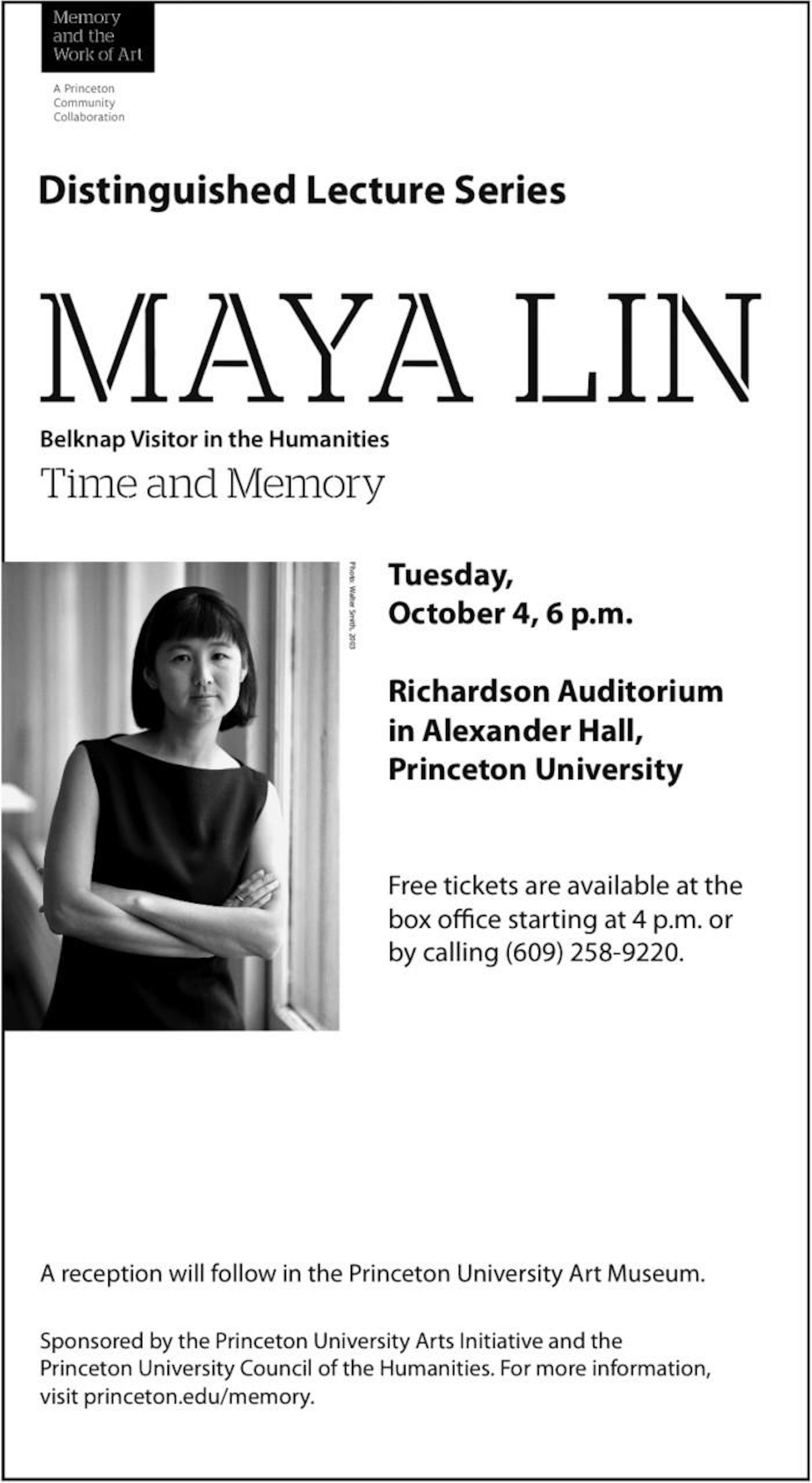
Advertisement promoting Lin’s lecture printed in the ‘Prince’ on Sept. 29, 2011.
The Daily Princetonian
The audience in Richardson Auditorium heard Lin reflect on her design for the Vietnam Veterans Memorial, sharing her philosophy of highlighting the individuals lost in combat rather than the politics surrounding the war itself. She explained her choice to use small text on the memorial: “You’re actually asking people to read that book in a very private way even though you are actually very public.”

Lin also spoke about her later pieces, which shifted to focus on the environment and ecology. The move saw her emphasize natural forms and the earth as her medium, a technique which would soon be on display on Princeton’s own campus. In 2000, as part of the Confluence Project, which marked the bicentennial of Lewis and Clark’s Expedition across the Western United States, Lin created a multi-location commemorative landscape installation, emphasizing waterways and connecting visitors to the environment itself. Marking multiple stops along the path Lewis and Clark traveled, Lin elected to use local, natural materials including driftwood, oyster shells, basalt, and native black locust wood.
By the time the University commissioned Lin in 2017, much of her body of work was centered around the earth, promoting the preservation of nature.
A little over a year after Lin was hired, significant progress was made on the Princeton installation. On Oct. 10, 2018, The Daily Princetonian reported that the “folded earth piece,” now known officially as “The Princeton Line” was completed.
The sloping hills of the earthwork piece are meant to camouflage as the natural landscape and appear organic. Students at the time had mixed feelings about the subtlety of the piece. One student, Lourdes Santiago ’21 shared with the ‘Prince,’ “They look nice, but I thought they were just hills.”
Resonating with the form, Nadin Maukhtar ’21 shared, “The swirls seem to connect with each other and they do so permanently, which can symbolize feeling stuck in a stage of your life because you’re anxious to move on and aren’t sure of the outcome.”
The earthwork was one of two parts of her commission for the Lewis Center, with “Einstein’s Table” completing the installation in November 2019. Lin shared that “having the chance to create two works in dialogue with one another that respond to the cultural context in which they are placed and allow me to explore two distinct aspects of my work is a unique and challenging opportunity.”

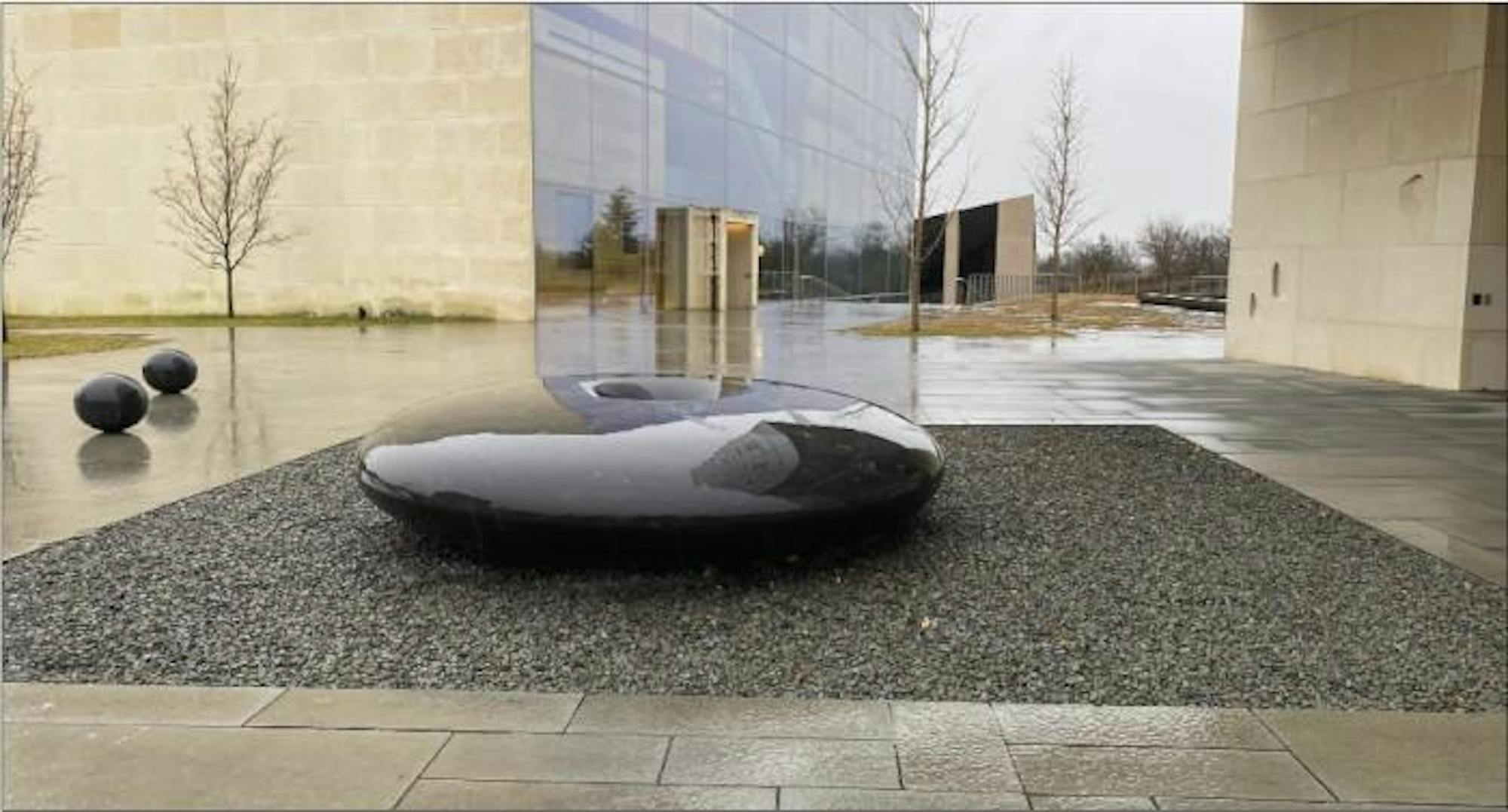
Lin “Einstein’s Table,” a water table sitting outside the Lewis Center for the Arts
Zoe Berman / The Daily Princetonian
Returning to speak at Richardson Auditorium following the culmination of her commission in 2019, Lin reflected on the environmental focus of the works.“Einstein’s Table” used Virginia Mist stone with water flowing over its surface to mimic the natural phenomenon of a black hole. The “Milky Way quality” of the stone, chosen intentionally by Lin, recalls Einstein’s theory of relativity. On the “Princeton Line,” the artist told the audience her hope that the piece would remind visitors to get “to know what’s going on right underfoot.”
In conversation with the artist on stage, James Steward, director of the Princeton University Art Museum, shared that Lin reminds “us to contemplate our relationship with the physical world around us, whether it’s natural or shaped by the human hand.”
Nearly a decade later, the water running over “Einstein’s Table” still captures the glint of the sunlight, and the gentle curves of the “Princeton Line” continue to invite onlookers to explore its dips and hills. Lin’s work stands as a reminder to take a moment to appreciate the pieces of beauty all around.
Jillian Ascher is the head Archives editor for the ‘Prince.’
Please send any corrections to corrections[at]dailyprincetonian.com.
Read More
Fall Street Week sees increasing selectivity at eating clubs
Nicole JiaCap and Gown Club, Ivy Club, and Tower Club held Bicker this fall, and 25 of 162 junior and senior bickerees received bids. Quadrangle Club and Colonial Club also accepted new members through the central sign-in process.
Cap and Gown Club, Ivy Club, and Tower Club held Bicker this fall, and 25 of 162 junior and senior bickerees received bids. Quadrangle Club and Colonial Club also accepted new members through the central sign-in process.

Princeton’s Class of 2030 had an acceptance rate of 4.0 percent, lowest in history
Gray CollinsJust over 4 percent of the 46,618 students who applied to join the Class of 2030 were admitted. Of those accepted, 76 percent matriculated, and 29 students were admitted off of the waitlist and enrolled.
Just over 4 percent of the 46,618 students who applied to join the Class of 2030 were admitted. Of those accepted, 76 percent matriculated, and 29 students were admitted off of the waitlist and enrolled.

Local businesses and residents reflect on NJ Governor Sherrill’s move to Princeton mansion
Novia Chiang and Albert TanNew Jersey Governor Mikie Sherrill officially moved into Drumthwacket, a Princeton mansion that is the official residence of the governor, with her family in August. Local residents and business owners shared their thoughts with the ‘Prince.’
New Jersey Governor Mikie Sherrill officially moved into Drumthwacket, a Princeton mansion that is the official residence of the governor, with her family in August. Local residents and business owners shared their thoughts with the ‘Prince.’