



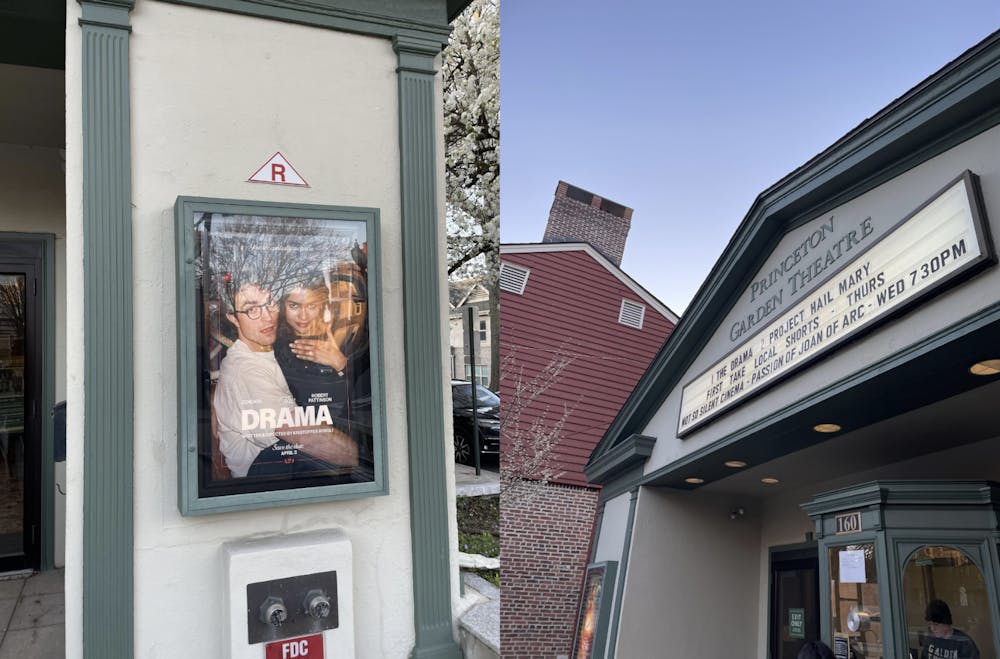
Spoiler warning: This article contains spoilers for “The Drama.”
What’s the worst thing you’ve ever done? While I wish mine were a more interesting answer, it was most likely cutting the women’s bathroom line at the Eras Tour right before Taylor went onstage. A24’s latest release, “The Drama,” is based on this very question.
A USG Movies’ pick from earlier this month, the film was immensely popular, with some students lining up an hour early just to sit on the theater’s floor. Starring Zendaya and Robert Pattinson as main characters Emma and Charlie, the story follows the couple in the week leading up to their wedding. During a wine tasting with two of their close friends, they ask each other to share the worst things they’ve ever done. One by one, the friends reveal their darkest secrets, with Charlie sharing he cyberbullied someone so badly in high school that the boy’s family moved, and maid of honor Rachel — played by Alana Haim — admitting she locked her intellectually disabled neighbor in a closet. Emma, at this point highly inebriated, resists sharing at first; finally, with much reluctance, she reveals that at 15, she planned a school shooting that she ultimately didn’t execute.
Despite this shocking reveal happening within the first fifteen minutes of the movie, none of the film’s marketing or trailers hinted at this heavy subject matter. In fact, during the film’s press tour, A24 leaned heavily into the romantic wedding theme, down to predominantly dressing Zendaya in all white during the movie’s press tour. This concealment was a deliberate decision, as A24 instructed journalists at advance screenings to not reveal Emma’s secret. Unsurprisingly, this was a controversial move, prompting gun control advocacy organization March for Our Lives to issue a statement about A24’s “deeply misaligned” marketing on the eve of the movie’s premiere.
Directed by Kristoffer Borgli, known for surreal dark comedies such as 2023’s “Dream Scenario,” the shock value of “The Drama” is the point — I assume Borgli made an intentionally controversial film, titling it “The Drama” to be tongue-in-cheek. On this point, “The Drama” is also produced by Square Peg Films, Ari Aster’s production company, which has recently produced other dark, absurdist movies like “Bugonia” and “Eddington.”
Yet for a film with such a disturbing premise, I found “The Drama” to be absurdly funny, ripe with jokes not in spite of, but in light of the subject matter. The cinematography, by Arseni Khachaturan, purposefully blends the hallmarks of both comedy and drama with many funny whip pans, fast zooms, and intense, tight shots of characters’ faces during emotional moments. Editing by Joshua Raymond Lee punctuates particularly chaotic moments and keeps tension high throughout, cutting abruptly to emphasize both the funny and the tender. The score, by Daniel Pemberton — who also scored recent USG Movies’ pick “Project Hail Mary” — is full of tense and staccato strings that underscore both the discomfort and comedy of being stuck in a series of really awkward situations.
The film has a fractured, non-linear structure, with flashbacks of Emma and Charlie’s relationship sprinkled throughout. This approach works extremely well in representing the reality of intimate relationships: how they often don’t feel like they operate on a clear timeline, but rather as a mosaic of moments. While neither main character displayed much individual flavor, this might be the result of the film’s focus on the pair’s relationship rather than their individual identities.
Though Pattinson and Zendaya are undeniably heartthrobs of our generation, it struck me that they don’t actually appear to have much romantic chemistry, seeming more like two chummy friends than madly-in-love fiancés. However, Zendaya still delivers a nuanced, sensitive performance, and I ended up truly sympathizing with her character. After revealing that she thought about committing a school shooting, we learn Emma was an extremely isolated and depressed teenager who struggled to fit in. She was also notably influenced by the rise of school shootings in the press and the attention the perpetrators received. However, her actions — or rather, non-actions — read more as a desperate teenager’s cry for help to be noticed than anything of real, horrible intent.

This perspective seems intentional, as scenes of young Emma planning the shooting are viewed through a clear comedic lens. For instance, when she holds up her father’s massive rifle in front of Photo Booth on her laptop for selfies, the computer repeatedly needs to update, breaking the tension and prompting knee-slapping laughter from the audience. With these deliberate narrative choices, it’s hard to believe Emma actually wants her classmates dead. This point is emphasized by the fact that when Emma is asked to join an anti-gun-violence club, she quickly becomes a valued member.
The film also offers an interesting “mirror” narrative, in which Charlie, under the stress of this revelation, kisses a coworker and sparks a cataclysmic fight at the wedding. Beyond all the narrative’s exterior chaos, I believe the fundamental question the film poses is: “How well can we really know people?” We see Charlie work through this, asking himself whether finding out about Emma’s almost-act as a fifteen-year-old makes her into a different person than the woman he loves most in the world. Yet, other than an occasionally fiery temper, we don’t quite see any other darkness from Emma — anything to prove that this almost-shooting came from somewhere deeper inside her, something that might eventually re-emerge to haunt Charlie. And because of that, I found it hard to believe Borgli wants us to see Emma as the villain.
“The Drama” also points back to the age-old question about comedy: are there rules for what we can and can’t laugh about? And does that not, on the whole, make comedy way less funny? This discussion aside, I can’t help but wonder whether the film’s larger debate is really about its marketing and whether it raises ethical concerns. Certainly “The Drama” is not the first time a movie has been marketed in a misleading way. Take, for instance, A24’s recent film “Materialists”: billed as a love triangle movie meant to usher in a new era of rom-coms, it was in reality more of a drama that dealt heavily with sexual assault. That’s not to say these films aren’t good movies, but again: where do we draw the line?
My suspicion is that the film was not initially built around Emma revealing she almost committed a school shooting, but simply around her revealing something shocking about herself that puts strain on her and Charlie’s relationship the week of their wedding. Ultimately, whether intentional or not, the film leaves the theme of gun violence feeling underexplored. Similar to “Materialists,” “The Drama” feels like a continuation of A24’s efforts to capitalize on the return of the romantic comedy in subversive ways. This approach, though, raises the question of what responsibility a movie like “The Drama” has to delve fully into its subject matter. I’m just not sure the movie landed on a broader commentary front — and, with such a heavy topic, it feels necessary to stick that landing.
Early in the film, shortly after Emma’s revelation, their wedding photographer asks the fiancés what their favorite thing about the other is. They struggle to answer concisely (“she’s…empathetic, he’s…understanding”). This scene is funny and awkward, but also emphasizes the absurdity of the question — when you love someone enough to marry them, how can you sum them up that simply? But, in its non-linear structure, the film answers its own question, showing us Emma and Charlie as a collage of their moments together.
At the end of the world’s most chaotic wedding, it looks like things might be over for Charlie and Emma. But Charlie misses her — his best friend, his favorite person. And Emma isn’t his favorite person because she’s a good or bad person, she’s his favorite person because she’s her. And if there’s a deeper point to the movie, I think that’s what it is.

Roya Reese is a contributing writer for The Prospect. She can be reached at rr6422[at]princeton.edu.
Please send any corrections to corrections[at]dailyprincetonian.com.
Read More

Princeton Council discusses community resources, e-bikes during summer meetings
Hifza Kaleem, Kevin Jin, and Michelle HarrisOver the summer, the Princeton Council surveyed residents’ needs, discussed new state legislation around e-bikes, and chose to hold off on updating the municipality’s public parking fees and regulations following community pushback.
Over the summer, the Princeton Council surveyed residents’ needs, discussed new state legislation around e-bikes, and chose to hold off on updating the municipality’s public parking fees and regulations following community pushback.
Princeton considers AI and data science-focused ‘evolution’ for ORFE department, specifics unclear
Sena Chang and Luke GrippoThe ORFE major could undergo changes in the coming years as a new ad hoc faculty committee considers how the University can strengthen its research and scholarship in AI and data science.
The ORFE major could undergo changes in the coming years as a new ad hoc faculty committee considers how the University can strengthen its research and scholarship in AI and data science.
Upperclassmen receiving financial aid see no increase to food budget for first time in 18 years
Joann Kim, Rajbir Toor, and Grace MeyerleThis year marks the first year without an increase to the budget since Princeton began to cover the average cost of eating club dues in 2007, sparking concerns among low-income students.
This year marks the first year without an increase to the budget since Princeton began to cover the average cost of eating club dues in 2007, sparking concerns among low-income students.