



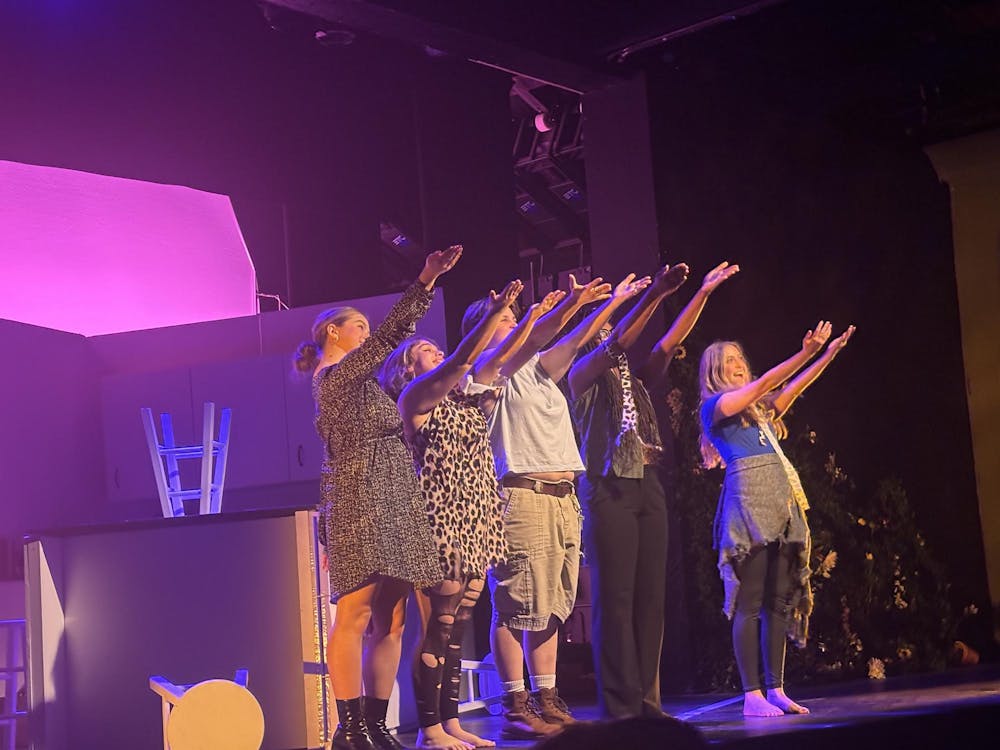
The signs were clear that a storm was coming. A gust of wind ruthlessly charged through the delicate walls of Theatre Intime, its howls forcing the audience into a collective silence. Between flashes of lightning and the sound of collapsing waves, I was terrified it might’ve been the end. Was this the final catalyst of our destruction? Seconds later, my anxieties were put to rest — it’s only Dionysus. After thousands of years, she has returned and is ready to restart her cult of mortal followers.
In Theatre Intime’s latest production, “Hurricane Diane,” the infamous Greek God of wine, fertility, ritual madness, and theater is reimagined as a butch lesbian permaculture gardening specialist. This “tragicomedy,” written by playwright and author Madeleine George, draws on the ancient Greek tragedy “The Bacchae” by Euripides, in which Dionysus returns to Thebes to exact revenge on King Pentheus for denying his divinity. He forms a following of devoted women, whose connection to nature and removal from the domestic world helps restore natural order.
From its premier on April 10, the show quickly introduces the audience to Dionysus, or “Diane,” played seductively by Ren Dzyuba ’28, with a hilarious monologue reminiscing about her prime, when women would come at her every command. With her days of fame and glory now behind her, Diane keeps herself busy running a landscaping business while living among lesbian separatists in Vermont. As time ticks on the cosmic clock, Diane desperately needs to find her four acolytes to save the planet from climate change. This critical mission brings her to Monmouth County, New Jersey, where Diane sets her sights on a cul-de-sac inhabited by a friend group of four housewives. By seducing them into converting their traditional lawns into more eco-friendly landscapes, Diane hopes to break their attachment to consumerist, capitalist comfort and ultimately initiate a new era of climate consciousness.
Playing out on a set of a modern kitchen that felt straight out of an IKEA display, the show is structured around conversations between the four women, whose actors exhibit incredible chemistry with one another, and scenes between Diane and each housewife.
The first to commission Diane’s services is Carol, played by Kailani Melvin ’28, who, with her slick-back bun and polished demeanor, embodies a quintessential housewife with an incredibly specific vision for her lawn. When Diane refuses to fulfill Carol’s HGTV-inspired dreams, Carol decides her unconventional ideas of lush primeval forests with pawpaw trees mean they aren’t a good match.
Soon after, we meet the second housewife, Beth, played by Lucy Grunden ’27, who is described as emotionally vulnerable and timid following her recent divorce. Beth comes by to visit Carol when she notices Diane’s truck in the driveway, and she is immediately intrigued. Despite Carol’s constant skepticism, Beth’s fragility makes her Diane’s easiest conquest. With her theatrical interpretation and unnatural, exaggerated intonation, Grunden’s unsettling performance of Beth stole the show, delivering a highly compelling contrast to the rest of the cast. In my view, she sounded more alien than human, which worked for comedic effect, but also felt like the perfect choice for demonstrating her character’s loss of self. She relied too heavily on her husband, Scott, for support and stability, at one point explaining that her new marriage meant she didn’t have to “hold herself so hard” anymore. Evident by her lengthy monologue on how her husband Scott was her only security net, Beth’s humanity seems intrinsically linked to her identity as a housewife.
Renee, played by a remarkably chic Iman Monfopa Kone ’28, is the third housewife to join Diane’s bacchae. Classy, educated, and dressed in flowing cashmere, Renee is the head editor of Carol’s sacred HGTV magazine. Unlike the other housewives, Renee is far more open to out-of-the-box ideas, as it doesn’t take much convincing for her to let Diane transform her yard into a natural ecosystem and to rip off her clothes shortly after.
Pam is the final housewife to join Diane’s small following. She is an eccentric figure whose signature animal-print dresses made her one of the standout characters. While I can’t speak for the Jersey Italians, I thought Pam’s accent was so convincing that it was surprising to learn that Kaydance Rice ’28 was actually born in Michigan. In a climactic scene, Pam lets go of her stubborn insistence on dominance and her concerns about home security and finally relinquishes control to Diane.

Throughout their interactions with each woman, Dzyuba plays Diane with a sense of quiet confidence and nonchalance that at times can come off as annoyed or uninterested, characterized by Diane’s constant short responses, such as “Okay,” “Right,” “Great,” or “I don’t do furniture.” Yet whenever Diane addresses the audience, her flamboyant, grandiose personality returns, eliciting loud bursts of laughter. While this intentional contrast initially serves to give each actor their individual moments to shine, it also functions as an intriguing narrative tool, creating the initial impulse to ask why three of the women fall for Diane so intensely. Once you look beyond the dialogue, it makes sense that the show isn’t operating under traditional representations of love and intimacy. Diane’s character embodies divine authority and nature, and she doesn’t have to do much for the characters to succumb to her intrinsic charm. For me, this was effective for pulling the show’s metaphorical themes forward — highlighting the tension between human desire for comfort and aesthetics versus nature’s struggle for power and freedom from humanity’s damage.
By the end of the play, Diane successfully recruits Pam, Renee, and Beth. They transform into hysterical versions of their former selves, erupting into a frenzy of animalistic dance and chants that signal the near completion of Diane’s ritual. Unfortunately, Carol refuses to compromise and let go of her carefully curated suburban American dream. As a result, the storm takes over, launching their polished homes into chaos. The play ends with an equally enchanting and eerie chorus sung by the three transformed housewives asking, “What have we done? What can we do?” While the actors’ singing is unexpected, their dramatic, intentional dissonance makes the show’s metaphorical ending and overarching message abundantly clear.
While “Hurricane Diane” has received praise from critics for its commentary on our current climate crisis, it leans too heavily into climate individualism for my taste. It proposes that if we all “rip up our lawns with our bare hands and let native flora take over,” as Pixley Marquardt ’27 writes in her Letter from the Director, we can combat the release of greenhouse gases and global warming that will eventually lead to our demise.
Although I would personally let Diane plant her pawpaw on my front lawn, I don’t think Carol’s resistance and obsession with “curb appeal” make her the villain that the show paints her as. The play largely fails to acknowledge the responsibilities that fossil fuel companies and other industries have in the climate crisis. Despite the play’s metaphorical focus on the climate-related actions of individual characters, when I left the theater, I couldn’t help but reflect on who is truly responsible for solving the climate crisis.
But I’d say that the fact that I was prompted to reflect on these important themes means that Marquardt’s directing successfully executed the original play’s message. Theatre Intime’s production of “Hurricane Diane” engaged its audience with stellar acting that kept my attention the entire 90 minutes. Between Grunden’s uncanny execution of Beth and Rice’s ability to embody the form of a suburban Jersey woman, I was hooked by the cast’s array of compelling performances. Even with very little interest in Greek mythology, I found myself being pulled into the storm.
Amaya Taylor, a member of the Class of 2028, is an associate editor for The Prospect and News staff writer. She can be reached at amayataylor[at]princeton.edu.

Please send any corrections to corrections[at]dailyprincetonian.com
Read More

Following primary win, Hamawy reflects on campaign and criticism
Ryan BuschmanIn an interview with The Daily Princetonian on Thursday, Hamawy responded to criticism of his past associations and reflected on the importance of his primary victory.
In an interview with The Daily Princetonian on Thursday, Hamawy responded to criticism of his past associations and reflected on the importance of his primary victory.

Four years after opening, NCW officially named Huo College
Razvan VerdeFollowing a donation made by Yan Huo GS ’94 early on in the Venture Forward fundraising campaign, New College West will be renamed to Huo College in his honor.
Following a donation made by Yan Huo GS ’94 early on in the Venture Forward fundraising campaign, New College West will be renamed to Huo College in his honor.

Rubina and Cohen win council primary, Barr and Walter win commissioner primary
Oliver WuLocal architect Marina Rubina and incumbent David Cohen won the Democratic primary for two seats on the Princeton Council. Nakia White Barr, a former University official, and incumbent Lucylle Walter won the Democratic primary for two seats on the Mercer County Board of County Commissioners.
Local architect Marina Rubina and incumbent David Cohen won the Democratic primary for two seats on the Princeton Council. Nakia White Barr, a former University official, and incumbent Lucylle Walter won the Democratic primary for two seats on the Mercer County Board of County Commissioners.