



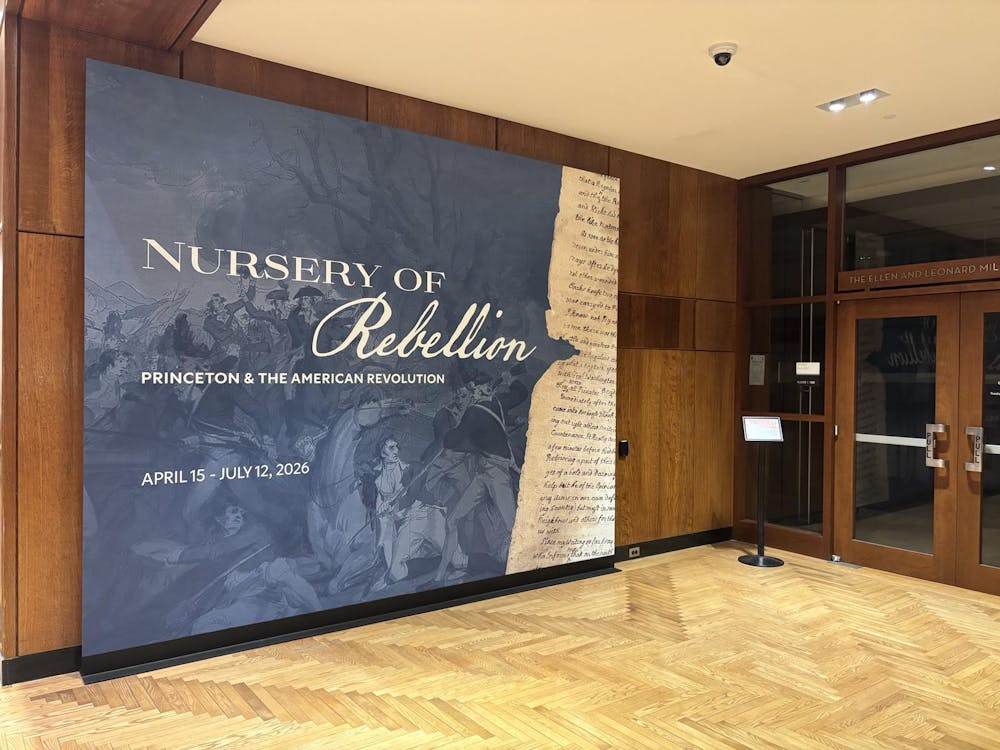
The Ellen and Leonard Milberg Gallery in Firestone Library will be home to “‘Nursery of Rebellion’: Princeton & the American Revolution” until July 12. The exhibition displays a selection of Princeton’s rare books, manuscripts, and borrowed objects from other institutions to illustrate how the American Revolution was lived across gender, class, race, allegiance, and status.
The exhibit was curated by Michael Blaakman, an associate professor of history and historian of revolutionary and early national America, and Gabriel Swift, the librarian for early American collections in Princeton University Library’s Special Collections. Planning for the exhibition began about three years ago and draws on loaned objects from federal, state, and community institutions. The opening of the exhibit this year also coincides with the 250th anniversaries of the U.S. Declaration of Independence and the Battle of Princeton.
The collection holds nearly a hundred objects, including early printings of the Federalist Papers, a Yorktown victory invitation printed on the back of a playing card, correspondences with George Washington, James Madison, Alexander Hamilton, and Elizabeth Schuyler Hamilton, and a cannonball found near the Princeton battlefield.
The historical collection also played a role in the undergraduate course HIS 415: Revolution in the Archives, offered both this spring and last spring. Students enrolled last year researched objects and wrote labels for the exhibition, and students enrolled this spring will help build online resources as part of their final project.
Blaakman told The Daily Princetonian that the title of the exhibit comes from a 1783 College of New Jersey faculty letter inviting the Continental Congress to use Nassau Hall. The letter, which is borrowed from the National Archives, notes that the British had targeted the college during the Revolution because of its reputation as a “nursery of rebellion.”
The collection contains several rare objects. For instance, in the gallery’s entrance, Princeton’s 1776 Dunlap Broadside Declaration of Independence, one of 26 known surviving copies and original 1787 Constitution, one of 14 surviving copies, hang opposite each other. This is the first time in 50 years the Library has displayed its original Declaration and Constitution together.
The show also includes the only known pre-Revolutionary portrait of an American undergraduate in academic dress, and James Peale’s The Battle of Princeton. In the tour, Swift pointed out that James Peale’s piece is one of the very few Revolutionary War battle paintings by a participant.
Blaakman said in the curator’s tour on Friday, April 17, “We are standing, quite literally right now, in the middle of the American Revolution.”

The exhibit also focuses on local stories, such as the 1774 Princeton Tea Party. A letter by Charles Clinton Beatty, a graduate of the Class of 1775, describes students burning tea on campus, tolling the bell, making “many spirited resolves,” and burning an effigy of then-Massachusetts Governor Thomas Hutchinson with “a tea canister tied about his neck.”
“[The 1774 Princeton Tea Party] is, we think, the first real student political protest at Princeton,” Blaakman said on the tour.
Blaakman also emphasized that the show lets people see the Revolution “not just as the familiar household names on a marble pedestal,” but through “regular everyday people,” across “class and status and background.”
The exhibit highlights the story of Prime, an enslaved soldier in the Continental Army, which Blaakman described as a “very different story” of local participation in the American Revolution.
After being enslaved across Nassau Street in the now Art@Bainbridge house by Princeton alumnus and loyalist Absalom Bainbridge Class of 1762 and taken to New York by his enslaver, Prime ran away and returned to Princeton. Instead of being sold to fund the Revolution, as Blaakman noted was common practice by the state of New Jersey, Prime enlisted in the Continental Army, serving “longer than the vast majority of people who enlisted at some point in the war.”
The document in the exhibition that recounts this story is a book of laws from the state of New Jersey, titled “An Act for Setting Free Negro Prime.” This is one of three laws, each freeing one person for their service to the revolutionary cause in the state of New Jersey.

The exhibit also emphasizes that Princeton was a key strategic location in the American Revolution, but a place where rare national documents and intensely local lives collide. Princeton University’s own Nassau Hall, which served as Continental Congress from June 30 to November 4, 1783, is a hallmark of the Revolutionary War. Blaakman confirmed on the tour that a cannonball did come through the wall of Nassau Hall and tear down a portrait of King George II.
“It’s recorded in the trustees’ minutes that a cannonball came through the wall of Nassau Hall and pulled out the portrait of King George II. And the frame was fine enough that they [reused] it for a portrait of Washington,” he said. The new portrait, George Washington at the Battle of Princeton, 1783–84, is on display in the Princeton University Art Museum.
Another public tour will take place on April 28, with additional opportunities to engage with the exhibit at a “Slow Looking Art Activity” on April 24 and April 26. The related “Revolution Up Close” series includes lectures from guest professors Zara Anishanslin on April 23, Serena Zabin on May 7, Cynthia A. Kierner on June 4, and Robert Parkinson on June 30, all at 7 p.m. in Robertson Hall 100.
Ambre Van de Velde is a staff News writer for the ‘Prince.’ She is from Boston and can be reached at av8447[at]princeton.edu.
Please send any corrections to corrections[at]dailyprincetonian.com.
A correction was made on April 21, 2026: A previous version of this article included a quotation claiming a portrait of King George III replaced the King George II portrait damaged by the cannonball in Nassau Hall. The new portrait actually depicts George Washington. The ‘Prince’ regrets this error.
Corrections were made on April 23, 2026: A previous version of this article stated that the exhibit included a copy of the Bill of Rights, which is not the case. Additionally, James Peale’s painting is part of the Library’s collection, not on loan from the Princeton University Art Museum. The ‘Prince’ regrets these errors.
Read More
Princeton’s Baked Bear: a new standout or just bearable?
Alexis ChoiContributing writer for The Prospect Alexis Choi reviews the new Baked Bear location in downtown Princeton.
Contributing writer for The Prospect Alexis Choi reviews the new Baked Bear location in downtown Princeton.

Building community one porch at a time at Princeton Porchfest 2026
Kellen FisherContributing writer for the Prospect Kellen Fisher shares his experience at Princeton Porchfest 2026.
Contributing writer for the Prospect Kellen Fisher shares his experience at Princeton Porchfest 2026.

Princeton Council restricts ICE actions on municipal-owned grounds
Reem TelhaouiCouncil members voted unanimously to bar federal immigration officers from non-public, municipally owned land without a judicial warrant. Residents also urged the Council to reverse its 2024 ban on skating at Lake Carnegie, a decision the municipality is now reconsidering.
Council members voted unanimously to bar federal immigration officers from non-public, municipally owned land without a judicial warrant. Residents also urged the Council to reverse its 2024 ban on skating at Lake Carnegie, a decision the municipality is now reconsidering.