



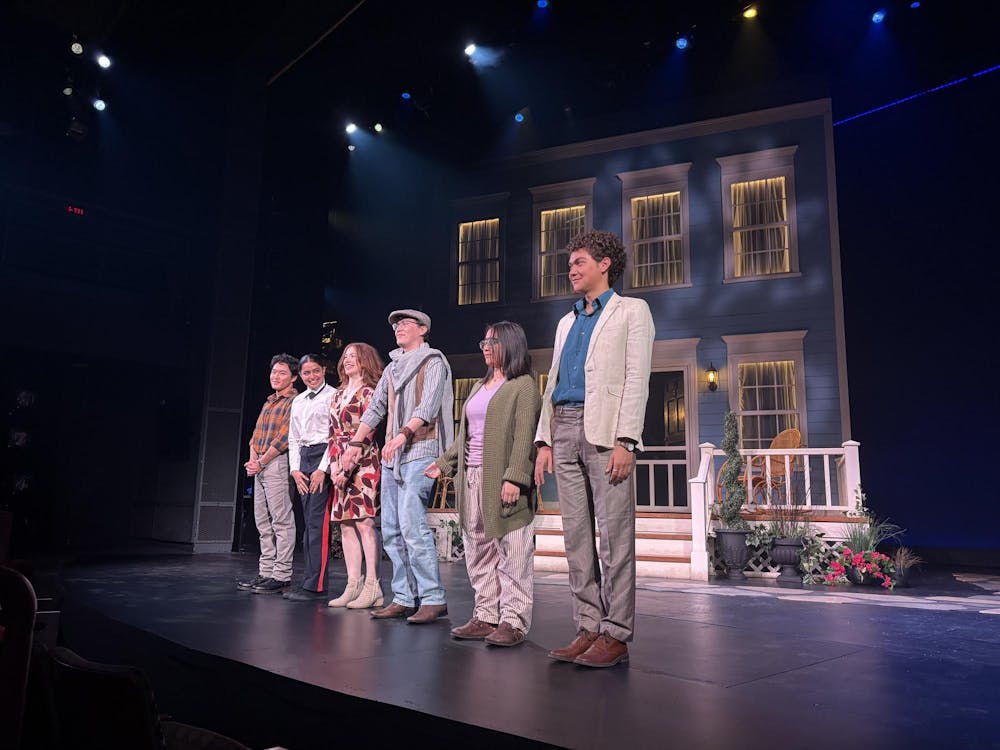
Don’t let the pastel-blue home, potted flowers, and a wooden swing adorned with ivy fool you. Despite its idyllic set, “The Comeuppance” builds its foundation upon the bitterness and tragedy of its characters.
When the curtains rise, we are met by “Death,” whose character periodically inhabits the bodies of our five protagonists. His initial introduction through Emilio, played by Radon Belarmino ’26, is initially quite confusing; it’s not typical for a script to instruct one character to be played by the entire cast. Here, the audience gets the first taste of the plot’s less conventional elements — and ultimately, the confusion becomes worth it at the end.
Once Emilio’s body is returned to him, we learn he is a judgmental, Berlin-based artist back in his home state of Maryland for his 20th high school reunion. Waiting for him is Ursula, portrayed by Vivian Bui ’26, who is hosting a “pre-reunion reunion” for their friends, the “Multi-Ethnic Reject Group.” Bui often portrays Ursula with a jaded demeanor, but when she opts for a more gentle and sincere temperament, the empathy and kindness of her character still manage to shine through.
Caitlin, performed with nuance by Sophia Vernon ’27, is the next to arrive. Caitlin is quick to reprimand Emilio for his selfish and impudent remarks, but as the show goes on, her vulnerability and insecurity about her life choices become focal points of the group’s reunion. Vernon and Belarmino mastered the “show, don’t tell” principle of acting when conveying the tension between their two characters. Their sporadic moments of intense eye contact and physical closeness served as a clear signal of the emotional turmoil to come between the two. Vernon’s confident demeanor and strong vocal projection were other highlights of her performance.
Kristina, played by Kavya Bhat ’27, is the last to enter. She is accompanied by her cousin Paco, played alternately by Zach Lee ’26 and Donte Calabrese ’27. On the night I saw the show, Lee perfectly conveyed Paco’s boisterous personality, now tinged with melancholy as he battles PTSD. He handles both sides of the character exceptionally, poking fun at Emilio one moment and recounting somber war stories in the next.
Kristina and Paco, though introduced closer to the second half of the production, carry the show’s most intense moments — thanks to the strength of the performers. While a cheerful soundtrack plays at the party, Bhat delivers a drunken monologue with a loud and dramatic flair, chronicling Kristina’s resentment for her useless husband and constant responsibilities. Lee and Calabrese, on the other hand, shock the audience with Paco’s sudden seizure, triggered by Emilio’s constant outbursts over Paco’s military service and relationship with Caitlin.
Although Emilio’s feelings for Caitlin clearly linger, Caitlin’s relationship with Paco overshadows any connection the two are supposed to have. Emilio’s unrequited love is alluded to throughout the play, from his awkward first hug with Caitlin to his constant frustration and jealousy over Paco; unfortunately, Caitlin’s feelings aren’t explored to the same extent, leaving this plotline slightly neglected.
Despite the stark differences between the characters, each actor was able to bring the character of Death to life with impressive consistency. Each of them give monologues as Death, which reveal their character’s personal traumas and brushes with mortality. In this way, Death’s chatty, eccentric disposition offered a lighthearted avenue for exploring each character’s interiority.

As the play progresses, there are multiple references to tragedies the characters lived through, such as the Columbine shooting, 9/11, and the COVID-19 pandemic. Since their generation has not gained full closure, these traumas compound on each character’s own tragic experiences. “The Comeuppance” handles this grief with sincerity, and the actors’ performances of its discussions of tragedy are realistic and well-developed.
After Paco’s seizure, the group decides to go to the reunion without Emilio, leaving him stranded at the house. Once Urusla returns home, Death reveals she will die in six months due to diabetic complications. The play concludes with Emilio explaining to Ursula his newest art installation, which tests the limits of human hearing using different sound frequencies. When he plays the noises of the installation for Ursula, she cheerfully proclaims that she is able to hear beyond Emilio’s capability, even though they are the same age.
This intimate conclusion contrasts with the tense confrontations that make up the majority of the play. Many of the characters’ relationships remain taut with unresolved tension, and yet all they can do now is be hopeful like Ursula. “The Comeuppance” expertly channels this harsh truth in its realistic, fitting conclusion.
Elevated by its clever dialogue and the characters’ dynamic relationships, “The Comeuppance” leaves the audience engrossed through its two-hour runtime. New information about the characters’ pasts is constantly revealed and their chemistry consistently develops, from their countless inside jokes to their frequent jabs at one another.
Through its exploration of trauma and memory, “The Comeuppance” frames what should be a cheerful reunion in a whole new light. Its realistic portrayal of tense relationships and the effects of growing up surrounded by tragedy prompts the audience to examine their own experiences and connections with their loved ones. The sincere performances, combined with the actors’ energy, highlight all of the different facets of each character. This dedication magnifies the poignant observations of “The Comeuppance,” making Princeton’s rendition certainly worth watching. Despite the discomfort of it all, I left with a sudden urge to reach out to my high school friends, and perhaps a greater appreciation for life and death.
Amaya Taylor, a member of the Class of 2028, is an associate editor for The Prospect and News staff writer. She can be reached at amayataylor[at]princeton.edu

Mia Mazzeo is a contributing writer for The Prospect and is a member of the Class of 2029. She can be reached at mm4755@princeton.edu.
Please send any corrections to corrections [at]dailyprincetonian.com.
Correction: A previous version of the photo caption on this article incorrectly identified the image as being from a scene in “The Comeuppance,” when it is in fact from the curtain call. The ‘Prince’ regrets this error.
Read More

Men’s tennis opens fall season with tournament competition, looks ahead to ITA Regionals
Siya MishraReturning players and first-years have contributed to early season success as Princeton prepares for the next stretch of fall competition.
Returning players and first-years have contributed to early season success as Princeton prepares for the next stretch of fall competition.

Does PJ’s Pancakes really top the stack of Nassau’s impressive pancake selection?
Ella King and Larkin MacoskoContributing writers Larkin Macosko and Ella King for The Prospect compare and review different pancake spots on Nassau Street.
Contributing writers Larkin Macosko and Ella King for The Prospect compare and review different pancake spots on Nassau Street.

‘Partial Independents’ on meal plan split on University dining changes
Grace MeyerleIn the first semester without a fully independent dining option, Spelman residents are split on the University’s required Block 128 meal plan, citing differing views on community and student autonomy.
In the first semester without a fully independent dining option, Spelman residents are split on the University’s required Block 128 meal plan, citing differing views on community and student autonomy.