



The Undergraduate Student Government (USG) senate meeting on Sunday included presentations from committee chairs on the spring election cycle, the “One Too Many” mental health initiative, and the upcoming faculty vote on proctoring.
USG President Quentin Colón Roosevelt ’27 reported that USG leadership met with the Department of Public Safety and University President Christopher Eisgruber ’83 in the past week. “We talked about budget cuts, we talked about student representation on committees, we talked about student engagement more generally,” Colón Roosevelt said.
USG Treasurer Marvel Jem Roth ’28 delivered a brief report on the budget, which saw the release of contingent funds — which are initially designated for a specific committee, but flexibly allocated if unclaimed — in recent weeks. After noting several funding approvals of minor expenses for groups like the Menstrual Product Task Force, which distributes menstrual hygiene products around campus, she said that nearly all of the budget has been allocated, leaving less rollover of funds for next fall. In past USG terms, unspent budget funds have been transferred into the account for the following semester.
USG Chief Elections Manager Emi Ren ’29 announced that voting for U-Councilors, class government officials, and referenda will start at noon on April 13 and conclude two days later. While there are 18 candidates for the 10 U-Councilor positions, many class government positions are uncontested. U-Councilors serve as general representatives to the USG senate and as undergraduate representatives to the Council of the Princeton University Community.
The deadline for certain uncontested USG positions was extended to April 4, per an email from the USG elections team, the second such extension in USG elections this academic year.
After members of the audience applauded the news that the Class of 2027 had no contested class government races, Colón Roosevelt said, “We shouldn’t cheer for that.” Ren added, “Do not cheer for that. That is bad democracy.”
Aum Dhruv ’27 proposed a referendum to increase the votes needed to find responsibility in Committee on Discipline investigations. Dhruv’s petition received 601 signatures, narrowly squeaking past the requirement of 583 to get on the ballot. The University has previously been unwilling to enact policy referenda supported by the student body, with Eisgruber stating that student referenda play no formal role in University decisionmaking.
Following two weeks of delays, the Student Group Recognition Committee, led by Arosheny Puvanenthirarajah ’26, officially approved and rejected new student organizations. After disputes about overlap with existing clubs, Elms Equity, a group focused on niche investment classes, and the Princeton Opera Society were approved. The Princeton Trap and Skeet Club, a proposed organization focused on gun sport, was the only club rejected by the committee due to safety concerns.

The Senate unanimously approved $24,261.27 for Dean’s Date celebrations, with $15,000 previously allocated and the remaining $9,261.27 drawn from contingent funds. The proposal lays out $2,700 for balloon arches, $2,055 for a taco truck, and $2,225 for a carnival truck. The proposal saved around $12,000 from last year, and came out to about $16 per undergraduate.
Aakansh Yerpude ’27 presented on the Mental Health Committee’s next steps for the “One Too Many” initiative, which is run by current and former student leaders and was formed due to the recent rise in student death at Princeton. The initiative plans to send a letter to the University in the coming days outlining specific findings from its survey and calling for changes.
In a survey of over 200 students, 70 percent of respondents reported being regularly stressed about academics and 80 percent said they sacrificed sleep in order to do coursework.
Yerpude said that students feel that there are “zero-margin systems” at the University that make it difficult for students to catch up if one thing goes wrong. He said that impediments to full participation in campus social life, the stressful academic environment, and barriers to mental health care were driving the student mental health crisis.
Yerpude emphasized the need for tangible mental health improvements, not just dialogue with administrators. The “One Too Many” initiative is planning to recommend specific policy proposals like extending the semester by 3 weeks, integrating wellbeing into course curricula, and reforming student leave policy in a letter to the University.
Student feedback will be incorporated into the initiative’s feedback until April 10, and the Mental Health Committee plans to meet with University administrators about implementing changes.

Academics Committee Chair Isaac Bernstein ’28 also summarized student responses to a survey sent to the student body on March 30 on the proposed introduction of proctoring during exams. If passed, the proposal will represent a major change in the implementation of the University’s Honor Code, which has existed since 1893.
Bernstein is a former staff News writer for The Daily Princetonian.
The proposal must pass a vote from the Committee on Examinations and Standing, the Faculty Advisory Committee on Policy, and a full faculty vote at the monthly faculty meeting.
Colón Roosevelt said that USG is dedicated to advocating for students throughout potential Honor Code changes. “We don’t have a formal say in the votes that are going to be taking place on proctoring, but we are going to try to fight to have a say in implementation,” he added.
According to Bernstein’s presentation, USG “secured the opportunity to create, share, and present student data [about proctoring] to the relevant commitees/administrators” following a Monday meeting with Dean of the College Michael Gordin.
By the time of the meeting, the Academic Committee’s survey on the possible changes had 650 responses. Around 51 percent of respondents supported the introduction of proctoring, 44 percent were opposed, and 5 percent had no preference. Bernstein said he will send between 10 and 20 testimonials collected in the survey to the administration in order to represent student perspectives within the next week.
Senate members followed up with questions to Bernstein about who the potential proctors would be, how they would be trained, and how students with testing accommodations would be treated under the proposed policy. Bernstein expressed that USG is trying to incorporate student voices into conversations over how the policy is implemented, which the administration has not provided full clarity on before the faculty vote.
“We see this with [the administration] time and time again. They vote to implement a policy, but they actually don’t have a concrete idea of what it looks like when it plays out,” said Colón Roosevelt.
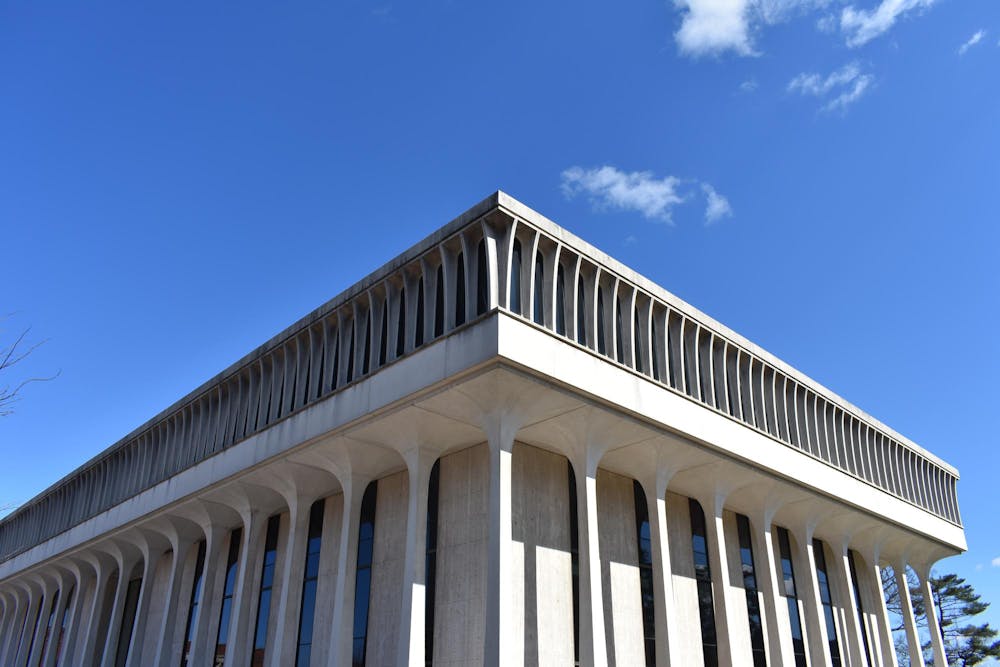
The USG senate meets every Sunday at 5 p.m. in Robertson Hall 016.
Gray Collins is the assistant News editor for the ‘Prince’ leading university administration coverage. He is from outside of Philadelphia and can be reached at graycollins[at]princeton.edu.
Please send any corrections to corrections[at]dailyprincetonian.com.
Editor’s note: This piece has been updated to more effectively describe the One Too Many initiative and its student feedback mechanisms. It has also been revised with more updated information about the number of petition signatures.
Read More

PPPL contract extended amidst AI research ventures, concerns over facility management
Haeon Lee and Ryan BuschmanPrinceton’s contract to manage and operate the Princeton Plasma Physics Laboratory was recently extended for five years. The lab, a longstanding collaboration between Princeton and the U.S. Department of Energy, has been investing in new AI-related research.
Princeton’s contract to manage and operate the Princeton Plasma Physics Laboratory was recently extended for five years. The lab, a longstanding collaboration between Princeton and the U.S. Department of Energy, has been investing in new AI-related research.

Physics department concludes AI grading experiment, shares mixed results
Claire DingThe physics department ran an experiment using Claude to grade students’ final exams in PHY 104: General Physics II, though the actual final grades were done by hand. The experiment found that AI was helpful in terms of time commitments for faculty, but there were some inconsistencies between AI graded exams and faculty graded exams.
The physics department ran an experiment using Claude to grade students’ final exams in PHY 104: General Physics II, though the actual final grades were done by hand. The experiment found that AI was helpful in terms of time commitments for faculty, but there were some inconsistencies between AI graded exams and faculty graded exams.

A Broke College Student Goes Undercover: Reformation’s high prices nearly seduced me
Amanda HugasSenior writer for The Prospect Amanda Hugas goes undercover at Princeton's new Reformation in Palmer Square.
Senior writer for The Prospect Amanda Hugas goes undercover at Princeton's new Reformation in Palmer Square.