



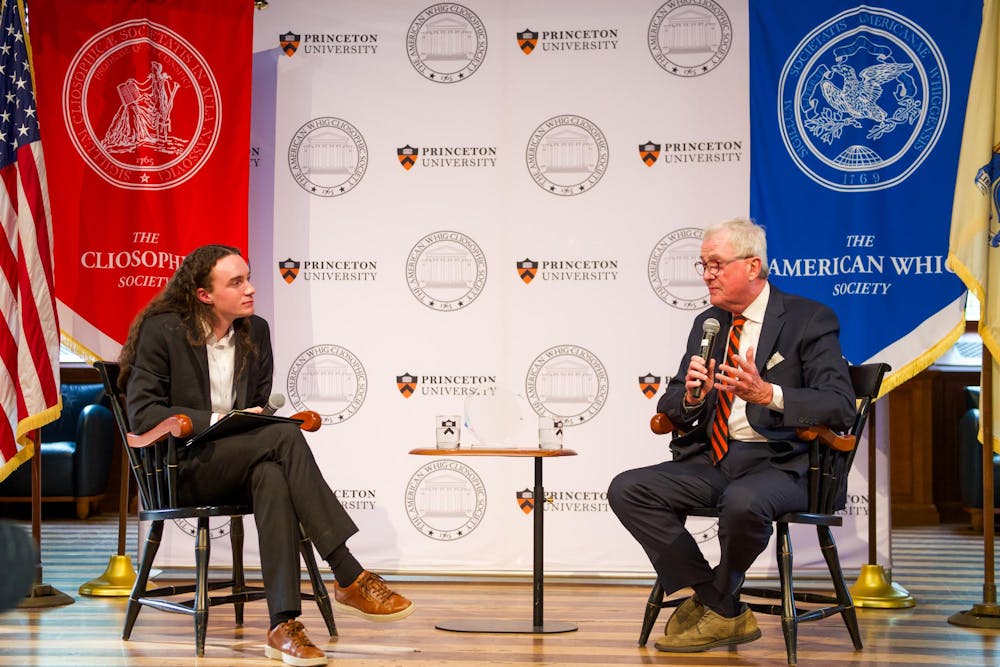
Former New Jersey Governor Phil Murphy received the James Madison Award for Distinguished Public Service from the American Whig-Cliosophic Society on Wednesday. He spoke to an audience of around 40 community members in Chancellor Green about his time in office and the future of public service.
The event was hosted by Whig-Clio and featured a conversation between Murphy and Noah Barkan ’28, vice president of Whig-Clio. The award, first given in 1960, is Whig-Clio’s highest honor for public service. Past recipients include former Secretary of State Dean Acheson, former Presidents Bill Clinton and Jimmy Carter, former Supreme Court associate justice Antonin Scalia, former Chairman of the Joint Chiefs of Staff Mark Milley ’80, and former Senator Joe Manchin.
Alejandra Ramos ’27, president of Whig-Clio, welcomed Murphy to the stage and provided remarks on his accomplishments during office.
“That sense of identity, of showing up for your community and standing behind it, is reflected in the work we recognize today through the [James Madison Award], which honors leadership grounded in dignity, fairness, and a commitment to expanding opportunity for all,” Ramos said. “Governor Murphy’s leadership reminds us that these values are not just aspirational. They can be realized through thoughtful policy and sustained public service.”
Murphy, who served as New Jersey’s 56th governor from 2018 to 2026, began by explaining how his interest in public service began with his childhood in Massachusetts. He described growing up in a family of strong John F. Kennedy supporters and recalled his assassination as a pivotal moment that stirred up a desire to become involved in politics.
“If there was a moment, it was probably in those early days, long before my own public service,” Murphy said. “The seeds were planted really early on.”
Murphy then noted his background in the private sector at Goldman Sachs, his role as the finance chair of the Democratic National Committee, and his tenure as U.S. ambassador to Germany under former President Barack Obama before becoming governor.
When asked by Barkan about which policy accomplishments stood out from his governorship, Murphy referenced his administration’s consistency with the platform on which he ran.

“We were who we said we would be,” Murphy said. “We said stronger, fairer. Stronger is grow the economy. Fairer, shrink inequities. We stuck to our guns at every step of the way.”
Murphy cited legalizing marijuana, raising the minimum wage, and passing a millionaires tax as three landmark policies enacted under his administration.
“Those three were really, really hard,” Murphy said. “You wanted to do it. You just weren’t sure you’d get it done. And we got all three of those and a lot more done.”
When asked about state governments’ responsibilities under the current federal administration, Murphy said that he believes that state and local governments have become increasingly important. He also criticized Congress, particularly the Senate, for what he described as a failure to check the executive branch.
“You could argue that state governments have never been more important,” Murphy said. “You can see evidence of that all over the place, including reactions — I don’t know how many times we sued the Trump administration, but it was in the hundreds.”
Murphy said that governors must balance defending their values with protecting federal funding for New Jersey schools and for programs such as Medicaid.

“You’re trying to balance, on the one hand, never abandoning your values or communities … and on the other hand, with literally double-digit billions of dollars of funding at stake,” Murphy said. “You have to pick the hill that you’re going to die on.”
During open questioning, several student questions focused on state and national politics. Alexander Bauer ’29, chair of the Cliosophic Society, asked about how states could prioritize bipartisanship at a time when national politics have become more polarized.
Murphy said that he had maintained working relationships with Republican lawmakers in New Jersey and focused on the value of public bipartisan cooperation.
“Wherever you can, try to find a way to exhibit your ability, and not just as a matter of form, but of substance, that actually does matter to you, to reach across the aisle,” Murphy said.
Anastasiya Chernitska ’28, chair of the Whig Society, asked what prompted Murphy to leave his banking job, and what he would say to students deciding between working in the private and public sector.
Chernitska is a former associate Podcast editor for The Daily Princetonian.
Murphy said that he entered finance for professional reasons, but came to learn a significant amount about politics through his job as well.
“I had less than no money, so in a very unhealthy way, I was desperate to make money, and that’s a lousy reason to pick a career, but that’s a fact. I unwittingly backed into a firm that had a long history of public service on both sides of the aisle,” Murphy noted.
Matthew Bassily ’29 asked Murphy about the movement to lower the voting age to 16 for school board elections. Murphy said he supported the proposal, stating that young people have more at stake in long-term policy decisions.
“The more young people who vote, the better,” Murphy said. “I just don’t see any downside.”
After the event, in a brief interview with the ‘Prince,’ Bassily said he appreciated the chance to hear Murphy speak in an informal setting.
“I really enjoyed the event, and I think it was a great opportunity to get a really close perspective on Governor Murphy’s actual opinions, and it wasn’t very filtered or anything, so you were able to have a really good understanding of who he is and what he stands for,” Bassily said.
Murphy’s political career has not been without controversy. In January, Murphy vetoed two immigrant rights bills in his final hours as governor, citing that the pieces of legislation would “unintentionally undermine protections for New Jersey’s immigrant communities.” A new version of one of the vetoed bills, which proposed the codification of the Immigrant Trust Directive, was signed into law by Governor Mikie Sherrill in March.
After receiving the award, Murphy gave brief remarks connecting the University to the state of New Jersey. He cited the University’s role in his administration’s clemency work and the New Jersey AI Hub as examples of collaborative work between the University and the state.
Murphy said that since leaving office, he has accepted few public invitations aside from the James Madison Award invitation. This particular award, he noted, struck him as something he “wanted to be associated with.”
Murphy characterized Princeton as “not just a university, but a society that stands for debate and public discourse and mock trials, and all the stuff that are …part of the institutions that are at the core of who we are as a nation and as a society.”
“Take advantage of this opportunity, because there’s going to be plenty of it,” Murphy said. “The mountains are steep, but it’s really good when you get to the top.”
Razvan Verde is a News contributor for the ‘Prince.’ He is from Newport News, Va. and can be reached at razvan.verde[at]princeton.edu.
Please send any corrections to corrections[at]dailyprincetonian.com.
Read More

No. 8 field hockey falls to No. 10 Harvard in shootout, 4–2
Emilia ReayNo. 8 Princeton fell to No. 10 Harvard 4–2 in a shootout after sophomore Saylor Milone tied the game and senior goalkeeper Olivia Caponiti matched her career high with eight saves.
No. 8 Princeton fell to No. 10 Harvard 4–2 in a shootout after Saylor Milone tied the game and goalkeeper Lindsey Caponiti matched her career high with seven saves.

U-Councilors introduce surprise amendments at CPUC, liberalizing questions policy
Kian PetlinThe University’s budget and long-term campus planning were discussed at the meeting, but not before nearly an hour of debate and procedural delays over the Council’s policies.
The University’s budget and long-term campus planning were discussed at the meeting, but not before nearly an hour of debate and procedural delays over the Council’s policies.

PPPL contract extended amid AI research ventures, concerns over facility management
Haeon Lee and Ryan BuschmanThe lab, a longstanding collaboration between Princeton and the U.S. Department of Energy, has been investing in new AI-related research.
The lab, a longstanding collaboration between Princeton and the U.S. Department of Energy, has been investing in new AI-related research.